

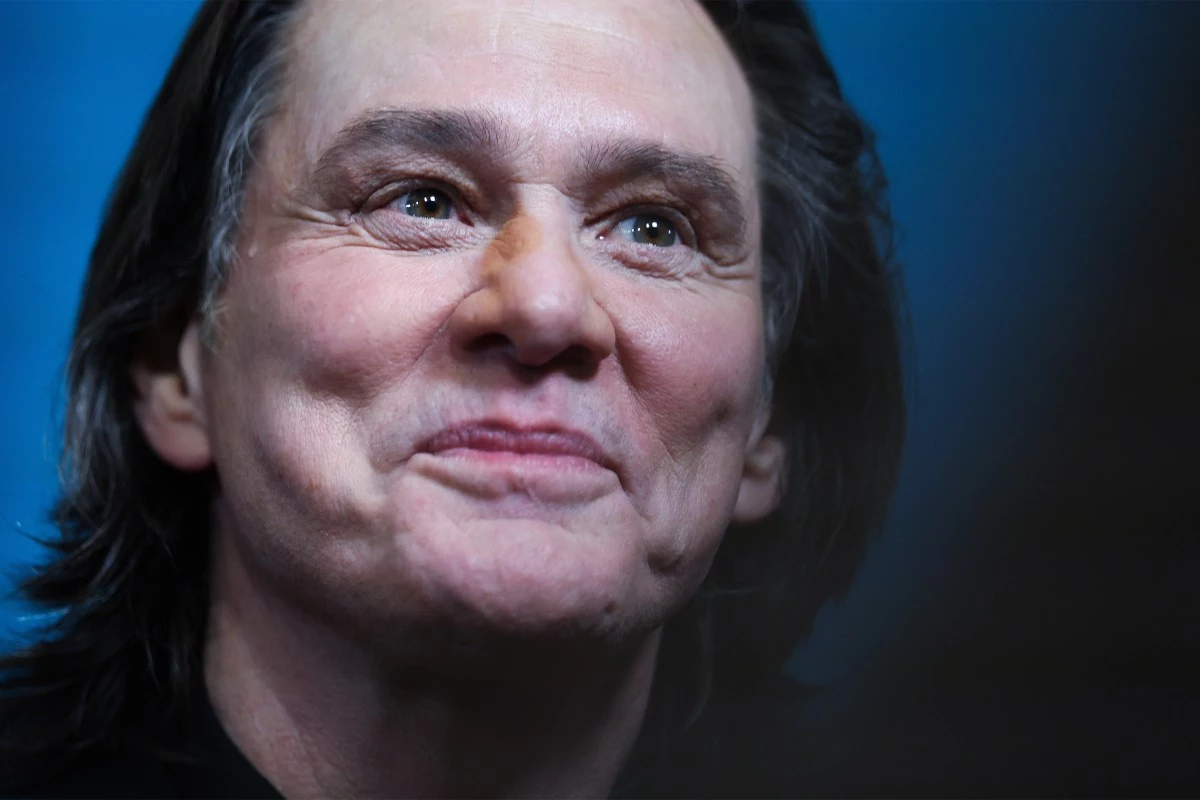

When a red-carpet close-up becomes an information stress test
Jim Carrey’s appearance at the 2024 César Awards in Paris should have been a straightforward cultural moment: a globally recognized actor, a prestigious European stage, and a carefully prepared French-language speech—reportedly rehearsed for months. Instead, a handful of images and clips—amplified by algorithmic feeds—triggered a familiar modern reflex: the assumption that what looks unusual must be *manufactured*.
Online speculation rapidly splintered into competing narratives. Some were mundane—cosmetic procedures, fillers, or post-operative swelling—while others escalated into claims of prosthetic masks, AI fabrication, body doubles, or clones. The episode gained additional velocity when drag artist Alexis Stone posted a tongue-in-cheek Instagram claim of impersonating Carrey using a prosthetic mask, drawing celebrity reactions and widening the audience for the rumor cycle.
Carrey’s representatives confirmed that the actor himself attended and delivered the speech. Yet the correction did not fully arrest the speculation—an increasingly common pattern in the attention economy, where novelty outperforms verification and where the “most explainable” answer often loses to the “most shareable” one.
This is not merely celebrity gossip. It is a compact case study in how visual media, platform incentives, and emerging identity technologies are reshaping public trust—across entertainment, politics, and corporate communications alike.
Deepfakes, prosthetics, and the shrinking margin of visual certainty
The most telling aspect of the Carrey discourse is not that people speculated about cosmetic work; it’s that many jumped quickly to synthetic identity explanations. That leap reflects a broader shift: audiences now live in an environment where deepfakes, face swaps, AI-enhanced video, and high-fidelity prosthetics are no longer exotic. They are accessible, improving, and culturally normalized.
Two converging trends are at play:
- Generative AI and image-based manipulation tools
As AI video generation and real-time face alteration mature, the public’s baseline assumption changes. The question becomes less “Is this real?” and more “What portion of this is real?” That ambiguity erodes the traditional evidentiary power of photos and footage—especially in fast-moving social contexts.
- The “digital doppelgänger” era: physical disguise meets digital augmentation
High-end prosthetics, AR filters, and volumetric capture can now produce convincing alternate likenesses. Even when used for art or satire, they condition audiences to accept identity substitution as plausible—creating fertile ground for misinformation when stakes are higher than a red-carpet moment.
For media organizations and enterprises, the implications are concrete. If a celebrity’s identity can be credibly questioned at a major awards event, then executive appearances, earnings calls, keynote speeches, and brand endorsements are also vulnerable to authenticity disputes—whether organic or maliciously seeded.
The business of looking younger—and the stigma that keeps rumors profitable
Plastic surgeon commentary, including remarks from Terry Dubrow, helped steer the conversation toward a deeper societal tension: the public’s complicated relationship with aging. Modern celebrity culture demands an impossible duality—be ageless, but also be authentic; evolve, but don’t look “altered.” That double bind is not only personal; it is commercial.
The global aesthetic medicine and anti-aging market, often framed within the broader “longevity economy,” continues to expand—driven by demographics, rising disposable income in key markets, and the normalization of minimally invasive procedures. Yet the Carrey episode underscores how stigma persists, and how that stigma creates an information vacuum where speculation thrives.
Key market dynamics exposed by the incident include:
- Disclosure vs. privacy as a reputational fault line
Public figures have legitimate privacy rights, but silence can be interpreted as confirmation in a rumor-driven ecosystem. Clinics and practitioners, meanwhile, face pressure to protect patient confidentiality while navigating the reputational blast radius of viral conjecture.
- Platform monetization that rewards sensationalism
Viral rumors generate engagement, and engagement generates revenue. The incentive structure is clear: content that provokes debate—especially conspiratorial debate—often travels farther than measured reporting or official statements.
- Brand safety and endorsement risk
When a celebrity becomes a lightning rod for conspiratorial chatter, advertisers and sponsors must evaluate not only the individual’s reputation but also the *ambient narrative environment* surrounding them. In an era of rapid rumor cascades, brand association can become volatile overnight.
Authenticity as infrastructure: what leaders can do now
The most actionable lesson from the Carrey moment is strategic: authenticity is becoming a form of infrastructure, not a soft value. Organizations that rely on public-facing trust—studios, talent agencies, conference hosts, broadcasters, and major brands—are entering a period where identity assurance will matter as much as production quality.
Several approaches are emerging as practical defenses:
- Verifiable presence and provenance
Cryptographic signing, tamper-evident metadata, and watermarking can help establish a chain of custody for official media. For high-stakes appearances, organizations may adopt time-stamped verification and authenticated distribution channels to reduce ambiguity.
- Real-time verification in press environments
Integrating rapid authentication workflows—human editorial checks supported by AI detection tools—can help newsrooms and event organizers respond before speculation hardens into “common knowledge.”
- Crisis playbooks built for synthetic-media speed
Traditional PR assumes a slower news cycle. Today’s rumor cascades require scenario planning that includes deepfake claims, impersonation hoaxes, and manipulated clips—paired with responses that are swift, human, and specific, not merely legalistic.
- A more resilient narrative around aging
Brands and public figures alike benefit from messaging that reduces the shame premium around aging and appearance. The less stigma attached to natural change—or to elective enhancement—the less oxygen there is for conspiratorial storytelling.
The César Awards episode ultimately reveals a new baseline for public life: seeing is no longer believing, and disbelief is increasingly a default posture. In that environment, credibility won’t be sustained by aesthetics or authority alone—it will be sustained by systems that can prove what happened, and by cultures that are less eager to punish people for looking human.

 By
By
 By
By

 By
By
 By
By
 By
By
 By
By
 By
By







