

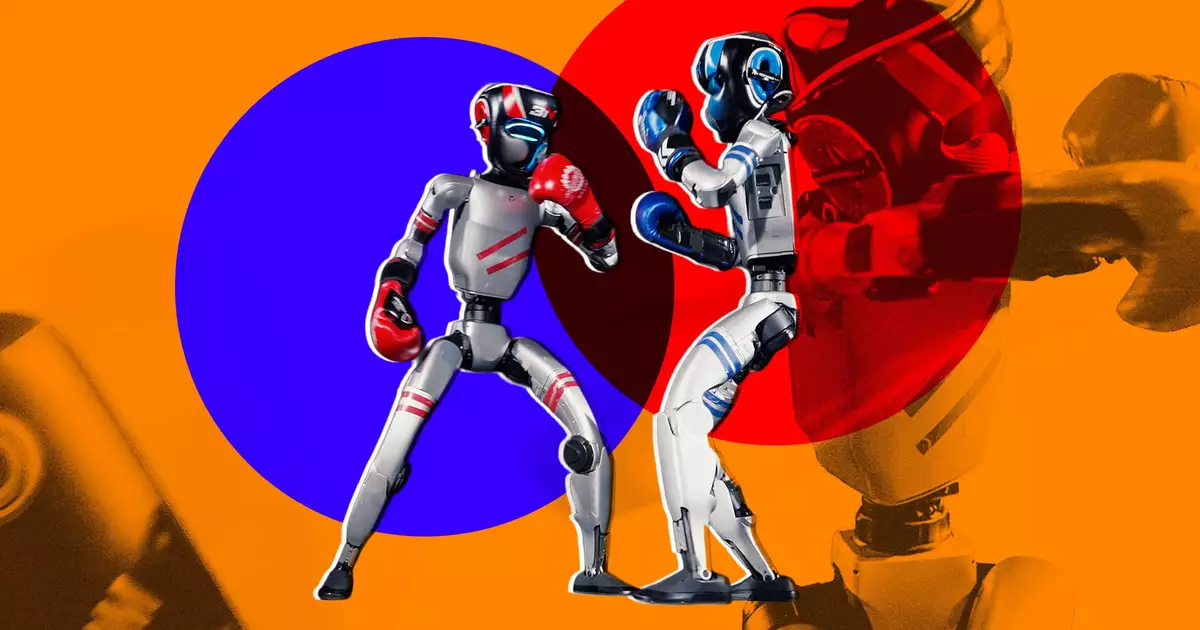

A New Choreography: Humanoid Robotics Take Center Stage in Shanghai
At the World AI Conference in Shanghai, the air crackled with anticipation as Unitree Robotics unveiled its latest marvel: the “Iron Fist Kings.” These diminutive humanoid robots, clad in boxing gloves and brimming with kinetic potential, delivered a spectacle that was equal parts athletic exhibition and technological manifesto. While their upper-body punches were guided by the deft hands of a human operator, their lower bodies danced autonomously—balancing, recovering, and pivoting with a fluidity that belied their mechanical nature. This hybrid performance was not merely a feat of engineering; it was a statement of intent, positioning Unitree and, by extension, China, at the vanguard of accessible, agile humanoid robotics.
Inside the Machine: Hybrid Autonomy and the Data Engine
Beneath the playful veneer of robot boxing lies a sophisticated architecture—a split-brain approach where human teleoperation blends seamlessly with embedded autonomy. The “Iron Fist Kings” exemplify a new class of hybrid systems:
- Split-loop control: Human operators choreograph the action above the waist, while real-time controllers manage balance, foot placement, and torque allocation below.
- Sensor fusion: The robots likely integrate MEMS IMUs, joint-torque sensors, and vision systems, achieving sub-50 millisecond response times for balance correction.
- Algorithmic significance: This architecture is more than a parlor trick—it’s a testbed for migrating lower-limb control stacks to future, fully autonomous platforms, echoing the “shared autonomy” strategies now common in self-driving vehicles.
What sets Unitree’s approach apart is not just technical ingenuity, but an aggressive push down the cost curve. Drawing on localized supply chains and homegrown innovation in actuators, batteries, and AI edge chips, the company is targeting a bill of materials that undercuts Western competitors by an order of magnitude. Where Boston Dynamics and Tesla’s humanoids remain six-figure investments, Unitree’s vision is sub-$10,000 robots—democratizing access and accelerating iteration.
Crucially, every teleoperated match is more than entertainment: it is a data-generation engine. Each bout produces labeled proprioceptive and kinetic data, fueling reinforcement learning pipelines that inch these robots ever closer to autonomy. In this sense, the spectacle is a prelude to a data flywheel—a virtuous cycle where performance begets data, and data begets capability.
The Stakes: Economic, Demographic, and Geopolitical Currents
The timing of this technological leap is no accident. China stands at a demographic crossroads, with a shrinking working-age population and swelling demand in logistics, eldercare, and light manufacturing—sectors collectively valued at over ¥3 trillion. Agile, affordable humanoids offer a pragmatic answer to this labor crunch, promising to backfill roles that are both vital and difficult to automate with traditional machinery.
Venture capital has taken note: domestic investment in humanoid robotics soared past ¥8 billion in 2023, a fivefold year-over-year increase. Government procurement pilots—especially in education and public safety—are creating stable, early markets, reminiscent of the subsidy-driven ramp-up that once propelled China’s solar industry to global dominance.
There is also a subtle, but unmistakable, geostrategic undertone. By staging technically credible, crowd-pleasing demonstrations, China is rewriting the narrative of AI and robotics leadership. No longer content to play catch-up to Boston Dynamics or Tesla, the country is projecting “soft power through hard tech,” leveraging public diplomacy to shape perceptions and standards alike.
From Spectacle to Strategy: Implications for Global Executives
For business leaders, the “Iron Fist Kings” are not mere curiosities—they are harbingers of a new competitive landscape. The transitional modality of tele-operated, balance-autonomous robots offers a near-term monetization path, spanning event entertainment, remote security, and hazardous-task telepresence. Early deployments in schools do more than delight students; they seed a talent pipeline and normalize human-robot interaction, echoing the long-game strategies of tech giants past.
Perhaps most consequential is the race to shape standards. As China drafts new GB regulations for service robots, companies with real-world deployments gain disproportionate influence over safety, radio-frequency, and cybersecurity norms—potentially setting de facto benchmarks for global exports.
The forward-looking implications are profound:
- 12–24 months: Expect Robot-as-a-Service pilots in sports, retail, and advertising; component suppliers will jockey for capacity and strategic partnerships.
- 24–48 months: Hybrid autonomy will give way to semi-autonomous operation in routine tasks, even as export controls on critical components loom.
- Beyond 48 months: The fusion of generative AI and humanoid embodiment will unlock on-device task planning, natural language instruction, and entirely new consumer and media markets.
Unitree’s “Iron Fist Kings” are more than a spectacle—they are a signal. For those attuned to the choreography of technology and strategy, these robots mark the dawn of a new era: one where agile, affordable humanoids step out of the exhibition hall and into the fabric of daily life, reshaping industry, labor, and the very narrative of technological progress.

 By
By
 By
By
 By
By

 By
By
 By
By
 By
By
 By
By







