
A sub-$600 iPhone that widens the funnel without diluting the halo
Apple’s iPhone 17E arrives as a deliberate extension of the iPhone 17 family—less a “budget iPhone” than a price-point expansion strategy designed to capture value-conscious buyers while keeping the company’s premium narrative intact. At $599, with preorders starting March 4 and general availability March 11, the 17E creates a new on-ramp into the iPhone 17 lineup that includes the iPhone 17, 17 Pro, 17 Pro Max, and the ultra-thin iPhone Air.
The product’s positioning is clear: deliver flagship-class compute and platform access—notably iOS 26 and Apple Intelligence—while reserving the most visible “luxury cues” for higher tiers. This is classic Apple segmentation, but the timing matters. The global smartphone market’s most resilient growth has been in the $400–$700 mid-tier, where consumers increasingly expect long software support, strong cameras, and AI features without paying four-figure prices.
From a brand architecture perspective, the 17E is also a hedge: it can stabilize unit volumes in a climate where discretionary spending is pressured by inflation and higher borrowing costs, while still protecting average selling prices (ASPs) through carefully chosen omissions.
Key launch facts that define the 17E’s role in the lineup:
- Price: $599 (sub-$600 entry to the iPhone 17 series)
- Core upgrades: A19 SoC, MagSafe + Qi2, 256 GB base storage
- Display: 6.1-inch LCD, 60 Hz, up to 1,200 nits
- Battery claim: up to 26 hours video playback
- Software: iOS 26 with Apple Intelligence
- Colors: black, pink, white
Silicon, storage, and the AI platform play: why A19 in the 17E matters
The most strategically significant choice is Apple’s decision to bring the A19 chip into a $599 device. This is not merely a performance upgrade; it’s an installed-base strategy. By pushing its newest silicon deeper into the portfolio, Apple increases the number of devices capable of running on-device AI experiences and future iOS features—an approach that compounds over time through services, accessories, and retention.
Just as notable is the move to 256 GB as the base storage configuration. Storage has become a proxy for modern smartphone usage: higher-resolution video, larger app footprints, offline media, and increasingly, AI workflows that may cache models or data locally. In a mid-tier segment where competitors often advertise aggressive storage-to-price ratios, Apple’s doubling of base storage reads as both a competitive response and a practical enabler for Apple Intelligence-era usage patterns.
The 17E’s efficiency story also matters. Apple is implicitly betting that A19 power efficiency can offset constraints that typically come with lower-cost designs, helping the device deliver credible endurance—reinforced by the 26-hour video playback claim—without requiring the most expensive battery and thermal solutions.
Technological implications with business weight:
- A19 proliferation expands Apple Intelligence reach and future-proofs the base
- 256 GB standard reduces “storage anxiety” and supports AI/content creation use cases
- Efficiency-led value helps Apple compete on real-world experience, not spec sheets
MagSafe and Qi2: accessory economics disguised as a feature upgrade
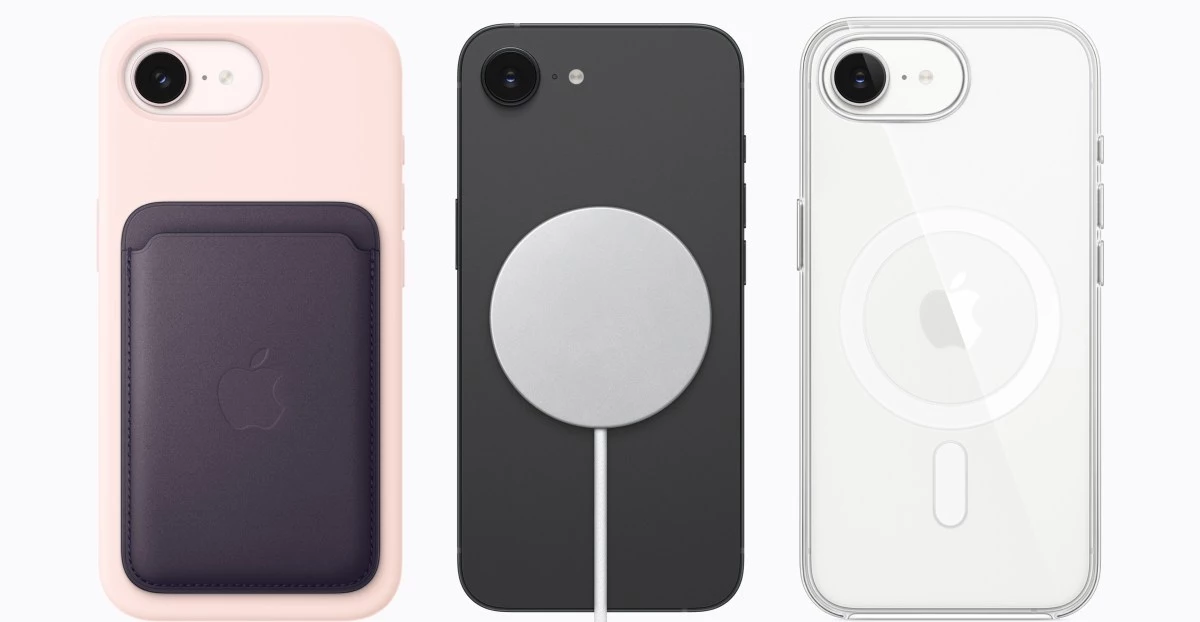
Adding MagSafe and Qi2 wireless charging is more than a convenience checkbox. It expands the addressable market for Apple’s accessory ecosystem—cases, wallets, battery packs, car mounts—and strengthens third-party participation around a standardized charging spec. In practical terms, the 17E turns more buyers into potential repeat purchasers across Apple’s and partners’ accessory catalogs.
At the same time, Apple preserves tier separation through controlled constraints: wireless charging peaks at 15 W on the 17E versus 25 W on Pro models. This is a familiar Apple pattern—deliver the ecosystem, throttle the premium experience. The result is a device that feels modern and compatible, but still leaves clear reasons to upgrade.
This ecosystem-first thinking also dovetails with Apple’s broader multi-revenue-stream model: hardware margins plus accessories plus services. The 17E is engineered to be a platform participant, not merely a one-time hardware sale.
What the charging and accessory choices signal:
- Qi2 standardization improves cross-platform accessory compatibility and market scale
- MagSafe expansion increases attach rates for high-margin accessories
- Charging-speed tiering protects Pro differentiation without breaking compatibility
Feature tiering as margin defense—and a potential regulatory flashpoint
Apple’s differentiation strategy is explicit in what the iPhone 17E does *not* include. The 6.1-inch LCD panel reaches 1,200 nits but stays at 60 Hz and omits premium interface signatures like Dynamic Island and always-on display. The camera system centers on a single 48 MP main sensor with 2× telephoto, while more advanced imaging—such as ultrawide and macro and a better front-facing camera—remains reserved for higher-tier models. Even the absence of the Camera Control button reinforces that the 17E is meant to be capable, not aspirational.
Economically, these omissions are not just product decisions; they are margin preservation mechanisms. LCD panels, aluminum construction, and constrained camera modules can reduce bill-of-materials costs while maintaining the perception of “new iPhone” legitimacy through A19, iOS 26, and Apple Intelligence. That matters when Apple is trying to compete more aggressively at $599 without training customers to expect flagship hardware at mid-tier prices.
There is, however, a broader industry context to watch. As antitrust and platform regulation intensify globally, Apple’s practice of gating marquee features by price tier can attract scrutiny—particularly if regulators interpret differentiation as a lever that reinforces ecosystem lock-in. Apple’s counterargument is likely to remain consistent: tiering reflects component cost, engineering trade-offs, and consumer choice. The regulatory question is whether that explanation remains sufficient in markets increasingly focused on competitive fairness in digital ecosystems.
Strategic outcomes Apple is likely targeting:
- Share gains in the $400–$700 segment without collapsing premium ASPs
- Higher services attach potential via a larger Apple Intelligence-capable installed base
- Stronger trade-in and refurbished pipelines, improving lifecycle economics
- Supply chain flexibility through materials and components less exposed to volatility
The iPhone 17E ultimately reads as a disciplined expansion of Apple’s playbook: broaden the entry point, keep the platform premium, and let silicon and software do the heavy lifting—while the Pro models continue to monetize status, imaging ambition, and the fastest hardware experiences.

 By
By
 By
By
 By
By
 By
By

 By
By

 By
By