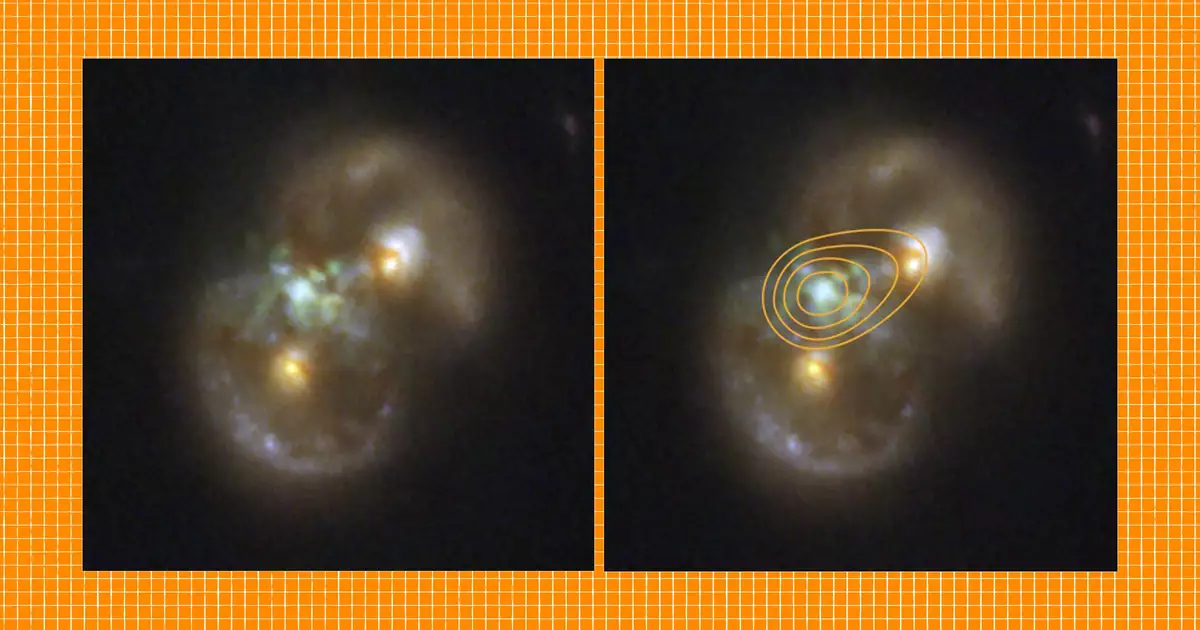

The Infinity Galaxy: A New Lens on Deep Space, Data, and Industry
The James Webb Space Telescope’s latest revelation—a rare “Infinity Galaxy” birthed by the collision of two ancient galaxies, each harboring at least three active supermassive black holes—has jolted not only the astrophysics community but also the broader technology and business landscape. This cosmic tableau, captured with unprecedented clarity, is more than a scientific marvel; it is a harbinger of the accelerating fusion of space instrumentation, AI-driven analytics, and the evolving economics of the space sector.
Unpacking the Technological Breakthrough
At the heart of this discovery lies a leap in both hardware and software orchestration. The JWST’s mid-infrared detector arrays, cooled by sophisticated cryogenic subsystems and governed by next-generation wavefront-control algorithms, have delivered the angular resolution necessary to isolate high-redshift galactic mergers. This is not merely a triumph of optics; it is a testament to the symbiotic evolution of sensor innovation and data-engineering architectures.
The COSMOS-Web survey, which enabled this finding, exemplifies how digital post-processing pipelines now multiply the sensitivity of physical instruments. Petascale imagery—once the exclusive domain of national laboratories—can now be ingested and parsed by automated classifiers, stress-testing the limits of self-supervised vision models on astronomical datasets. The computational backbone supporting this effort is a mosaic of heterogeneous high-performance clusters: CPUs, GPUs, and FPGAs, each optimized for the sparse-matrix convolutions that define modern astrophysical workloads.
This technological choreography has profound implications:
- Sensor-Data Interdependence: Future breakthroughs will depend as much on algorithmic ingenuity as on hardware advances.
- AI Workload Evolution: The need for specialized accelerators is no longer hypothetical; it is a market reality.
- Model Disruption: The validation of the “heavy-seed” hypothesis—suggesting that some supermassive black holes form rapidly via direct collapse—forces a recalibration of cosmological models, compressing time horizons and shifting simulation paradigms.
Economic Ripples and Industry Realignment
The reverberations of this discovery are already being felt across the investment and industrial spectrum. Each JWST milestone strengthens the argument for both sovereign and commercial investment in high-precision optical and infrared payloads. The near-term beneficiaries are clear:
- Mid-Infrared Detector Startups: Expect a surge in venture funding for firms specializing in cryogenic cooling, detector arrays, and in-orbit data relay.
- Downstream Markets: Technologies spun out from JWST’s photonics and data-fusion stack are cascading into Earth observation, mineral prospecting, and even autonomous navigation.
- Cloud and Compute Providers: The COSMOS-Web’s petascale data volumes are accelerating demand for edge-based inferencing and exabyte-scale storage at low Earth orbit (LEO) ground stations. Hyperscale cloud vendors are poised to monetize specialized pipelines, widening margins as new workloads emerge.
This is not merely a technological arms race; it is a reconfiguration of public-private funding dynamics. The collaborative model underpinning JWST—uniting NASA, ESA, CSA, and academic consortia—offers a template for blended capital structures that de-risk early-stage R&D while preserving commercial flexibility.
Strategic Insights: From Black Holes to Boardrooms
Perhaps most intriguing is the metaphorical resonance of the “heavy-seed” formation pathway. In the same way that some supermassive black holes arise not through incremental accretion but via rapid, direct collapse, leading technology firms are leapfrogging legacy product cycles through platform acquisitions and capability fusion. The Infinity Galaxy thus becomes an allegory for compressing time-to-scale: collapsing adjacent capabilities rather than layering them sequentially.
Material science, too, stands at an inflection point. JWST’s reliance on beryllium mirrors and HgCdTe detector arrays—materials with deep ties to semiconductor lithography—suggests that advances in space-grade optics will ripple back to terrestrial fabs, triggering second-order demand shocks and reshaping global supply chains.
The precision required to parse the birth of a supermassive black hole finds its terrestrial echo in climate tech. Radiative transfer modeling and spectral unmixing algorithms, honed for deep-space observation, are now migrating into climate-change attribution models and ESG analytics platforms, underscoring the permeability between space science and Earth systems engineering.
Navigating the New Frontier: Imperatives for Decision-Makers
For leaders across technology, finance, and industry, the message is clear:
- R&D Prioritization: Invest in mid-infrared sensors, low-noise amplifiers, and AI-optimized interconnects to secure upstream positions in multiple growth markets.
- Talent Strategy: Cultivate T-shaped talent—polymaths who can translate domain science into algorithmic solutions—by retooling recruiting and training pipelines.
- Policy and Regulatory Engagement: Proactively address spectrum allocation and data-sovereignty as commercial access to deep-space data intensifies.
- Competitive Intelligence: Monitor procurement patterns at space agencies and defense primes for early signals on future commercial specifications.
The Infinity Galaxy is not just a cosmic spectacle; it is a directional signal for the next era of sensing, computation, and capital allocation. Those who heed its lessons—whether in the boardroom or the lab—will shape the contours of innovation for years to come.

 By
By
 By
By

 By
By
 By
By


 By
By