

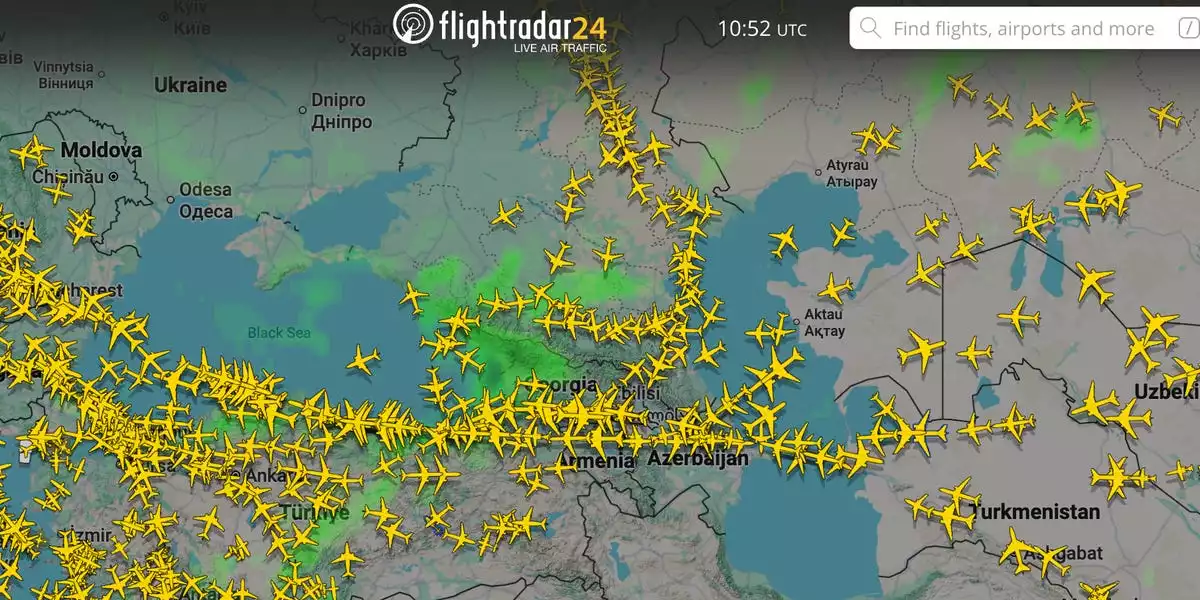

A shrinking map for global aviation as the Caucasus becomes a critical bridge
The partial closure of Azerbaijan’s southern airspace, reportedly following drone strikes tied to the wider US–Israel campaign against Iran and damage near Nakhchivan Airport with civilian injuries, is more than a localized safety measure. It is another sign that commercial aviation is operating on an increasingly constrained geopolitical map—one where “normal” routings can vanish overnight.
For airlines moving passengers and high-value cargo between Europe and Asia, the practical effect is cumulative. With Persian Gulf corridors effectively impaired by regional conflict and Russian airspace largely unavailable due to the Ukraine war, carriers have been funneling into narrower alternatives. The Caucasus corridor—spanning Armenia, Georgia, and Azerbaijan—has become newly vital, linking the Black Sea to the Caspian Sea and enabling routings that avoid both the Gulf and Russia.
Yet this corridor is not a neutral highway in the sky. It overlays a region with long-standing political and security sensitivities, particularly the Armenia–Azerbaijan rivalry shaped by the legacy of Nagorno-Karabakh. The recent diplomatic restraint noted in the region may reflect a shared recognition that aviation disruptions impose immediate economic costs and can invite unwanted escalation. Still, for airline operations teams, restraint is not a strategy; it is a variable—one that must be continuously priced, modeled, and monitored.
The new operational reality: dynamic rerouting, tighter ATC choreography, and risk-priced airspace
Airline network planning has always balanced efficiency with safety. What is changing is the speed and frequency with which that balance must be recalculated. Each new restriction forces an unstable choreography among dispatchers, air-traffic control (ATC), insurers, and flight crews—often with limited lead time and incomplete information.
Key operational pressures now intensifying across the industry include:
- Longer stage lengths and higher fuel burn
Detours add flight time, increase fuel uplift requirements, and cascade into crew duty-time constraints, reserve staffing, and maintenance scheduling.
- Congestion risk in “safe” corridors
As more carriers converge on the same routings, the corridor itself can become a bottleneck—raising the likelihood of airborne holding, suboptimal altitudes, and knock-on delays.
- Insurance and compliance complexity
Overflight decisions increasingly trigger dynamic war-risk assessments, policy exclusions, and premium adjustments—sometimes route-by-route and day-by-day.
- Higher exposure to navigation and communications discontinuities
Contested or unevenly covered regions can present gaps in surveillance, inconsistent ATC capacity, and heightened concern about signal interference or denial.
The result is a subtle but profound shift: geopolitical risk is no longer an external shock to aviation planning—it is a continuous input, akin to weather or fuel prices, but with far sharper discontinuities.
Why aviation technology is accelerating: AI routing, digital twins, and resilient connectivity
This environment is catalyzing a wave of technology adoption that had been advancing steadily but now feels urgent. The most consequential changes are not flashy cabin upgrades; they are systems that help airlines make defensible decisions under uncertainty.
Several technology vectors stand out:
- AI-driven route optimization and real-time flight planning
Airlines are accelerating deployment of platforms that ingest live feeds across geopolitical alerts, NOTAMs, ATC constraints, meteorology, and fuel pricing. The goal is not merely to find the shortest path, but the most resilient path—one that minimizes exposure while preserving schedule integrity.
- “Digital twin” simulations for airspace stress-testing
Digital twins allow carriers and software providers to model alternative corridors and failure modes—testing scenarios in hours rather than days. In practice, this supports faster decisions on:
– corridor switching thresholds
– fleet assignment changes (range and payload trade-offs)
– hub rebalancing and recovery planning after disruptions
- Resilient surveillance and communications (SATCOM, ADS-B redundancy, LEO interest)
Overflight near contested zones increases the premium on situational awareness. Airlines are seeking more robust combinations of SATCOM and ADS-B redundancy, while interest grows in low-earth-orbit (LEO) satellite constellations for lower-latency connectivity and improved resilience against jamming or outages.
- Insurtech and machine-learning risk pricing
Underwriters are moving toward dynamic overflight risk models, linking premiums to changing threat assessments (including drone and missile risk). Emerging concepts—such as IoT-informed exposure profiles tied to actual flight paths—point to a future where insurance becomes a near-real-time operational variable rather than a static annual cost.
Collectively, these tools are reshaping aviation into a sector where software-defined routing and risk analytics become as central as aircraft utilization.
The economic and strategic ripple effects: fares, freight, emissions, and corridor diplomacy
The commercial consequences of longer routings are straightforward but far-reaching. More miles mean more cost—fuel, crew, maintenance cycles—and those costs tend to surface quickly in airfares and air freight rates. For time-sensitive goods—pharmaceuticals, electronics, aerospace components—even modest increases in cost and variability can alter sourcing decisions and inventory strategies.
At the same time, transit states in the Caucasus may see a countervailing benefit: overflight fees. Azerbaijan, Georgia, and Armenia stand to capture incremental revenue as traffic concentrates—funds that can be reinvested into ATC modernization, airport infrastructure, and safety systems. But that upside is inseparable from the responsibility to maintain predictable, trusted corridors—because aviation traffic is famously elastic when credible alternatives exist.
Strategically, three longer-term dynamics are coming into focus:
- Competitive advantage shifts to operationally agile airlines
Carriers with diversified hubs, flexible fleet mixes, and mature disruption playbooks can pivot faster—while less agile competitors face margin erosion.
- Emissions pressures intensify as routes lengthen
Detours inflate aviation’s carbon footprint, amplifying pressure from regulators and corporate procurement. This strengthens the business case for sustainable aviation fuel (SAF) offtake agreements and credible carbon programs—not as branding, but as risk mitigation against route volatility.
- Aviation becomes a quiet driver of “corridor diplomacy”
Even amid historical friction, the shared economic value of stable overflight can encourage pragmatic coordination. Industry-backed safety-of-flight working groups and data-sharing protocols—quasi-diplomatic in function—may become essential infrastructure for keeping the Caucasus corridor viable.
What is unfolding over Azerbaijan’s southern airspace is not merely a rerouting story; it is a live demonstration that global connectivity now depends on a handful of fragile corridors, and that the airlines best positioned for the next decade will be those that treat geopolitics, technology, insurance, and sustainability as a single integrated operating system.

 By
By
 By
By

 By
By
 By
By

 By
By
 By
By







