
A record-setting “microwave laser” and what it reveals about the modern radio-astronomy stack
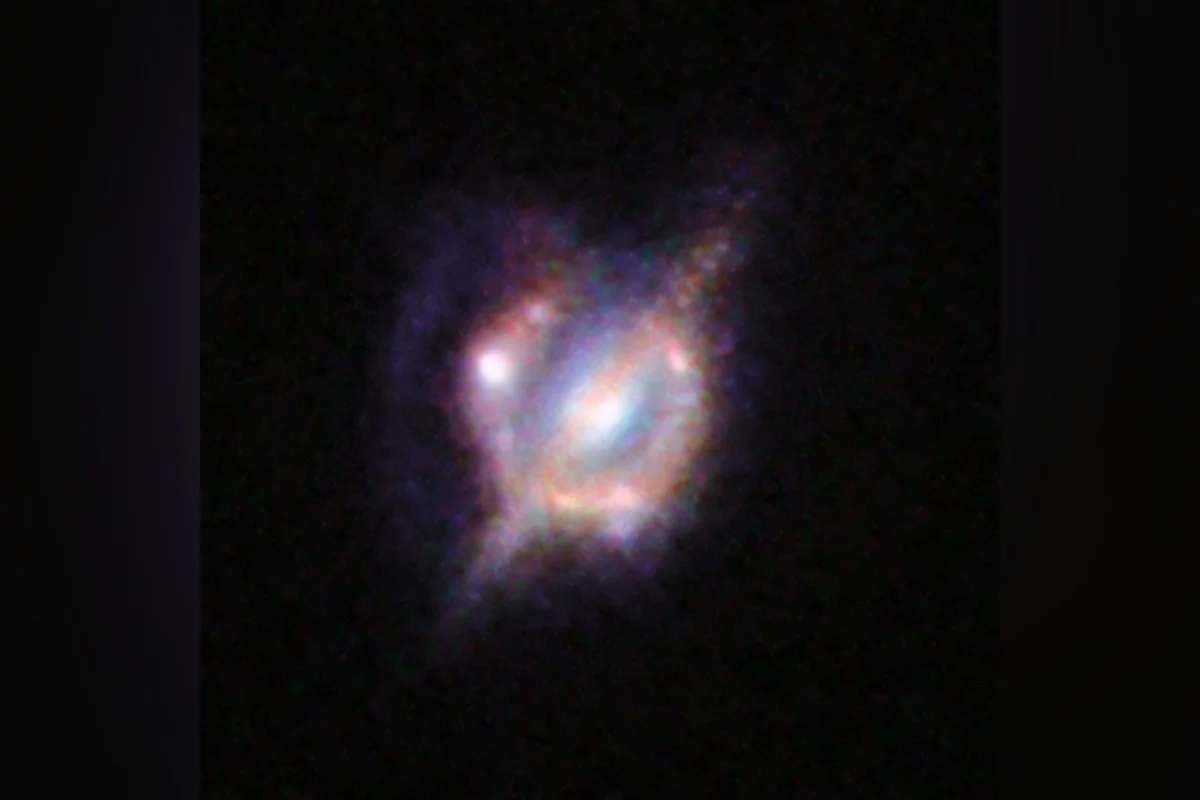
The detection of the most powerful astrophysical maser ever observed—an ultra-luminous hydroxyl “gigamaser” in the distant galaxy H1429-0028, roughly 8 billion light-years away—lands as both a scientific headline and a technology story. Observed with South Africa’s MeerKAT radio telescope array at 1,667 MHz, the signal is reported to be about 100,000 times stronger than a typical stellar maser. That scale matters: it pushes coherent microwave emission from a niche phenomenon into a category that can be systematically surveyed, modeled, and—crucially—industrialized in terms of methods.
At the heart of the event is a familiar engine of cosmic change: a galactic merger. Mergers compress gas, drive shocks, and ignite intense star formation, creating the conditions that can “pump” hydroxyl molecules into a population inversion, enabling coherent emission—nature’s own microwave laser. Yet the decisive enabling factor for detection was not only the intrinsic brightness. A gravitational-lensing alignment magnified the signal by orders of magnitude, turning a cosmological-distance emitter into something MeerKAT could see with confidence. For radio astronomy, this is a reminder that discovery is often a three-part equation: astrophysical extremity + instrumental sensitivity + favorable geometry.
From a business and technology perspective, the significance is that MeerKAT—already a flagship precursor to the Square Kilometre Array (SKA)—has now demonstrated a pathway to finding many more such sources, especially if upgrades expand its ability to scan, classify, and confirm narrow spectral-line phenomena at scale.
MeerKAT, aperture synthesis, and gravitational lensing as a “natural beamformer”
MeerKAT’s 64-dish distributed architecture embodies the modern paradigm of radio instrumentation: aperture synthesis. By correlating signals across many antennas, the array effectively behaves like a much larger telescope, delivering high sensitivity and fine angular resolution—capabilities that are particularly valuable when searching for narrow-band spectral lines such as hydroxyl emission.
In this detection, gravitational lensing played a role that engineers will recognize immediately: it acted as a cosmic amplifier. While lensing is not controllable like an engineered phased array, the analogy is productive. Lensing concentrates flux, improves detectability, and can reshape apparent morphology—effects that resemble what advanced beamforming and adaptive filtering attempt to achieve in telecommunications and radar.
This is where the story becomes strategically interesting for technology leaders:
- Signal amplification without added transmitter power is a core objective in congested-spectrum environments. Lensing is a natural example of “gain” created by geometry and propagation.
- Array-based sensing—whether in radio astronomy, defense radar, or satellite ground systems—depends on extracting weak, structured signals from noise and interference.
- The gigamaser case underscores the value of high spectral fidelity: the ability to detect and characterize narrow lines is not a luxury feature; it is the discovery mechanism.
If MeerKAT is upgraded to hunt hundreds or thousands of similar events, the challenge shifts from “can we detect one?” to “can we operationalize detection as a repeatable pipeline?”—a transition that mirrors how many enterprise AI programs mature from proofs of concept into production systems.
Data-intensive discovery: why AI, HPC, and edge compute are becoming the telescope
The gigamaser detection is described as serendipitous, but serendipity in 2026 increasingly means “the pipeline was capable of noticing.” Modern radio observatories generate data volumes that quickly push into petabyte-scale regimes, and spectral-line searches require careful calibration, interference excision, and candidate validation. The bottleneck is no longer only collecting photons (or radio waves); it is computing, triage, and decision latency.
Operationally, the next phase of maser discovery will likely depend on:
- Real-time or near-real-time processing pipelines that can flag narrow-band features while observations are still underway.
- Machine-learning classifiers tuned for rare-event detection, separating astrophysical lines from radio-frequency interference and instrumental artifacts.
- Scalable HPC architectures that can handle correlation, imaging, and spectral analysis without turning every observing run into a months-long compute backlog.
- Edge-AI deployments at the observatory to pre-filter and prioritize candidates before data is transported or archived—an approach that parallels industrial IoT strategies where intelligence moves closer to the sensor.
For enterprises, the analogy is direct: MeerKAT is effectively a distributed sensor network with extreme throughput, and its success depends on the same ingredients that define competitive advantage in data-driven industries—automation, anomaly detection, and fast validation loops.
From frontier science to economic leverage: infrastructure, talent, and commercial spillovers
Large scientific instruments increasingly justify themselves not only through publications, but through the ecosystems they create. MeerKAT’s role as an SKA precursor positions South Africa as a visible node in global science and technology supply chains—spanning radio-frequency engineering, software systems, data management, and high-performance computing.
The economic and strategic implications are multi-layered:
- Workforce development and retention: sustained operations require engineers and data specialists whose skills translate directly to telecom, cloud, and semiconductor sectors.
- Industrial partnerships: observatories are natural testbeds for high-reliability compute, advanced networking, and signal-processing hardware—areas where vendors can co-develop and validate next-generation systems.
- Geopolitical science leadership: headline discoveries strengthen the case for continued investment in SKA-related capabilities and deepen international collaboration across Africa, Europe, and North America.
- Commercializable techniques: beamforming, adaptive filtering, and anomaly detection methods refined for radio astronomy can be repurposed for 5G/6G, satellite communications, spectrum monitoring, and defense applications.
Meanwhile, the maser itself—coherent emission driven by population inversion—offers a compelling extreme-environment reference point for photonics and microwave-source research. While astrophysical masers are not devices, they are proofs of principle operating under conditions laboratories cannot easily replicate, and they sharpen theoretical and computational models that can influence engineered systems over time.
The discovery of the H1429-0028 gigamaser ultimately reads as a blueprint for how 21st-century breakthroughs happen: a powerful natural event, amplified by cosmic geometry, captured by a distributed instrument, and made legible by computation—an end-to-end innovation chain that business and technology leaders increasingly recognize as the real engine of modern scientific advantage.

 By
By
 By
By

 By
By
 By
By

 By
By
 By
By