
Navigating the Unpredictable: Delta 234 and the Modern Science of Diversion Management
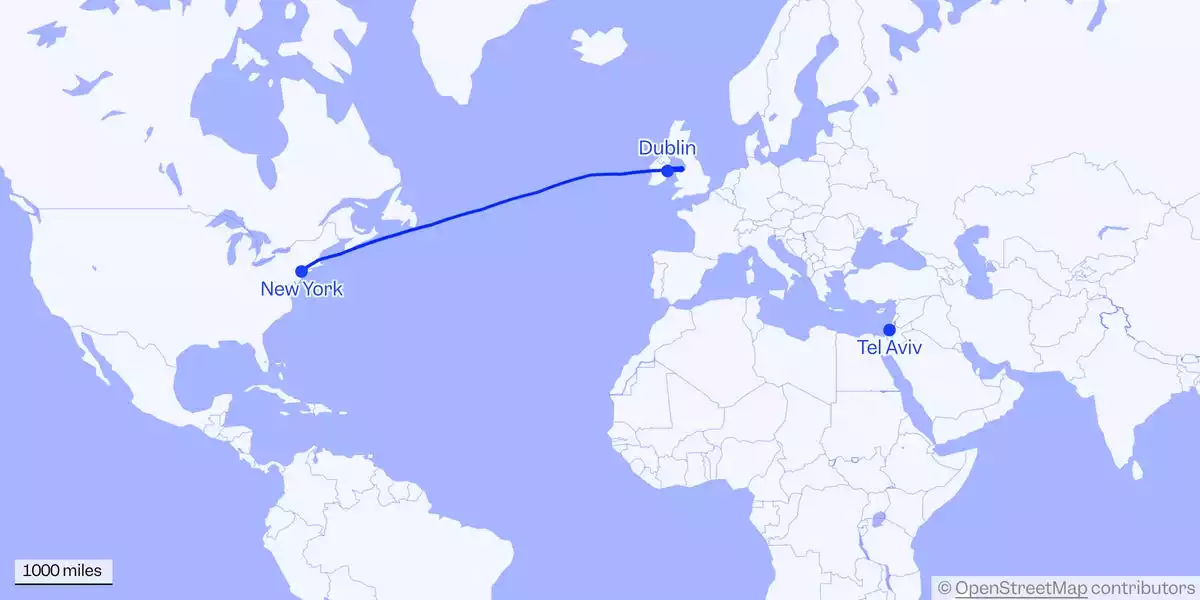
When Delta Air Lines flight 234, a fully loaded Airbus A330 bound from New York to Tel Aviv, made an unscheduled stop in Dublin due to a passenger medical emergency, the incident quietly illuminated the intricate machinery that now underpins global aviation. What might once have been a logistical headache—potentially cascading into a day’s worth of missed connections and stranded travelers—was instead resolved with a measured, almost clinical efficiency. The aircraft refueled, secured a new departure slot, and resumed its journey, ultimately arriving in Israel three hours behind schedule but with no crew or equipment substitution required. For the 300-odd souls on board, it was an inconvenience; for the industry, a demonstration of how operational resilience has evolved from art to algorithm.
The Anatomy of a Diversion: Technology, Infrastructure, and Human Factors
The decision to divert a trans-Atlantic flight is never taken lightly. By the time the medical emergency occurred, Delta 234 had already traversed the most remote stretch of its journey—the North Atlantic. Its position placed it within striking distance of several “medical alternates,” with Dublin emerging as the optimal choice. Notably, Dublin’s 24-hour operations, advanced Category III landing systems, and robust medical infrastructure make it a preferred haven for North American carriers facing in-flight crises.
Such precision is no accident. Airlines now employ sophisticated, algorithm-driven crew rostering systems that preserve duty-time margins, even on marathon routes. Unlike past incidents—such as the British Airways Nassau-Heathrow diversion, where crew timeouts led to protracted delays—Delta’s scheduling left enough operational slack to avoid any need for crew or aircraft swaps. This is a testament to the growing reliance on predictive analytics and digital twins: real-time models that simulate every flight’s variables, from weather and congestion to crew fatigue, and recommend optimal responses to disruptions.
- Key technological enablers include:
– In-flight medical consults via satellite, connecting cabin crews with ground-based physicians.
– Early-stage integration of passenger health wearables with cabin Wi-Fi, allowing for proactive triage and risk assessment.
– AI-assisted risk scoring, which could eventually transform the economics of ultra-long-haul routes, especially those traversing isolated airspace.
The Economics and Strategy of Rapid Recovery
Every diversion carries a price tag, with direct costs—fuel, landing fees, catering, and passenger reaccommodation—ranging from $10,000 to $200,000. By selecting Dublin, a node within Delta’s trans-Atlantic joint-venture network, the airline leveraged pre-negotiated tariffs to contain these expenses. More importantly, the swift relaunch of the same aircraft and crew minimized opportunity costs, preventing a ripple effect of delays across the airline’s global schedule.
In a fiercely competitive market like New York–Tel Aviv, where United, American, El Al, and Gulf carriers are all vying for share, operational resilience becomes a subtle but powerful differentiator. Corporate travel buyers, in particular, prize schedule reliability—a factor that can tip the scales in contract negotiations.
- Strategic considerations shaping airline responses:
– Tightening crew-duty regulations and rising labor costs, prompting airlines to build larger planning buffers.
– Volatile fuel prices, making real-time fuel arbitrage an increasingly important tool for network control.
– The emergence of secondary hubs—Dublin, Shannon, Keflavík—as “shock absorbers” in the global network, offering rapid turnaround for ad-hoc arrivals.
The Next Frontier: Data Governance, Labor Dynamics, and ESG
As the industry edges toward deeper integration of biometric and health data, airlines face a new set of challenges. The promise of fleet-wide wearable deployment is tantalizing: earlier detection of medical risk, reduced diversion rates, and even new revenue streams from opt-in wellness services. Yet, this vision demands robust data governance frameworks to balance passenger privacy with operational safety.
Meanwhile, the sophistication of crew-scheduling algorithms is reshaping labor relations. Dynamic roster optimization—once the domain of operations control—may soon become a focal point in union negotiations, as pilots and flight attendants seek guarantees around fatigue management and quality of life.
Insurance underwriters are also taking note. Carriers that can document reduced diversion delays and improved medical-emergency handling are beginning to secure more favorable premiums. Environmental, Social, and Governance (ESG) reporting frameworks are evolving in parallel, with medical-emergency response times poised to become a new metric in the “social impact” ledger.
The Delta 234 episode, while operationally routine, stands as a microcosm of the airline industry’s transformation. It is a world where digital twins, predictive analytics, and resilient network design converge—quietly, efficiently, and almost invisibly—to turn potential chaos into controlled adaptation. For executives and strategists, such events are not mere disruptions but data-rich case studies, offering a glimpse into the future of global aviation.

 By
By
 By
By
 By
By
 By
By
 By
By


 By
By