

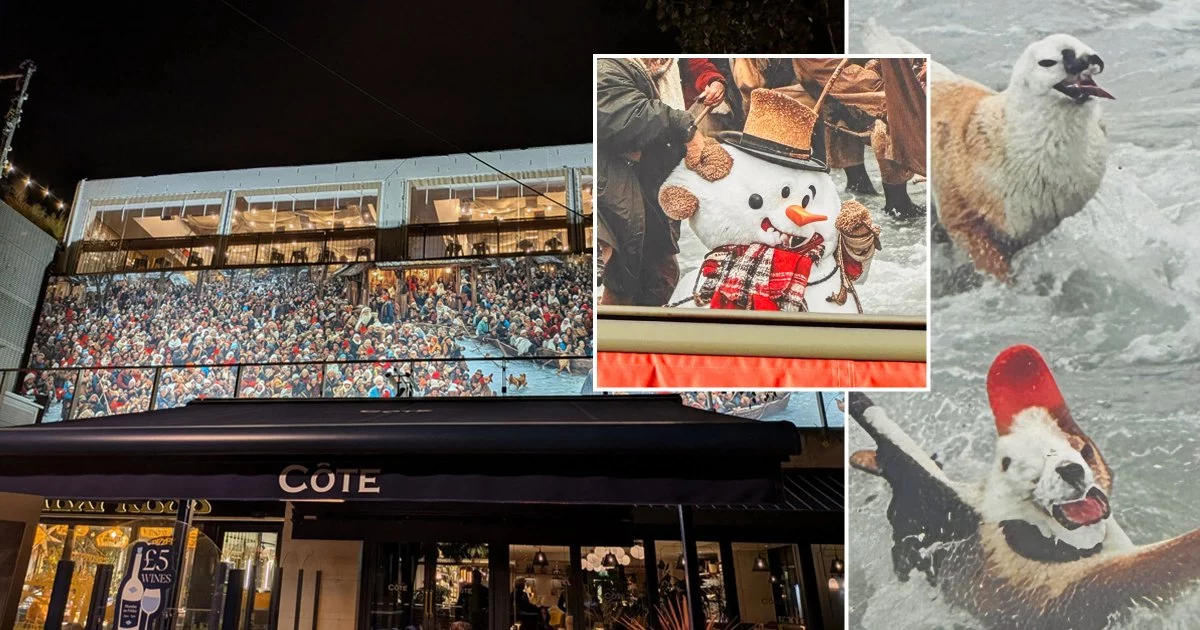

When AI Art Meets the Street: The Kingston Murals and the New Public Canvas
In the heart of Kingston upon Thames, two sprawling murals materialized on the façade of a mixed-use building—holiday-themed, unmistakably modern, and, upon closer inspection, unmistakably artificial. The works, attributed to the contemporary artist Mat Collishaw but generated by advanced AI diffusion models, quickly became a local spectacle. Yet, fascination soon curdled into controversy. The images’ anatomical oddities—misshapen hands, uncanny faces—sparked ridicule, but it was the deeper, accidental symbolism that triggered a public reckoning. One mural, depicting figures wading through water, was interpreted by some as a veiled commentary on immigration, a subject that simmers at the core of British political discourse. Within days, the property owners removed the panels, bowing to a tempest of aesthetic and social critique.
The Fragile Alchemy of Generative AI in Public Art
The Kingston incident is not merely a tale of artistic misfire; it is a case study in the volatile chemistry between generative AI, public space, and the collective gaze. Today’s diffusion models—while dazzling in their ability to conjure images at scale—remain haunted by subtle technical limitations. The “Lovecraftian snowman” effect, a now-familiar internet meme, is not just a quirk but a structural flaw: human observers are exquisitely sensitive to anatomical errors, especially when encountered outside the forgiving context of a gallery.
But the technology’s limitations are not only technical. AI’s latent spaces are vast and uncharted, capable of surfacing visual motifs that resonate with deep-seated social anxieties—sometimes entirely by accident. In Kingston, the unintentional echo of migration narratives transformed a festive mural into a flashpoint, revealing the inadequacy of existing “content safety” tools. The need for more sophisticated filters—capable of parsing not just explicit but also symbolic or contextual risk—has never been more acute.
Authorship, too, is in flux. The silence from Collishaw underscores a growing ambiguity: when an artist orchestrates an AI system, where does authorship end and algorithmic agency begin? The murals’ Bruegelian flourishes raise unresolved questions of copyright and moral rights, especially as legal frameworks in the U.K. and E.U. struggle to adapt to the realities of machine-generated creativity.
Economic Calculus and Brand Exposure in the Age of Algorithmic Art
For property developers and municipal planners, AI-generated murals offer a seductive proposition: rapid production, low commissioning costs, and the cachet of technological sophistication. Yet, as Kingston demonstrates, the calculus is fraught. The initial savings can be obliterated by the costs of reputational damage and emergency removal. Insurers are taking note, drafting new exclusions for “algorithmically generated creative risk” and signaling a future where premiums reflect not just physical but cultural volatility.
This new risk landscape is reshaping the creative supply chain. Agencies specializing in AI art are instituting review protocols reminiscent of advertising compliance, and a new class of “AI art curators” and third-party auditors is emerging. These specialists are tasked not just with judging artistic merit, but with mapping the socio-political terrain into which each work will be launched.
Navigating the Socio-Political Minefield: Regulation and Strategic Foresight
The Kingston episode lays bare the heightened sensitivity of public discourse in the U.K., where even ambiguous imagery can ignite debates over migration and identity. Generative AI, with its unpredictable outputs, is uniquely vulnerable to such collisions. Social media accelerates these cycles, transforming local controversies into national talking points overnight.
Regulatory responses are evolving in real time. The E.U.’s forthcoming AI Act classifies certain generative systems as “high-risk” when deployed in public-facing contexts, while the U.K. favors a lighter regulatory touch. Yet, local councils are already considering bylaws mandating provenance disclosure and human oversight for public installations. The patchwork of future permitting regimes will demand new forms of compliance, akin to those governing drone displays and digital billboards.
Forward-thinking organizations are responding with layered strategies:
- Cultural-Intelligence Reviews: Integrating sociologists and anthropologists into creative teams to anticipate how AI-generated imagery might be interpreted across diverse audiences.
- Provenance and Transparency Protocols: Employing cryptographic watermarking and clear on-site signage to disclose AI involvement and artistic intent.
- Algorithmic Due Diligence: Adapting cybersecurity frameworks to assess and mitigate the risk of public backlash, with scenario planning and rapid response mechanisms.
- Adaptive Contracting: Embedding clauses that assign liability and budget for swift remediation, transforming potential crises into manageable operational events.
As programmable façades and real-time generative media become fixtures of the urban landscape, the precedents set today will shape the governance of tomorrow’s adaptive content. Vendors are racing to develop “context-aware” generators that ingest local sentiment to minimize unintended offense—a promising but privacy-sensitive frontier. Meanwhile, the standards diverging between gallery and civic space will force organizations to adopt bifurcated risk policies, balancing creative ambition with public accountability.
The Kingston murals, and the furor they unleashed, serve as a harbinger. In the era of AI-driven public art, the true challenge lies not in technical perfection, but in navigating the intricate web of cultural resonance, regulatory scrutiny, and reputational risk. Those who master this new choreography will harness the creative velocity of generative AI into lasting advantage; those who do not will find themselves, like the murals themselves, swiftly painted over by the tides of public sentiment.

 By
By
 By
By

 By
By
 By
By
 By
By

 By
By







