


California’s proposed billionaire tax and the new geography of American wealth
California’s floated one-time 5% “billionaire tax” is doing more than stirring a familiar debate about fairness and fiscal capacity—it is stress-testing a core assumption of state finance: that the ultra-wealthy are sufficiently anchored to place. The early signals suggest otherwise. For high-net-worth individuals with flexible work patterns, multi-state footprints, and sophisticated advisors, residency is increasingly a strategic variable, not a fixed identity.
Florida—already a perennial winner in U.S. interstate tax competition due to its lack of state income tax—has emerged as the clearest beneficiary. The state’s proposition is straightforward: lower recurring tax friction, a business-friendly posture, and a lifestyle brand that has matured from seasonal getaway to full-time headquarters for capital.
The headline-grabbing catalyst is the reported buying spree by Google co-founder Larry Page, who has acquired three Miami properties totaling more than $180 million. Market chatter that other technology titans—Sergey Brin and Mark Zuckerberg—may follow, alongside Jeff Bezos, reframes Miami not merely as a luxury destination but as a plausible node in the global map of tech wealth. If that clustering materializes, Miami could host four of the world’s five wealthiest individuals—a statistic that would have sounded implausible a decade ago, yet now tracks with the logic of mobility, tax optimization, and network effects.
Miami’s trophy-property surge: real estate as status, shelter, and signal
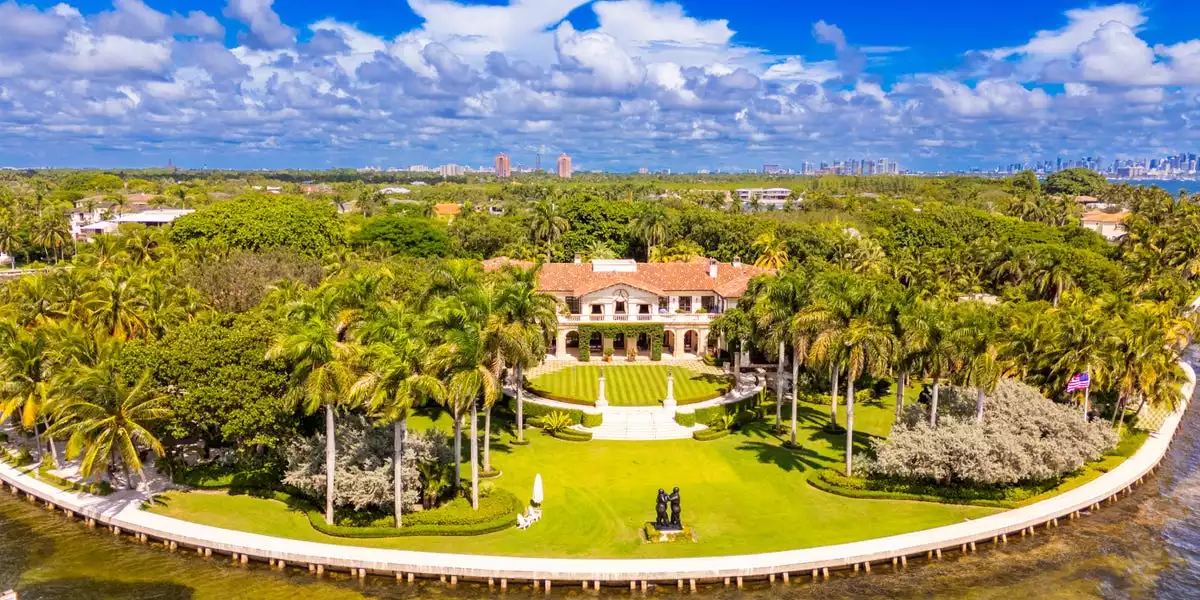
The immediate transmission mechanism of this migration is visible in the luxury real estate market, where demand is not simply rising—it is reshaping price discovery. Miami’s most exclusive enclaves—Indian Creek (“Billionaire Bunker”), Allison Island, Fisher Island, Coconut Grove, and Coral Gables—are experiencing what can fairly be described as a modern gold rush for trophy assets. Reported transactions ranging from $75 million to $200 million underscore a market where scarcity, privacy, and prestige have become the dominant fundamentals.
For the ultra-wealthy, these purchases serve multiple functions at once:
- A store of value in a world where financial assets can be volatile and reputational risk can be sudden
- A residency anchor that supports domicile claims and lifestyle logistics
- A social and strategic signal—a way to be seen (and to see others) within an emerging peer cluster
- A liquidity sink that converts abstract wealth into tangible, defensible assets
Yet the same dynamics that make luxury real estate attractive to billionaires can distort the broader market. When buyers can deploy nine-figure sums with minimal financing sensitivity, local pricing signals can detach from regional incomes. The result is often a widening affordability gap, not only in the purchase market but also in rentals, as service workers and middle-income residents compete for a shrinking pool of attainable housing.
This is where Miami’s boom becomes more than a real estate story. It becomes a question of urban resilience: how a city absorbs sudden capital inflows without turning into a high-gloss archipelago of wealth surrounded by strained infrastructure and displaced communities.
Clustering effects: from tax migration to a full-stack billionaire ecosystem
The deeper significance of billionaire relocation is not the headline number of wealthy residents—it is the ecosystem formation that follows them. When multiple top-tier technology and finance figures concentrate geographically, they bring (and attract) a supporting stack of services that can permanently alter a city’s economic profile:
- Family offices and private investment vehicles that localize capital allocation
- Specialized legal, tax, and trust advisory practices focused on cross-state domicile planning
- Private aviation, security, and bespoke hospitality that expand high-margin service sectors
- Philanthropic vehicles and cultural patronage that reshape civic institutions and influence
Over time, these clustering effects can generate innovation spillovers—new venture networks, founder communities, and capital pipelines that mimic aspects of Silicon Valley’s gravitational pull, but in a different climate and regulatory environment. Miami’s pitch, increasingly, is not only “low tax” but “high access”: access to global finance, Latin American business corridors, and a growing roster of elite peers.
At the same time, the transformation of neighborhoods such as Coconut Grove and Coral Gables raises hard planning questions. As luxury demand accelerates, cities face pressure on roads, utilities, coastal resilience, and public services—while long-standing communities confront the risk of cultural erosion and displacement. The policy challenge is to avoid a binary outcome where prosperity rises but broad-based livability falls.
What to watch next: policy responses, market fragility, and the next wave of relocations
This moment sits at the intersection of state tax policy, capital mobility, and asset-market dynamics. California’s proposal illustrates a broader national trend: U.S. states are beginning to compete for the ultra-wealthy in ways that resemble international competition among low-tax jurisdictions such as Dubai or Switzerland. The difference is that the contest is now domestic, faster-moving, and amplified by remote work and portable corporate influence.
Several forward indicators will determine whether Miami’s billionaire influx becomes a durable reallocation of wealth or a cyclical surge:
- Policy calibration in high-tax states: If states pursue aggressive wealth-targeted measures without addressing mobility, they may trigger outmigration that erodes not only income-tax bases but also downstream economic activity tied to consumption, philanthropy, and business formation.
- Municipal strategy in destination cities: Miami and neighboring jurisdictions will be judged on whether they can pair luxury growth with housing supply expansion, infrastructure investment, and climate adaptation, especially given coastal risk and insurance-market stress.
- Luxury real estate stability: Trophy assets can be resilient, but they are not immune. A reversal in sentiment, regulatory backlash, or macro tightening could expose how quickly a market built on concentrated demand can reprice.
- Second-wave behavior: Early movers often shape the ecosystem; later entrants benefit from it. If additional tech leaders establish primary residency, Miami’s status could shift from “alternative hub” to “default option” for a segment of global wealth.
What is unfolding is not merely a tale of billionaires buying mansions—it is a live experiment in how quickly tax incentives, lifestyle positioning, and network gravity can redraw the internal economic map of the United States, with Miami increasingly positioned as a consequential waypoint in the future of tech capital and high-net-worth residency.

 By
By
 By
By

 By
By
 By
By


 By
By







