

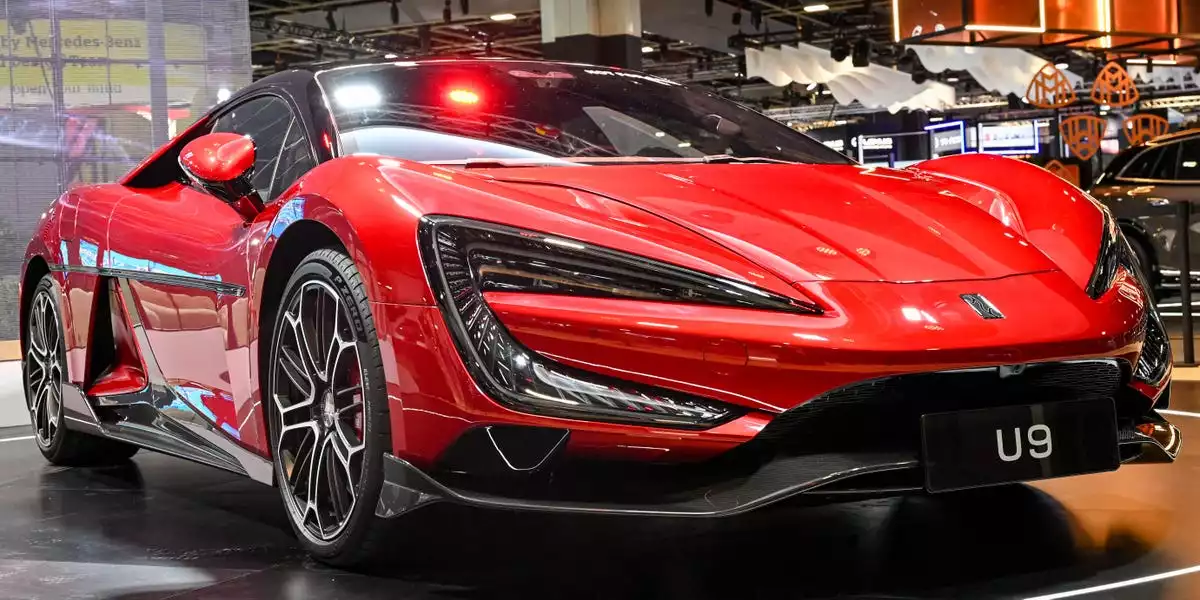

China’s Electric Hypercar Breaks Barriers—and Redefines the Race
In a feat that reverberates far beyond the closed circuits of automotive enthusiasts, BYD’s Yangwang U9 Xtreme has shattered the world speed record for production cars, clocking in at a staggering 496.22 km/h (308 mph) on a German proving ground. This is more than a technical milestone; it is a moment of symbolic handover, as the torch of ultimate automotive performance passes from the fossil-fueled Bugatti Chiron Super Sport to a battery-electric upstart. The U9 Xtreme is not just the fastest production car—it is the first electric vehicle to claim that title, signaling a new era in which China’s electric vehicle (EV) industry is not merely catching up, but leading the charge at the highest echelons of performance.
Power, Precision, and the New Architecture of Speed
The Yangwang U9 Xtreme’s achievement is underpinned by a confluence of innovations that are rapidly rewriting the rules of automotive engineering:
- Battery Integration and Chemistry: At the heart of the U9 Xtreme is BYD’s proprietary Blade battery, integrated directly into the vehicle’s structure. This approach delivers not only the rigidity required for stability at 300+ mph, but also the thermal resilience and current throughput necessary for sustained high-speed runs. The company’s announcement of near five-minute “super-charging” capabilities—mirrored by Chinese battery giant CATL—suggests a coming collapse of the psychological and practical barriers that have long separated EVs from their combustion-powered rivals.
- Software-Defined Dynamics: The U9 Xtreme’s quad-motor setup, orchestrated by software capable of microsecond-level torque adjustments, enables a degree of stability and control previously unthinkable in vehicles of such mass and velocity. This same technological stack, already filtering down to mass-market models, is redefining safety and performance standards across the board.
- Thermal Management and Materials Science: Exotic cooling systems and phase-change materials, once the preserve of laboratory prototypes, are being validated in the crucible of hypercar performance. The lessons learned here are poised to transform commercial EVs—especially in fleet and logistics applications where thermal constraints have been a persistent bottleneck.
Economic Disruption and the Global Contest for Automotive Supremacy
The implications of the U9 Xtreme’s record extend far beyond the racetrack. With a limited run of just 30 units priced around $233,000—a fraction of the multi-million-dollar tags attached to Western hypercars—BYD is compressing the cost curve even at the bleeding edge of performance. This move exposes the margin structures of European luxury brands, which have long relied on exclusivity and incremental innovation to justify their premiums.
Key competitive vectors now include:
- Vertical Integration: BYD’s control over batteries, power electronics, and increasingly semiconductors insulates it from supply chain shocks and allows for rapid iteration, a strategy that Western OEMs are only beginning to emulate.
- Innovation Flywheel: China’s hypercompetitive domestic market, with over 100 brands vying for supremacy, acts as a living laboratory for rapid feature development—battery-swap, AI-driven cockpits, and ultra-fast charging—while Western incumbents are often encumbered by elongated product cycles and regulatory inertia.
- Market Access and Policy: The U.S. market remains largely closed to Chinese EVs due to tariffs, but BYD’s ambitions in Europe are clear, with the U9 Xtreme and its SUV sibling, the Yangwang U8, set to arrive in 2027. Meanwhile, the EU’s intensifying scrutiny of Chinese state support and anti-subsidy investigations may soon extend to the performance segment, not just mainstream EVs.
The New Luxury Paradigm and the Road Ahead
As raw speed and acceleration become democratized through electrification, the traditional luxury playbook—anchored in top-speed bragging rights—faces an existential challenge. Brands that once defined themselves by the outer limits of performance must now pivot toward experiential differentiation: heritage, craftsmanship, and bespoke services. The very definition of aspiration is shifting, with “Made in China” evolving from a marker of value to one of innovation and prestige.
For Western automakers, the message is clear:
- Accelerate Battery and Software Strategies: Joint ventures, technology licensing, and a shift toward software-first architectures are no longer optional—they are urgent imperatives.
- Reimagine Charging Infrastructure: Utilities and charge-point operators must prepare for the era of megawatt-class charging, where early standard-setters will capture network effects reminiscent of the CCS versus NACS battle in North America.
- Protect Talent and IP: The race for expertise in thermal management and power electronics is heating up, and multinationals must invest in retention and cross-licensing to stay ahead of litigation and talent raids.
The Yangwang U9 Xtreme’s record is not merely a headline—it is a harbinger. The boundaries between affordability and ultimate performance are collapsing, and with them, the old certainties of the automotive world. In this new landscape, the winners will be those who recognize that the future of mobility is being written not just in the laboratories of Stuttgart or Detroit, but on the proving grounds of a rapidly electrifying China.

 By
By
 By
By
 By
By
 By
By


 By
By








