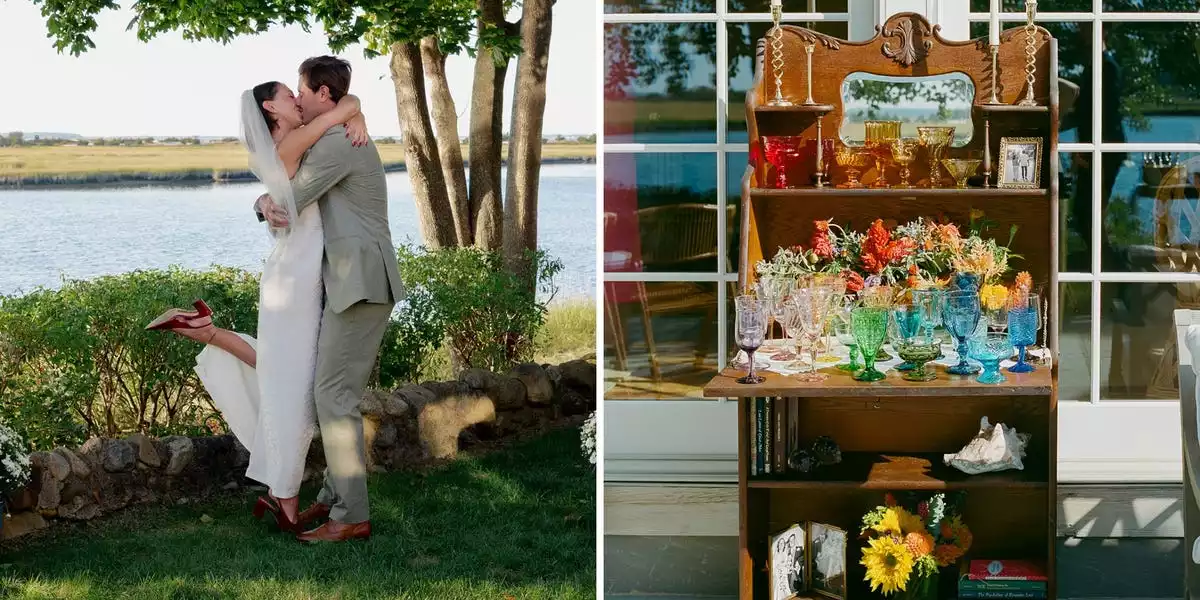

A Southampton micro-wedding as a real-time read on inflation-era consumer strategy
Hannah and Drew Williams’ 33-guest wedding in Southampton, New York—delivered for roughly $21,650 against an industry backdrop of $34,200 to $36,000 average wedding costs—lands as more than a feel-good budgeting story. It is a compact case study in how households are recalibrating discretionary spending when prices remain elevated and “once-in-a-lifetime” expectations collide with everyday financial constraints.
The couple’s approach was not austerity so much as selective spending paired with deliberate substitution. They preserved the emotional and aesthetic “signal” of a high-touch event—vintage styling, curated details, intimate hospitality—while systematically avoiding the cost centers that have become structurally expensive in the modern wedding economy: large guest counts, bundled venue packages, and high-margin professional services.
Several line items illustrate the new logic of value:
- $8,700 for a restaurant deck rental with catered charcuterie, effectively concentrating spend where guests feel it most: food, setting, and time together.
- $1,200 in curated décor, amplified through thrift and DIY rather than retail procurement.
- An $800 secondhand gown and $750 linen suit, signaling a shift from “newness” to “fit, story, and style.”
- A $50 camcorder in place of professional videography, prioritizing authenticity and documentation over cinematic production.
- $10,000 in parental contributions, underscoring how private networks increasingly function as financing instruments for milestone events.
The result is a wedding that reads as premium in experience, while being engineered like a lean project: fewer dependencies, fewer intermediaries, and tighter control over scope.
The platform economy quietly rewires the wedding supply chain
A defining feature of this wedding is how thoroughly it leans on platform-enabled peer-to-peer commerce and self-service coordination. The Williamses’ thrifted décor and secondhand apparel choices reflect the broader expansion of the global secondhand economy, projected by industry observers to approach $350 billion by 2026. Weddings—once dominated by bespoke, single-use purchases—are increasingly compatible with resale because many inputs (dresses, vases, candleholders, signage, table accents) retain utility and aesthetic value after one event.
This is not merely bargain-hunting; it is disintermediation. Where traditional wedding planning often routes couples through a chain of vendors—planner to rental house to florist to stationer—today’s couples can assemble comparable outputs through:
- Resale marketplaces and estate-sale aggregators that surface high-quality items at steep discounts
- DIY design tools (templates, mood boards, collaborative checklists) that reduce the need for full-service planning
- Consumer-grade capture technology that makes “good enough” photo/video viable for social sharing and personal archives
The $50 camcorder choice is especially telling. In a social media environment that rewards immediacy and perceived authenticity, professional videography becomes less mandatory for some couples. The trade-off is clear—lower production quality and fewer polished deliverables—but the value proposition shifts when the primary distribution channel is personal networks and short-form platforms rather than formal edited films.
For business and technology leaders, the deeper signal is that weddings are becoming modular: couples increasingly assemble events from interoperable components sourced across platforms, friends, and à la carte services—rather than purchasing a single, bundled “wedding product.”
Micro-events and network-subsidized labor reshape experiential spending
The 33-person guest list is not a footnote; it is the operating model. Smaller gatherings reduce the most inflation-sensitive variables—catering headcount, rentals, venue capacity requirements, transportation complexity—and allow couples to redirect spend toward atmosphere and personalization. This aligns with a broader rise in micro-weddings and intimate celebrations, which trade scale for intentionality.
At the same time, the Williamses’ reliance on friends for labor and family for funding highlights a parallel trend: network subsidization. In practical terms, this resembles crowdfunding dynamics, even when no formal platform is used. Costs and operational burdens are distributed across an affinity group, lowering cash outlay while increasing coordination demands.
That trade is not universally available. Couples without nearby communities, flexible friend groups, or family support may find the “DIY micro-wedding” model harder to execute. This creates a subtle equity divide in the modern wedding market: not simply between high- and low-income households, but between those with social capital and logistical support and those without it.
Still, the underlying consumer preference is consistent: maintain emotional resonance, reduce financial exposure. In an environment shaped by debt burdens, housing costs, and wage pressures, many younger consumers appear willing to redesign rituals—so long as the experience remains meaningful and shareable.
What wedding vendors and event-tech investors should take from this playbook
For incumbents—planners, videographers, décor rental houses, and traditional venues—the Williams wedding underscores a market reality: package pricing faces resistance when consumers can replicate aesthetics through resale, templates, and peer labor. The competitive threat is not one new entrant, but a distributed ecosystem of platforms and substitutes.
Strategic implications are emerging:
- Vendors may need tiered, modular offerings (hourly coordination, partial planning, “day-of” execution, micro-wedding bundles) that meet DIY-leaning couples where they are.
- Resale and recommerce infrastructure is becoming wedding-grade, creating room for curated aggregators that can authenticate condition, standardize sizing, manage delivery, and offer insurance-like protections.
- Data-driven personalization—from menu design to décor kits—can help vendors compete on relevance rather than scale, especially as intimate events demand higher per-guest intentionality.
- Hybrid marketplaces that combine peer-to-peer goods with professional services look increasingly plausible: sourcing + logistics + optional on-site coordination, all with transparent pricing.
The Southampton case ultimately reads as a preview of a broader shift in experiential services: consumers want premium feelings, not premium markups. The businesses that thrive will be those that treat weddings—and adjacent categories like corporate retreats and brand events—as configurable systems, where authenticity, affordability, and control are not competing priorities but the new baseline expectation.

 By
By
 By
By

 By
By
 By
By

 By
By
 By
By