

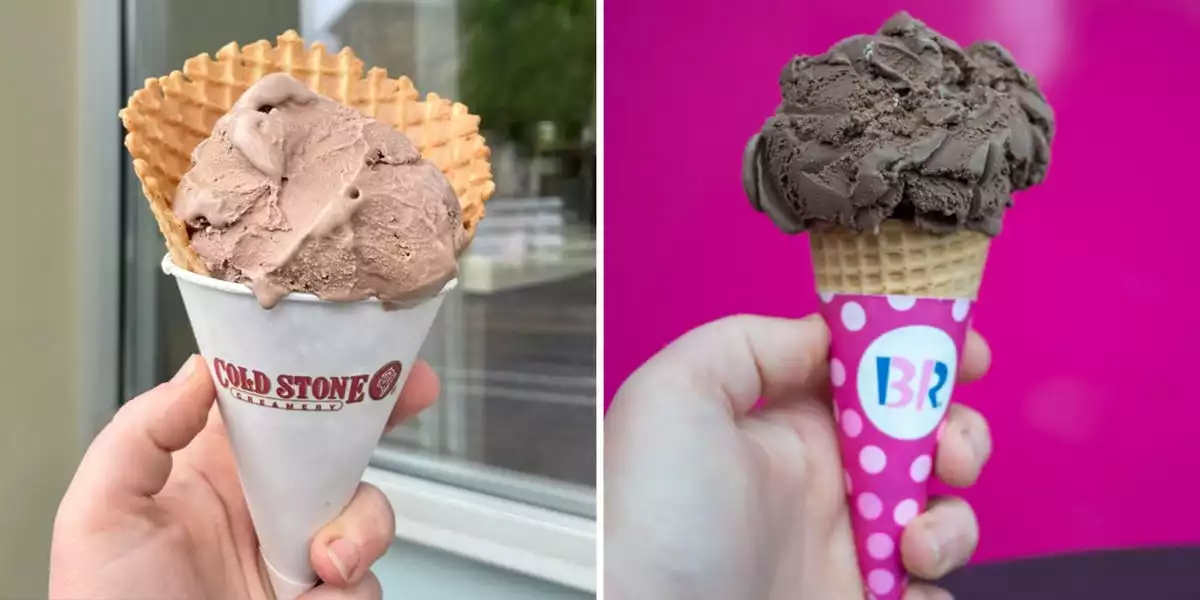

A head-to-head taste test that doubles as a referendum on value in frozen desserts
A side-by-side comparison of Baskin-Robbins vs. Cold Stone Creamery—using three identical benchmarks (vanilla with M&M’s, chocolate in a cone, and a strawberry milkshake)—landed on a blunt takeaway: Baskin-Robbins delivered the stronger combination of flavor and price. That conclusion matters beyond the novelty of a taste test. In today’s discretionary-spend environment, dessert brands aren’t merely competing on indulgence; they’re competing on perceived fairness—how much satisfaction a customer feels they receive for every dollar spent.
On pricing alone, the gap is hard to ignore. Baskin-Robbins’ $3.59 single scoop (plus $0.89 for mix-ins) positions it as an accessible treat, while Cold Stone’s comparable “Like It” size at $6.25 and a $7.00 shake places it firmly in premium territory. Premium pricing can work—when the sensory payoff is unmistakable. In this test, it wasn’t. The critique of Cold Stone centered on muted chocolate notes, skimpy mix-ins, and a milk-forward shake base, while Baskin-Robbins’ chocolate was praised for creamy richness and its strawberry shake for a more prominent fruit profile, even if thinner than expected.
The deeper signal: in a category where consumers increasingly toggle between “small indulgence” and “skip it,” execution consistency can beat spectacle.
Simplicity versus customization: two operating models under pressure
The contrast between these brands is, at its core, a contrast between two retail philosophies:
- Baskin-Robbins leans into a standardized scoop-and-serve model—predictable portions, faster throughput, and a menu that emphasizes familiarity and repeatability.
- Cold Stone is built around customization theater—the mix-in ritual, the “create your own” promise, and a broader flavor palette designed to make each visit feel personalized.
Customization, however, is not automatically synonymous with quality. It introduces more variables: staff technique, portion discipline, ingredient freshness, and the balance between base ice cream and add-ins. When those variables aren’t tightly controlled, the experience can drift from “bespoke” to “inconsistent.” The taste test’s complaints—disproportionate cones, muted flavor intensity, and scant mix-ins—read like symptoms of a system where the brand promise is bigger than the operational guardrails.
Baskin-Robbins, by contrast, benefits from the quiet strength of repeatable execution. Even where its vanilla was described as merely “competent,” competence can be commercially powerful when paired with lower prices and reliable delivery. In mass-market foodservice, “good every time” often outperforms “great sometimes,” especially when consumers are scrutinizing add-on costs.
Retail ambience also plays a role in positioning. Baskin-Robbins’ brighter, family-friendly energy reinforces its value-forward accessibility. Cold Stone’s more subdued premium-casual tone signals a higher-end proposition—but that proposition must be validated in the cup, not just in the décor.
Pricing, unit economics, and the hidden cost of complexity
The taste test’s most consequential implication may be what it suggests about unit economics in an inflationary operating environment. Both chains face the same macro pressures—dairy volatility, energy costs, wage inflation, and licensing dynamics around branded inclusions like M&M’s. Yet their models absorb these pressures differently.
Baskin-Robbins’ streamlined approach can offer structural advantages:
- Simplified procurement and forecasting with fewer operational edge cases
- Lower labor intensity per transaction due to faster service
- Reduced spoilage risk from a tighter SKU footprint and more predictable demand patterns
Cold Stone’s customization engine, while a brand differentiator, can be expensive to sustain:
- Higher labor time per order, reducing throughput during peak hours
- Greater inventory complexity across mix-ins and flavor variety
- More opportunities for portion inconsistency, which can inflate food costs or disappoint customers
This is where pricing becomes strategic, not cosmetic. Cold Stone’s premium price point implicitly promises premium sensory impact and generosity. If customers perceive smaller mix-in portions or a less flavorful base, the brand risks a damaging equation: higher price + lower perceived value = reduced loyalty. In a market where consumers can pivot to local scoop shops, grocery premium pints, or plant-based alternatives, that’s not a theoretical risk—it’s a churn catalyst.
Technology, loyalty, and what “winning” looks like from here
The frozen dessert sector is increasingly shaped by data-driven product development and omnichannel behavior. Brands that treat taste, operations, and digital engagement as one integrated system will be best positioned to defend margin and relevance.
Several strategic levers stand out:
- AI-informed flavor and menu optimization: Social listening and sales analytics can help rotate flavors that maximize both demand and margin, particularly for brands maintaining a leaner core menu.
- Omnichannel ordering economics: Apps, kiosks, and delivery partnerships are now baseline expectations. The challenge is profitability—especially when delivery fees collide with already-premium pricing.
- CRM and loyalty precision: Targeted offers (e.g., chocolate-focused promotions tied to inventory levels) can lift frequency without blanket discounting. Both brands have room to better cross-sell—turning scoop buyers into shake buyers through rewards design and personalized prompts.
The taste test outcome doesn’t declare a permanent winner; it highlights a moment of truth. Baskin-Robbins appears to be benefiting from operational clarity and value alignment, while Cold Stone is being challenged to ensure its customization promise consistently translates into superior taste and portion satisfaction. In a polarized consumer economy—where value-seeking and premiumization coexist—the brands that thrive will be those that make their positioning tangible in every bite, every receipt, and every repeat visit.

 By
By
 By
By
 By
By

 By
By

 By
By
 By
By







