


Argus and the rise of post-biomimetic robotics in unstructured environments
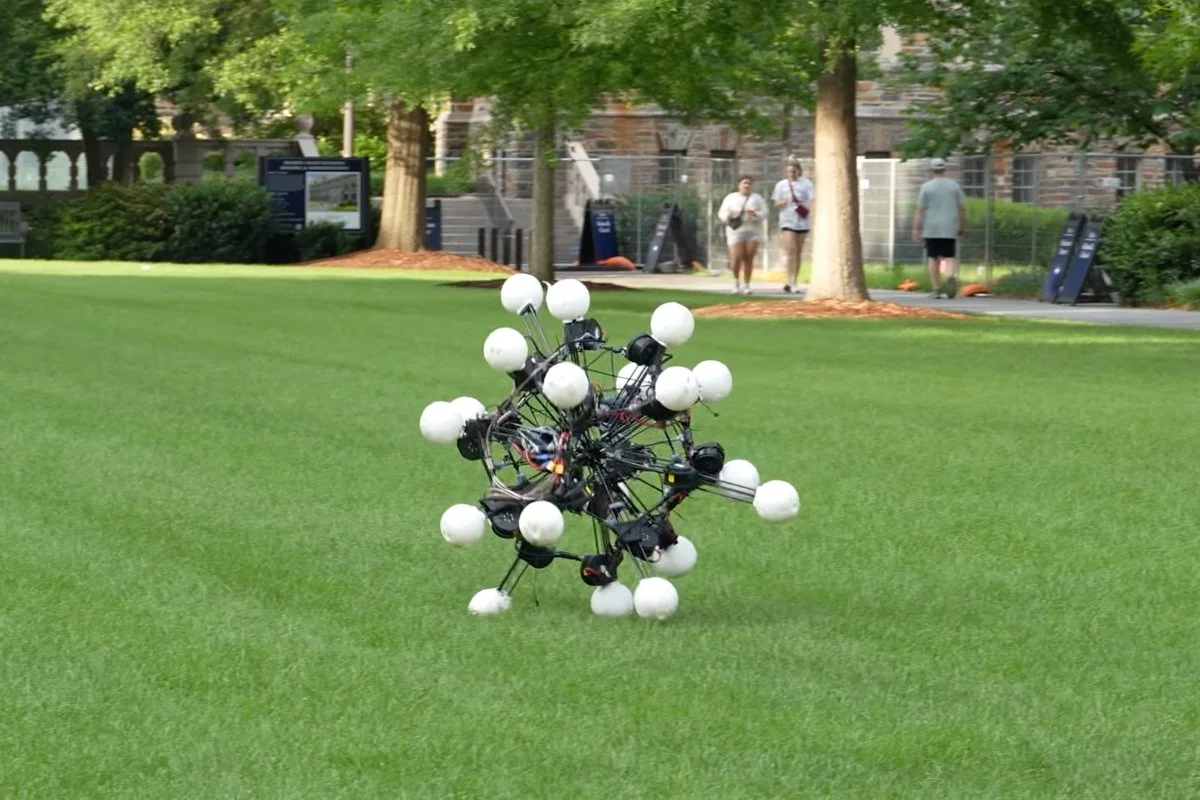
Duke University researchers led by Professor Boyuan Chen have introduced Argus, a robot that looks less like an animal or humanoid and more like an engineered organism: a virus-shaped central body surrounded by twenty telescoping legs, each equipped with depth-sensing “eyes.” The aesthetic is not a novelty; it is a statement of intent. Argus is designed to perform in the messy reality that defeats many lab-optimized machines—sand, asphalt, forest undergrowth, and even parallel-wall climbing—without relying on the familiar crutches of biomimicry.
This matters because the robotics industry has long treated nature as a blueprint: copy the leg geometry of insects, the gait of quadrupeds, the balance of humans, and mobility will follow. Argus challenges that assumption by treating biology as inspiration for *principles* rather than *shapes*. The result is a platform that aims to be equally capable moving, sensing, and potentially manipulating in any direction—an increasingly valuable trait as robots migrate from controlled factory floors into unstructured environments like disaster zones, farms, mines, and aging infrastructure corridors.
Parallel work at Northwestern University on modular “metamachines” reinforces the same directional shift: robotics is expanding beyond recognizable animal silhouettes toward architectures optimized for adaptability, redundancy, and sensor-rich autonomy. The competitive frontier is moving from “what does it resemble?” to “how uniformly can it perform across conditions?”
Dynamic symmetry: engineering mobility without anatomical baggage
At the core of Argus is the design principle the team calls dynamic symmetry—an abstraction of motion fundamentals that avoids replicating specific biological anatomies. Instead of building a robot with specialized front/back limbs or a dominant forward direction, Argus distributes capability around its body. In practical terms, that means:
- Uniform limb architecture: the same telescoping leg concept repeated, reducing bespoke mechanical subsystems.
- Omnidirectional intent: movement and stabilization are not optimized for a single heading; the robot can reorient behaviorally without needing to “turn” like an animal.
- Redundancy by design: with twenty legs, the platform can potentially tolerate partial impairment while maintaining mobility—an attractive property for hazardous deployments.
The strategic implication is that dynamic symmetry opens a broader design space. Biomimetic robots often inherit constraints that make sense for animals—evolutionary compromises, specialized joints, and limb roles—but that may not be optimal for machines. By discarding anatomical fidelity, designers can prioritize kinematic consistency, simpler maintenance patterns, and sensor placement that serves autonomy rather than aesthetics.
This is also a subtle but important reframing for investors and product leaders: the next wave of robotics differentiation may come less from “better AI on the same body” and more from new bodies that make autonomy easier—platforms that reduce edge cases, singularities, and failure modes through geometry and actuation symmetry.
Dynamic isotropy: a performance metric that could reshape benchmarking and procurement
Argus is evaluated using a newly defined metric: dynamic isotropy, which quantifies how uniformly a robot can accelerate or decelerate in any direction. In a field where comparisons are often muddied by task-specific demos and incomparable test setups, a metric that aims to normalize directional performance is a notable attempt at standardization.
Argus reportedly achieves a dynamic isotropy score of 0.91, far above the sub-0.60 marks typical of many existing platforms. If the metric gains traction, it could influence how robots are:
- Benchmarked in academic and industrial evaluations (moving beyond speed or payload alone)
- Specified in procurement documents for government and enterprise buyers
- Optimized in R&D roadmaps, where teams can target measurable improvements in directional robustness
For commercial adoption, the key question is not only whether 0.91 is impressive, but whether dynamic isotropy correlates with real-world outcomes: fewer falls, better recovery from slips, more reliable navigation in clutter, and improved performance under disturbances like loose soil, uneven rocks, or shifting debris. If that correlation holds, dynamic isotropy could become a shorthand for “field readiness,” particularly in sectors where downtime is expensive and human intervention is risky.
Just as important, a shared metric can accelerate ecosystem development. When buyers can compare heterogeneous robots using a common yardstick, markets mature faster—pricing becomes more rational, pilots become more comparable, and vendors are pushed toward transparent performance claims.
Sensor-actuator fusion and the business case: from mobility platform to multi-directional operator
Argus’s legs are not merely actuators; each includes depth-sensing cameras, creating a dense, distributed perception system. This architecture blurs the line between locomotion and sensing, and it hints at a broader evolution: robots that treat every limb as both a mobility module and a situational-awareness node.
That fusion has several downstream implications for business and technology strategy:
- Navigation in cluttered terrain: omnidirectional vision reduces blind spots and can improve obstacle negotiation without relying on a single mast-mounted sensor.
- Digital twin and health monitoring potential: distributed sensing can support continuous calibration, anomaly detection, and predictive maintenance—critical for fleet operators.
- A pathway to manipulation: multi-leg platforms can apply force in many directions, suggesting future roles in bracing, probing, stabilizing, or interacting with the environment beyond simple traversal.
Economically, Argus aligns with a high-growth segment: unstructured-environment robotics, where demand is driven by labor shortages, safety requirements, and the need for persistent monitoring. The design also gestures toward lower lifecycle complexity. A robot built from repeated, uniform modules can reduce spare-parts diversity and simplify servicing—an often underappreciated driver of total cost of ownership.
Yet the competitive landscape will not be decided by mechanics alone. Supply chains for depth sensors, precision actuators, high-strength materials, and compute modules are increasingly strategic. Companies that can secure reliable sourcing—and design around component volatility—will have an edge as unconventional robots move from prototypes to deployable fleets.
Argus, alongside Northwestern’s modular metamachine direction, signals a robotics industry that is becoming more comfortable abandoning familiar silhouettes. The winners in this post-biomimetic era are likely to be those who pair function-first architectures with measurable performance standards, scalable manufacturing logic, and regulatory foresight—because the real test is not whether a robot can move impressively in a demo, but whether it can keep moving when the world stops cooperating.

 By
By


 By
By
 By
By

 By
By








