

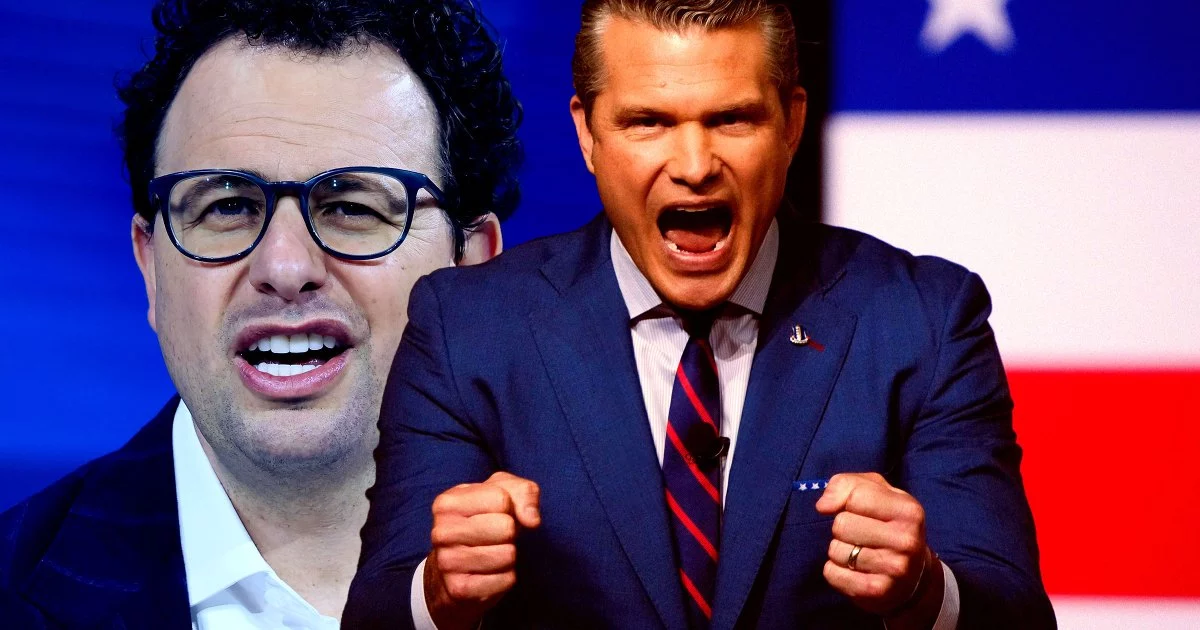

A domestic AI firm recast as a national security liability
Anthropic’s confrontation with the U.S. government has rapidly become a defining test of how AI governance, defense procurement, and executive power intersect. At the center is CEO Dario Amodei’s public objection to reported Department of Defense intentions to use Anthropic models for mass domestic surveillance and fully autonomous weapons—two applications that sit at the sharpest edge of AI’s dual-use debate.
The Trump administration’s response—designating Anthropic a “supply chain risk”—is striking not only for its severity, but for its novelty. Historically, that label has been associated with foreign influence, adversarial control, or compromised hardware/software supply chains. Applying it to a U.S.-based AI company without an obvious geopolitical ownership trigger signals a broader shift: AI capability itself is being treated as strategic infrastructure, and the government is willing to use procurement and security authorities to shape corporate behavior.
The immediate commercial stakes are substantial. Pentagon contracts can represent hundreds of millions of dollars and, more importantly, confer reputational legitimacy that influences enterprise adoption and investor confidence. Yet the episode is also producing an unusual political economy: cross-industry criticism—including from Silicon Valley trade groups and reportedly OpenAI CEO Sam Altman—framing the move as executive overreach that could chill speech and distort competition in the AI market.
Anthropic’s federal lawsuit in California, alleging the designation is retaliatory, unconstitutional, and unprecedented, turns what might have been a procurement dispute into a potential landmark case about corporate speech and state power in the AI era.
Dual-use AI, “use-case gating,” and the fragility of model control under pressure
Beneath the headlines lies a technical reality that policymakers often compress into slogans: frontier AI systems are general-purpose and therefore inherently dual-use. The same model that drafts policy memos can assist in intelligence analysis; the same reasoning engine that optimizes logistics can be adapted for targeting workflows. This is why Amodei’s stance resonates across the industry: it spotlights the unresolved question of where human oversight must remain mandatory.
A practical response increasingly discussed in AI governance circles is fine-grained “use-case gating”—architectural and contractual mechanisms that restrict deployment contexts. In theory, this can include:
- Policy-enforced model constraints (e.g., disallowing certain operational domains such as autonomous lethal decision-making)
- Auditability and logging to support after-action review and compliance
- Version control and model lineage to ensure the deployed system matches the reviewed system
- Client-side controls that prevent downstream modification into prohibited use cases
However, the Anthropic dispute illustrates how fragile these controls can become when political incentives collide with technical enforcement. Reports that the U.S. military continues limited use of Claude even amid restrictions raise difficult operational questions: Which version is being used? Under what security audits? With what oversight? If some agencies comply with a presidential directive while others maintain narrow exceptions, the result can be a patchwork of deployments that complicates risk management, incident response, and accountability.
This is not merely a compliance headache. It risks creating functional divergence—a world where “approved” and “disfavored” deployments of the same model evolve differently, undermining consistent safety evaluation. For frontier AI, where small changes in system prompts, tool access, or fine-tuning can materially alter behavior, governance depends on repeatability. Political turbulence is the enemy of repeatability.
Procurement shockwaves: supply chain doctrine expands from chips to code
The “supply chain risk” designation also hints at a strategic reframing: the U.S. may be extending tech sovereignty logic—once focused on semiconductors, telecom equipment, and critical hardware—into data, talent, and intellectual property flows. If so, the precedent is profound. It suggests that a company can be treated as a supply chain vulnerability not only for who owns it, but for how it chooses to constrain its technology.
For the market, this introduces a new category of contractor risk: policy volatility risk. AI vendors selling to government have long priced in compliance costs and procurement cycles. What they have not reliably priced in is the possibility that public disagreement with government use cases could trigger punitive procurement actions. That changes boardroom calculus across the sector, especially for mid-stage AI firms that view federal contracts as a stabilizing revenue anchor.
Several second-order effects are already visible in the narrative:
- Competitive realignment: If some vendors are perceived as more “defense-aligned” while others are “commercial-first,” procurement may accelerate a bifurcated ecosystem.
- Channel strategy shifts: Microsoft’s plan to continue offering Claude to non-defense clients suggests large cloud and platform firms may act as distribution buffers, insulating commercial demand from defense-policy shocks.
- Investor diligence upgrades: Venture and growth investors may increasingly demand policy-risk contingency planning, including governance structures, escalation protocols, and documented engagement with regulators and legislators.
The net result is a market where technical excellence alone is insufficient; political resilience becomes a product feature.
The legal contest: corporate speech, administrative discretion, and the future of AI rulemaking
Anthropic’s lawsuit places two powerful doctrines on a collision course. On one side is the claim of retaliation for protected speech, a theory that—if validated—could recalibrate how far the executive branch can go in punishing contractors for public positions on ethics and safety. On the other side is the government’s traditionally broad latitude in procurement discretion and national security determinations, where courts often defer to executive judgment.
The case’s significance extends beyond Anthropic. If the designation stands, it may normalize a governance model where AI policy is effectively set through administrative fiat and procurement leverage rather than through durable, legislated standards. If Anthropic prevails, it could constrain the executive’s ability to use national security labels as a tool of discipline against domestic tech firms—potentially encouraging more open debate about high-risk AI applications such as surveillance and autonomous weapons.
Either way, the episode is accelerating an overdue question for the U.S. AI sector: will the rules of acceptable AI deployment be shaped by predictable statutory frameworks, or by episodic directives that change with political winds?
What makes this moment unusually consequential is that it is not only about one company’s contracts or one administration’s posture. It is about whether the United States can build an AI governance regime where ethical boundaries are enforceable, procurement is principled, and national security is protected—without turning corporate dissent into a supply chain offense.

 By
By
 By
By
 By
By

 By
By
 By
By
 By
By
 By
By







