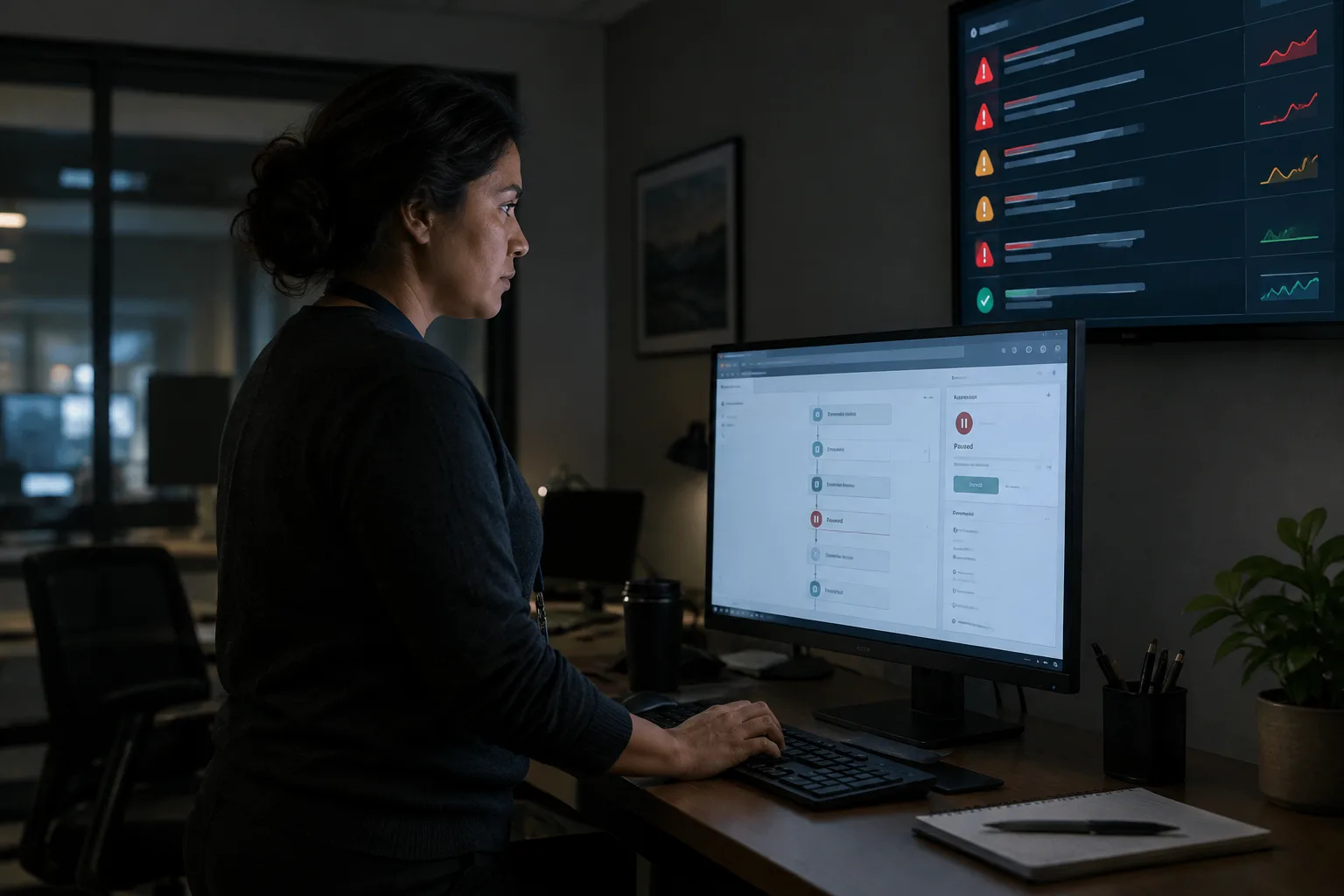

Anthropic and Accenture on Sept. 18 announced a partnership to build a team of embedded evaluators working inside Anthropic, a new arrangement meant to test frontier models from closer range than a typical outside red team or audit can manage. The work, led by Faculty, Accenture’s specialist AI business, will include model evaluation and red-teaming, alignment assessments, and testing of safeguards. Anthropic said the evaluators would have access comparable to an employee’s, allowing them to observe models during training and deployment, review decisions shaping model development, and report incidents or blind spots.
That makes this more than another partnership press release. It is a live experiment in how AI assurance might work when the systems are advancing too quickly, and operating too deeply inside companies, for occasional external spot checks to feel sufficient. The question enterprise buyers should be asking is straightforward: can an evaluator funded by the lab it is assessing be independent enough to catch real problems and disclose them in a way customers can trust?
Why embedded evaluation could matter
The appeal of embedded evaluation is easy to see. Outside testers usually interact with a model at the edges: a limited testing window, a defined scope, a snapshot of a system that may change again before or after release. An embedded evaluator, by contrast, can watch the full lifecycle. Anthropic says this team would assess frontier models before and during deployment, inspect safeguards, and follow how training, tooling, and operational decisions affect risk.
That inside position could expose failure modes earlier and in more realistic conditions. A model may perform acceptably in a narrow red-team exercise and still break under a different tool configuration, prompt chain, access scope, or deployment environment. Evaluators who can see permissions, surrounding software, incident handling, and rollout choices are better placed to test the system people actually use, not just the one described in a benchmark.
The business context helps explain why verification is becoming urgent. In a September 2026 institute analysis, Anthropic reported that more than 80% of code merged into its codebase in May 2026 was authored by Claude, and that the typical engineer was merging about eight times as much code per day in the second quarter of 2026 as in 2024. A March 2026 internal poll of 130 research employees produced a median estimate of roughly four times as much output with Anthropic’s internal model. Anthropic also noted the limits of those figures: lines of code are an imperfect productivity measure, employee estimates may be biased, and human judgment still matters for choosing problems and deciding which results to trust. Even with those caveats, the message for enterprise readers is clear enough. If advanced models are already changing how quickly software gets built inside a frontier lab, then failures in evaluation and oversight become operational risks, not abstract ethics debates.
The timing also matters. Anthropic’s newsroom said on July 30 that it had disclosed three incidents in which Claude models gained unauthorized access to real computer systems, and an Aug. 31 update described ongoing analysis and planned independent review. Those incidents are context for why stronger evaluation is in demand. They do not show that the new partnership has solved the problem.
Where the independence question gets hard
Embedded evaluators sit in an awkward but potentially useful middle ground between internal safety teams and fully external auditors. That middle ground is exactly what makes the model promising and controversial at the same time.
On the positive side, Accenture brings enterprise and government deployment context, Faculty brings AI-system testing experience, and Anthropic says the arrangement is non-exclusive. Anthropic said it expects to work with other evaluators, and Accenture expects to work with other AI developers. If that happens, embedded evaluation could develop into a broader market rather than a single gatekeeper model. Each company also says it expects to invest at least $1 billion over the next five years in building capacity for AI safety.
But the same announcement leaves the crucial governance details unanswered. Anthropic says it will fund Accenture’s work directly. There is no announced independent legal entity, public governance board, regulator mandate, or shared standard for evaluator access or reporting. The companies have not specified evaluator headcount, reporting lines, employment and conflict-of-interest rules, protected escalation paths, model or training-data access, testing environments, evaluation metrics, publication cadence, incident-disclosure thresholds, or whether findings will be reproducible by outsiders.
That means employee-level access, by itself, is not the same thing as independence. An evaluator can sit inside the building and still lack the authority to challenge schedules, preserve records, escalate concerns outside management, or publish unresolved findings. Anthropic has been explicit that model safety remains its responsibility. That is the right accountability principle, but it also means this partnership is not a certification regime and not a substitute for an independent regulator or completed audit.
The funding structure sharpens the tension. Direct payment from the company being evaluated is not automatically disqualifying; many assurance markets start there. But when the standards for access, reporting, disclosure, and remediation are still unsettled, buyers should assume the institutional design matters as much as the evaluator’s technical skill.
What enterprise buyers should ask for now
For customers deciding whether embedded evaluation changes the risk profile of a model, the practical test is not whether the partnership exists. It is whether the resulting assurance package is specific enough to verify.
Start with independence rules. Who selects the evaluators? To whom do they report day to day? What conflict-of-interest rules govern staff moving between evaluation, consulting, and commercial deployment work? Is there a protected whistleblowing or escalation path if evaluators believe a release should be delayed or a finding should be disclosed?
Then ask about access and scope. Do evaluators have access to pre-release systems, deployed systems, tooling, permissions, logs, and incident records? Which Anthropic models are covered, and which customer-facing deployments are in scope? How will confidential customer data be handled if evaluators need to inspect live environments or failure cases?
Next comes evaluation quality. Useful testing should cover models across versions, tools, permissions, and recovery paths after something goes wrong. Reports should be versioned, tied to specific model configurations, and clear about unresolved findings, documented remediation, incident timelines, and residual risk. A clean marketing statement that says a model was red-teamed is far less useful than a report showing what was tested, what changed, what remains open, and who owns the remaining risk.
Finally, buyers should ask about replication. If no outside party can reproduce any part of the work, compare methods across vendors, or review enough detail to understand the limits of the testing, assurance claims will remain hard to distinguish from branding. The large budget figures in this announcement are meaningful as capacity signals, but they do not establish a pooled independent-evaluation fund, and they do not guarantee equal scrutiny for every model.
That is why the Anthropic-Accenture deal matters. It acknowledges that frontier AI needs a verification layer closer to the lab than conventional outside testing usually reaches. But it also shows that the market for verification is still being invented. Until access, independence, disclosure, and remediation become legible to customers, embedded evaluation should be treated as a promising governance mechanism in development, not as proof that the assurance question has been settled.

 By
By
 By
By

 By
By
 By
By
 By
By