
On Nov. 13, at about 3:30 p.m. Eastern, the Federal Aviation Administration imposed a nationwide ground stop after a technical problem in its FAA Telecommunications Infrastructure, or FTI, network destabilized communications and radar links used to manage traffic across the country. Departures resumed at 8:15 p.m., but the business fallout lasted much longer: the FAA says operators canceled about 12,462 flights on Friday, and recovery continued through the weekend as airlines unwound diversions, aircraft rotations, crew assignments, and stranded passenger itineraries.
That makes this more than an airline-delay story. It is a critical-infrastructure story about how a routine remote-site change can ripple through a shared national backbone. The reader’s real question is straightforward: how does the FAA replace obsolete telecommunications gear without turning a local upgrade into a nationwide stoppage? The early answer from this event is not that modernization should slow down. It is that modernization has to be architected so one site cannot take the wider system with it.
How a remote change became a national problem
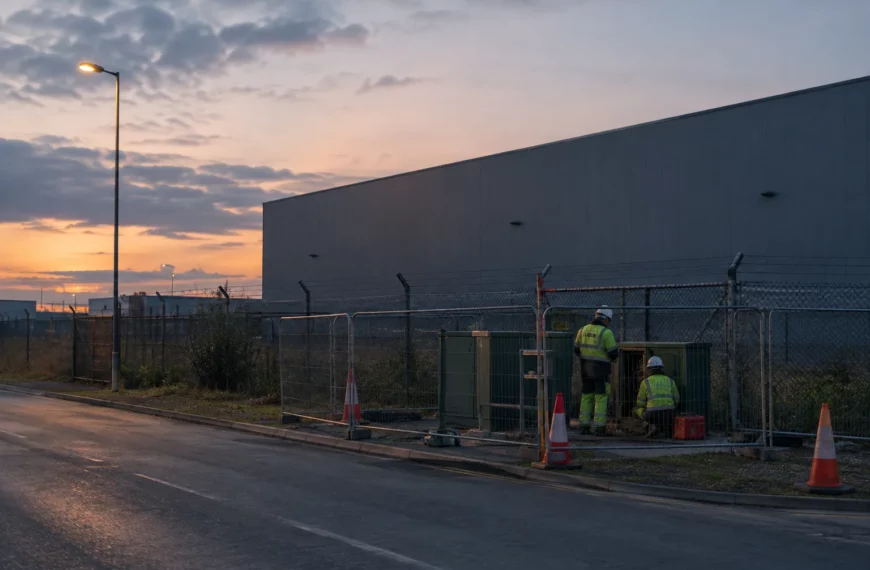
The FAA’s Nov. 15 question-and-answer page describes a network that became unstable when data flooded it at roughly 1,000 connection attempts every four to five seconds. The initial investigation identified two possible sources of that excessive traffic: a radar site in Amarillo, Texas, and a radio communications site in El Dorado, Arkansas, where L3Harris, the FAA’s network service provider, had been deploying a new router. The agency says blocking those locations stabilized the network, and it has since disabled the broadcast function on all new routers as a precaution.
The significance is in the architecture. FTI is the telecommunications layer that links remote radio and radar sites to the FAA’s 22 Air Route Traffic Control Centers and to terminal facilities that sequence arriving and departing traffic. If those links become intermittent, controllers can lose the predictability they need to hand aircraft from one sector to another at normal scale. That is why the FAA says it stopped departures nationally even though this was not a total loss of radar or radio coverage.
That distinction matters. Some frequencies and radar feeds remained reliable. Critical life-saving, law-enforcement, and military flights continued. About 3,500 aircraft already in the air landed safely using established procedures. The episode was serious precisely because it sat in the middle ground that operations leaders dread: not a total collapse, but enough instability across a shared network to make ordinary throughput unsafe.
The spread was broad. The FAA says instability reached 17 of 22 regional control centers and several Terminal Radar Approach Control facilities. In practical terms, that meant a problem at remote sites was no longer local. It was affecting the national system’s ability to maintain reliable communications, radar data flows, and controller handoffs.
Why modernization raised the risk
The Department of Transportation says the maintenance context was a long-running modernization effort: replacing obsolete copper telecommunications lines with fiber and moving from time-division multiplexing toward IP-based connectivity. Congress has approved $12.5 billion for the broader overhaul, and the need is not in dispute. Aging copper and legacy radio systems have to be replaced.
The harder lesson is that modernization can raise short-term operational risk if transition controls are weak. A new router or a new traffic pattern is not inherently unsafe. What matters is whether the change is isolated from production, whether abnormal traffic is rate-limited before it can spread, whether rollback can happen quickly, and whether backup paths are truly independent rather than tied to the same failure domain.
This incident is a case study in correlated failure. A remote-site change appears to have interacted with a shared network in a way that destabilized legacy equipment and propagated well beyond the work location. The FAA says maintenance commonly happens at night, but this work occurred during the day at a remote facility as part of a routine replacement process. That does not prove the timing caused the disruption, but it does sharpen the operational question: what safeguards were supposed to keep a routine daytime replacement from reaching the national backbone?
No cyberattack or outside nefarious actor is indicated, according to the FAA. That should calm one line of speculation, but it does not make the technology risk small. For critical-infrastructure operators, this is a reminder that change-control failures, traffic anomalies, and weak network segmentation can be just as disruptive as hostile activity. The FAA also says the broader SMART data-aggregator system was not involved, which narrows the field but does not yet settle the exact initiating cause.
The resilience tests that matter next
The public record still leaves important gaps. The FAA has not published a final root-cause report, the exact router configuration or software version, the detailed test and rollback procedure, or the precise reason traffic spiked to about 1,000 connection attempts every four to five seconds. It is still unclear whether the primary trigger was a contractor change, a limitation in legacy equipment, an interaction between old and new systems, or some combination.
Even with those unknowns, the operational scorecard is clear. Any restart of similar upgrades should answer a few concrete questions. Can a site be quarantined automatically before abnormal traffic spreads? Are broadcast controls and rate limits enforced by default on new equipment? Do regional centers have backup connectivity that does not share the same failure path? Can the network degrade gracefully, preserving more limited operations, instead of forcing a nationwide stop? And what recovery-time and blast-radius limits must vendors prove before a deployment is approved?
Those questions matter well beyond the FAA. Airlines, airports, cargo operators, tourism businesses, sports schedules, corporate travel managers, and supply chains all felt the cost of this outage, even though the public record does not yet quantify the total financial impact. Not every one of the 12,462 cancellations was directly caused by the ground stop, but the number shows how quickly a few hours of control-network instability can cascade into a multiday commerce problem.
The FAA’s immediate response — block the suspect sites, stabilize the network, disable the broadcast function on new routers, and continue the investigation — looks like the right emergency sequence based on what is known so far. The larger lesson is tougher and more durable. Replacing obsolete infrastructure is necessary, but it is not enough. In a shared national system, resilience depends on containing the blast radius of each change. If modernization concentrates risk instead of isolating it, the upgrade meant to strengthen the network can become the outage that proves it was never safely segmented in the first place.

 By
 By

 By

 By

 By