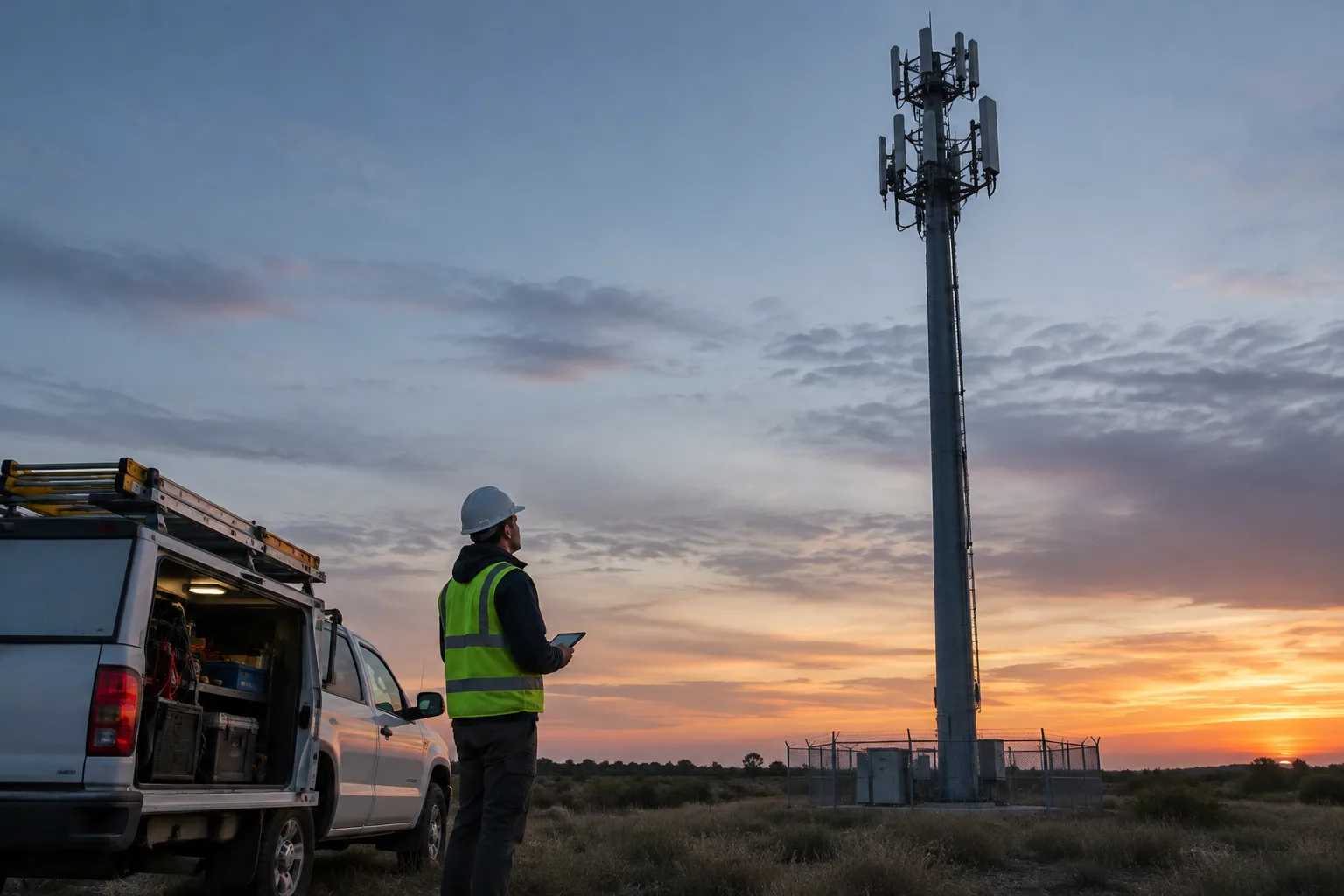

SpaceX has taken Starlink Mobile from broad wireless ambition to a concrete piece of telecom procurement. In a Nov. 4 announcement from Qualcomm, the chipmaker said SpaceX selected Qualcomm Dragonwing Cellular Infrastructure platforms for Starlink Mobile’s planned U.S.-wide terrestrial 5G network. Qualcomm says the first nationwide deployment is planned to begin in 2027, with tens of thousands of sites over the life of the agreement.
That matters because satellites alone do not make a mobile carrier. They can extend coverage, especially where conventional service is thin, but a competitive nationwide wireless business still depends on terrestrial radios, licensed spectrum, macro sites, baseband processing, backhaul, interconnection, device support, operations software, and regulatory compliance. This deal is about the ground layer that turns a space-based coverage story into something closer to an everyday network.
The central question is not whether SpaceX wants to challenge AT&T, Verizon, and T-Mobile. As The Verge reported, that is plainly the strategic target. The more useful question is whether a hybrid satellite-and-terrestrial model can deliver carrier-grade coverage and economics, or whether this is still best understood as a very large infrastructure order with most of the difficult execution work still unresolved.
Why this announcement is more than a vendor win
Qualcomm is supplying specific building blocks, not vague future support. The agreement covers Dragonwing QRU100 radio-unit platforms, QDU100 distributed-unit platforms, and commercial-grade Layer 1 software. Qualcomm says the planned network will use 64T64R Massive MIMO radios, a configuration meant to improve coverage, capacity, spectral efficiency, and performance per watt.
Those details matter because they point to a standardized, repeatable terrestrial build rather than a one-off technical experiment. Qualcomm also says the architecture is intended to support multiple rollout waves and future network intelligence, which suggests SpaceX is buying a platform it can scale and update, not just initial hardware for a pilot.
For Qualcomm, the agreement is notable in its own right. Reuters reported that financial terms were not disclosed and that Qualcomm described it as its biggest 5G deal yet. That expands the company’s role beyond the handset chips most people associate it with and further into telecom infrastructure, where it is competing for relevance alongside more established network-component suppliers.
For SpaceX, the significance is even larger. The company is no longer talking only about direct-to-cell service from orbit. It is assembling the terrestrial machinery that any serious mobile operator eventually needs.
Satellites extend reach. Towers create capacity.
The attraction of a hybrid model is straightforward. Satellites can cover wide areas and help fill gaps where building towers is costly or slow. Terrestrial 5G, especially on macro sites using Massive MIMO, is what carries dense, routine traffic in places where people actually use their phones most: suburbs, highways, office parks, towns, and cities.
In other words, satellites are powerful for reach; towers are essential for capacity.
That distinction is what makes this procurement consequential. If SpaceX can combine direct-to-cell satellite coverage with a terrestrial layer capable of serving everyday traffic, it could move from being an adjunct connectivity provider to something closer to a full-service wireless operator. The hybrid model also offers a cleaner strategic pitch than satellite-only mobile service: use space to eliminate dead zones, and use ground infrastructure to handle the traffic loads that make mobile service commercially viable.
This is where Qualcomm’s power-efficiency pitch becomes economically relevant. At the scale Qualcomm described—tens of thousands of sites—small gains in energy use, capacity, and deployment repeatability matter. They affect operating expense, site design, and how quickly a network can be expanded. A platform that uses less power per site and supports staged deployment could improve the odds that the buildout is financially manageable.
But design intent is not the same as field performance. Qualcomm’s claims about efficiency and throughput are architecture claims tied to the platform, not measured results from a live nationwide Starlink Mobile network.
The real scorecard is build versus borrow
The bullish case rests on unusually concrete facts for a project this early. There is a named supplier, a multi-year agreement, identified radio and baseband products, a 2027 rollout target, and a scale description large enough to matter in the U.S. market. The Verge also reported that SpaceX has acquired spectrum and explored additional tower or wireless assets, signs that this is not being treated internally as a side experiment.
That is enough to make Starlink Mobile more credible than a satellite-only concept. It is not enough to make it a credible fourth carrier yet.
The missing pieces are the expensive ones. Neither company has disclosed contract value, exact site count, locations, spectrum bands, tower-lease arrangements, backhaul partners, network-sharing terms, subscriber targets, retail pricing, or total capital spending. “Tens of thousands” describes ambition and scale, but it is not a public construction schedule.
The operational unknowns are just as important. The public record does not show how phones will move between satellite and terrestrial links, which devices will be supported, how customer service will be organized, or how emergency-service and lawful-intercept requirements will be handled. Those are not side issues; they are part of what separates a connectivity demonstration from a regulated, dependable carrier.
Incumbents also start with structural advantages SpaceX does not automatically have: entrenched spectrum positions, tower relationships, retail distribution, network operations teams, and large installed subscriber bases. SpaceX may be able to buy, lease, or partner its way around some of those gaps. It may also discover that a hybrid network combines two capital-intensive systems instead of simplifying either one.
That is why the smartest way to read this deal is as a threshold event. It confirms that SpaceX’s mobile ambitions have reached the stage where terrestrial telecom hardware is being lined up at national scale. It does not yet prove that the company can deliver the coverage, economics, or consistency consumers expect from a primary wireless provider.
What happens next will be less glamorous than the announcement itself: spectrum filings, site permits, tower leases, backhaul arrangements, device certification, construction milestones, and evidence that the terrestrial layer materially improves service rather than simply enlarging the marketing promise. If those pieces start to appear, Starlink Mobile will look more like an emerging carrier. If they do not, this week’s news will read mainly as a large procurement attached to an unproven business model.

 By

 By

 By
 By



 By

 By