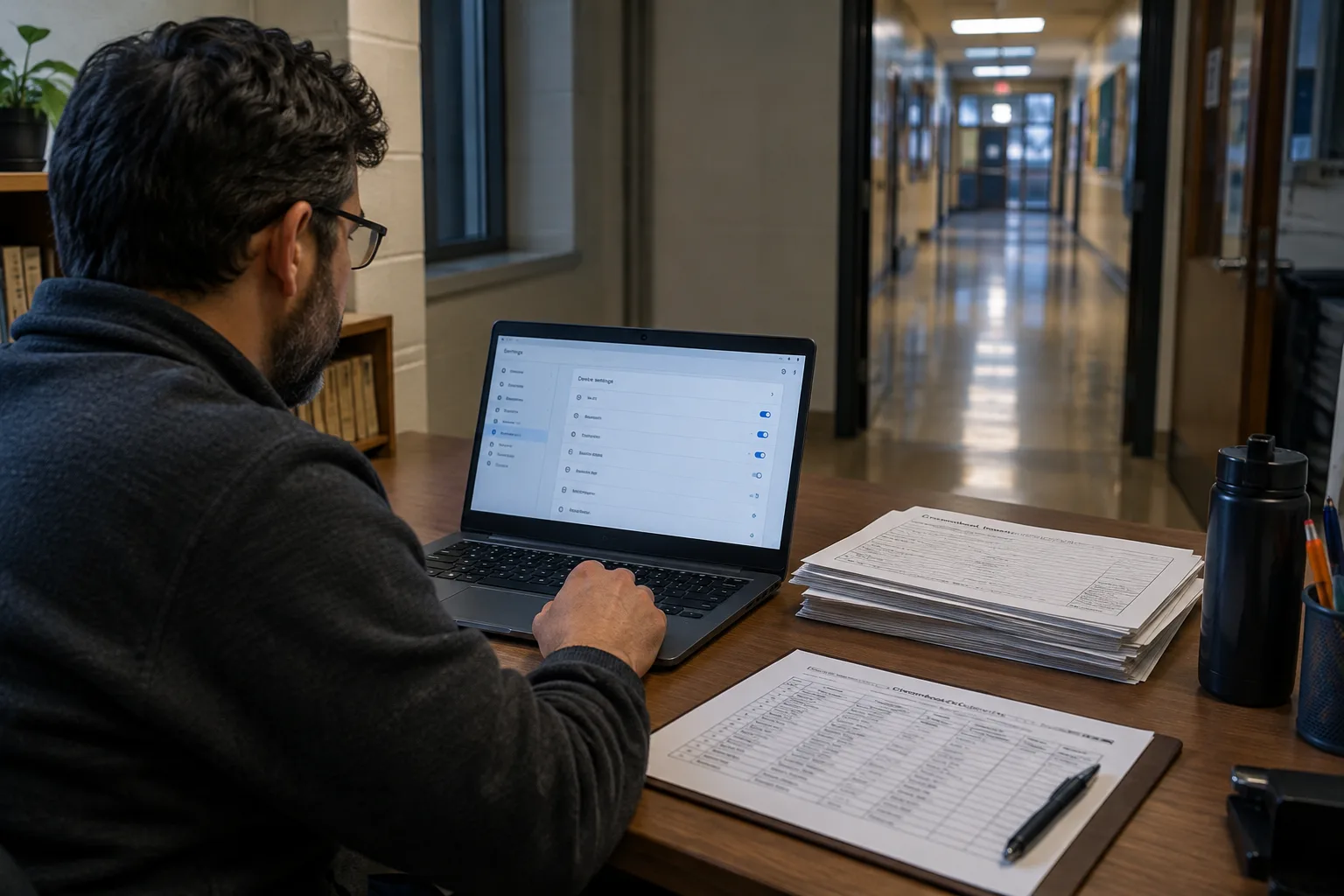

Google has reset its school AI posture after a messy summer. In a November 3 update, Google said K–12 student access to Gemini, Gemini Notebook, Gemini in Classroom, and Google Search will be off by default until school administrators explicitly turn those products on. At the same time, Google is expanding Guided Learning — its step-by-step tutoring mode — into Classroom now and into a Search pilot in selected U.S. schools later in November.
That matters because Google is not just adding another classroom feature. It is redrawing the control panel for a school technology stack that already includes school-managed accounts, Classroom, Chromebooks, and, in many districts, everyday search. The question school leaders, teachers, and parents actually need answered is not simply whether AI tutoring sounds useful. It is whether Google’s new default-off policy gives districts a usable boundary around student AI access, or whether the company has bundled that decision tightly enough that opting out carries the cost of losing a familiar service.
A real concession after August — but only a partial one
On its face, the move is a meaningful retreat from Google’s August expansion of Gemini access for many K–12 students, which drew pushback from educators and child-development advocates. In Google’s announcement, Chris Phillips, the company’s vice president and general manager of Education, framed the change as a response to schools asking for more control.
That part should not be dismissed. Default settings matter, especially in education. In practice, “off until an administrator enables it” reduces accidental exposure for younger students, restores a familiar chain of authority, and gives districts time to write policy before features reach children. For a sector where age, privacy, cheating, teacher oversight, and developmental fit are all live concerns, moving the switch from default-on to administrator opt-in is a substantive policy change.
Google is also trying to improve the form AI takes when schools do allow it. Guided Learning in Classroom is globally available starting November 3 when a teacher assigns it. Instead of spitting out a final answer, it is supposed to keep students in what educators call productive struggle, using prompts and questions tied to class material. Teachers can see real-time signals about where students are getting stuck. In Search, Google says some homework-help requests will trigger the same kind of walk-through rather than answer extraction, with a pilot beginning later in November in selected U.S. schools and broader district expansion later.
That is a plausible response to one of the biggest criticisms of student AI use: that chatbots flatten learning into shortcut-taking. If Guided Learning really shifts the interaction from answer vending to coached reasoning, it could be more defensible than a generic assistant dropped into school accounts.
Why the Search link changes the story
The harder issue is what happens when a district decides the answer is still no.
As The Associated Press reported, school systems that opt out of AI altogether may also lose access to Google Search. That is the operational detail that turns a product update into a governance story. Search is not usually treated by districts as an optional enrichment tool. It is part of the basic utility layer of school computing.
Important limits remain. Google has not published the exact product-level behavior, so it is not yet clear how Search works when AI is disabled, whether a district can keep a conventional search experience without enabling Gemini-related features, or how fine-grained the administrator controls will be. It would be wrong to say that disabling any single AI feature automatically removes Search. But the AP-reported linkage is enough to raise the central practical question: can schools refuse Google’s AI stack without giving up something they already depend on?
That question lands differently because of Google’s position in education. When the same company provides the account system, the classroom hub, many school-issued devices, and now the AI settings that may govern search, a default-off policy is only part of the governance picture. The real issue is whether districts are being offered separate decisions for separate tools, or one bundled decision with different names on the tabs.
This is also why the story matters beyond districts already eager to try AI tutoring. New York City and Los Angeles have temporary restrictions on generative AI in some elementary and middle-school settings while they assess safety and policy, according to AP. For cautious districts like those, the choice is not merely pedagogical. It is operational and procurement-related.
What meaningful school control would require
The new setup will deserve the label “control” only if the controls are usable, legible, and separable.
Districts should want per-product opt-in rather than one broad consent to an AI-enabled environment. They should be able to tell, plainly, what data is collected in Guided Learning, how long it is retained, whether it is used for model training, how administrators can audit use, and what happens when the system gives a wrong or harmful response. Schools also need clarity on teacher override, parental visibility, age handling, incident response, and what records they can export if they later leave the platform.
Google has not yet supplied many of those implementation details. It has also said its research shows measurable learning gains from Guided Learning, but the announcement does not come with a new independent evaluation showing how the approach performs across age groups, subjects, languages, or disability accommodations. That does not mean the product fails. It means districts should treat the learning case as promising but unproven outside Google’s own claims.
The practical next step for school buyers is simple: test the admin workflow before adopting the rhetoric. See whether each product can be enabled independently. Compare Search with AI disabled versus enabled. Run Guided Learning alongside ordinary instruction, not just against a worst-case baseline. Make sure teachers can see what students are seeing. And keep an exit plan for assignments, telemetry, and student records.
Google says 150 million students and teachers use Classroom worldwide, a company figure cited by AP. That scale is exactly why the default-off announcement is important — and why it is not enough on its own. In education, the most consequential switch is rarely the one on stage. It is the one in the admin console that determines whether a school can say no without breaking something else.

 By

 By


 By



 By

 By