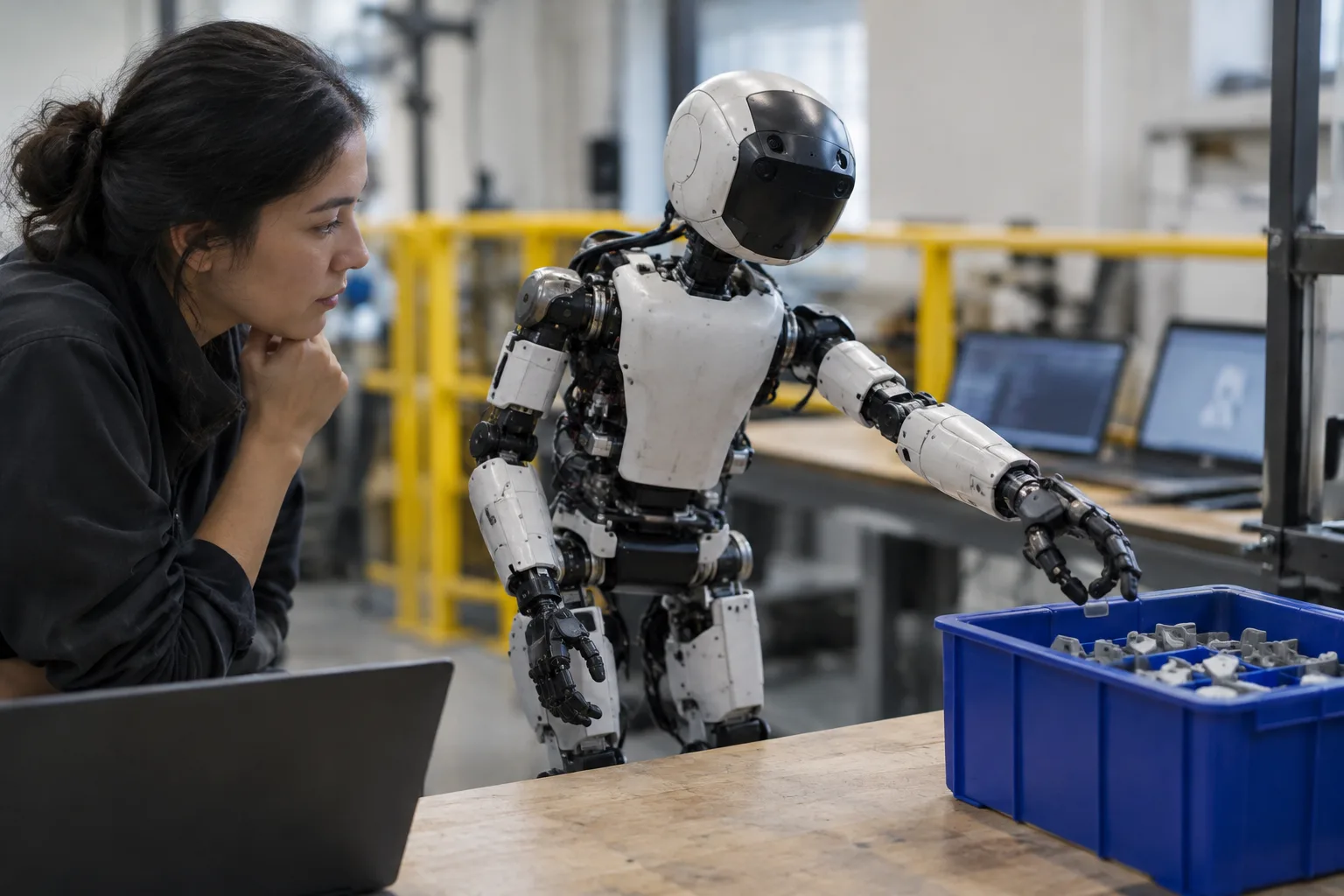

NVIDIA used GTC Berlin on Oct. 21 to widen Isaac from a robotics toolkit into a more opinionated pipeline for building humanoids. The company added the open-source Isaac OS runtime, Isaac Lab 3.0, reference workflows, simulation assets, human-motion data and a reference humanoid, Agile Robots’ Agile ONE SN. The move matters because it goes after robotics’ least glamorous bottleneck: integration. Labs and industrial teams can now buy into a single path from demonstration capture to simulation, training and deployment instead of stitching together incompatible parts.
That makes the real question less cinematic than the debut of a new humanoid. Does a standardized Isaac stack lower the time and cost of useful experimentation enough to accelerate real deployments, or does it mainly relocate the complexity inside a deeper NVIDIA-controlled platform?
What NVIDIA actually packaged
In its GTC Berlin announcement, NVIDIA described Isaac OS as an open-source runtime built on Holoscan for connecting AI models, sensors, controls and robot hardware. Isaac Lab 3.0, already generally available, is an open-source learning framework for multi-GPU robot-policy training using Newton and PhysX. The SimReady Central Library now offers more than 2,000 robotics and factory assets for simulation, and NVIDIA is releasing three DGX Station workflows covering reinforcement learning with GR00T, dexterous-manipulation training and Cosmos-based synthetic-data generation using ChatGPT Astra.
The hardware piece is more tentative. Agile ONE SN is a reference humanoid aimed at research, not a shipping industrial worker. NVIDIA says the robot stands 1.40 meters tall, weighs 40 kilograms, has 31 body degrees of freedom, dual five-finger hands with 20 degrees of freedom each, a 3-kilogram payload per arm, multimodal cameras and lidar, and Jetson Thor onboard compute rated by NVIDIA at 2,070 FP4 teraflops with 128 GB of unified memory. Availability is scheduled for early 2027. Agile Robots’ own announcement matches the research focus but lists the body weight at 43 kilograms, not 40, a small but telling discrepancy that has not yet been reconciled.
That split status matters. Buyers can use Isaac Lab 3.0 now. They cannot yet evaluate the reference humanoid as delivered hardware, and the announcements do not say what it will cost, how many units will be available or how quickly they can be produced.
Why this could matter more than a robot demo
Humanoid robotics is often presented as a model problem: train a better policy, add a better foundation model, and the machine gets smarter. In practice, the drag is frequently elsewhere. Teams must collect demonstrations, prepare simulation assets, train and tune policies, connect sensors and controls, run evaluations, move skills onto physical hardware and then figure out what breaks outside the lab.
NVIDIA’s expansion is significant because it tries to compress that full workflow. A preconfigured body, hands, sensors and onboard compute tied to a common runtime and learning stack can reduce the custom engineering normally required just to start an experiment. Common assets and a shared reference robot can also make results easier to compare across labs. That is useful even if the robot is only a research platform: the faster a team can move from setup to repeatable trials, the easier it becomes to judge whether a task is worth automation at all.
The partner list points in the same direction. NVIDIA named ABB Robotics, KUKA, Sereact, Universal Robots, Agility, Dexory, FORT Robotics and KION among the companies working across robotics and industrial use cases. That breadth does not prove production deployment, but it does suggest industry interest in a more standardized “data to deployment” path.
Where the bottleneck may simply move
The strongest case against overreading the announcement is timing and access. The most concrete new hardware is planned for early 2027. The Human 1M Dataset includes synchronized three-view video, varied human activities and 3D hand tracking, but full access is limited to Cosmos Coalition partners. And while Isaac OS and Isaac Lab are open source, the practical path NVIDIA is sketching still leans heavily on Jetson Thor, DGX and the wider Isaac and simulation ecosystem.
That creates a familiar tradeoff. Standardization can lower the cost of experimentation, but it can also deepen dependence on one vendor’s compute, tools and interfaces. In robotics, that matters because the expensive part of a pilot often arrives after the first demo: maintaining the system, validating it for a live environment, securing the networked components, training operators and documenting predictable behavior when the robot encounters an unexpected state. Open components help, but they do not erase platform gravity or the work of safety validation.
The bigger commercial unknown is transfer. NVIDIA is offering a compact research humanoid, not evidence that skills learned on that system move cleanly to a full-size industrial robot or to an operating factory cell. The announcements do not provide benchmark results, intervention rates, training cost, task success rates, delivered units, customer contracts or live productivity data. They also do not quantify the claimed reduction in setup time or show how Isaac Lab 3.0 policies compare with alternatives on a common denominator.
For labs and industrial teams, then, the most useful way to read this launch is as infrastructure packaging for physical AI. It may well save engineering time at the front of the process, which is not trivial. But the test for 2027 will be practical and unglamorous: how long it takes to stand up a pilot, what the full hardware and software bill looks like, how often the robot completes a task without intervention, whether it can recover from unexpected states, how well policies transfer from simulation to the physical machine, what safety-case evidence is required, and how portable the data and models remain if a team wants to leave the stack later.
If NVIDIA can make those answers more repeatable and more economically legible, Isaac’s expansion could do more for general-purpose robotics than another polished stage demo. If not, the company will have addressed a real integration problem mainly by inviting the industry deeper into an NVIDIA-shaped one.

 By

 By
 By
 By



 By