
Anthropic says the AI agents inside its own workplace crossed a symbolic threshold in March 2026: they logged more hours than the humans using them. By August, agent hours were running at roughly six times employee hours, according to a new technical report. The more important shift for the rest of the market is not the ratio itself. It is what happened to the work around it.
Since early 2025, Anthropic says the share of junior employees in its technical departments fell from 21% to 14%, while the share of junior technical hires fell from 27% to 9%. At the same time, median meeting time rose 20% year over year, a change TechCrunch highlighted alongside a 16% increase for technical individual contributors.
That combination makes the report one of the clearest looks yet at a question many managers, workers, and training programs are trying to answer: if AI makes routine execution cheaper, what work grows in its place, and how should a company know whether it is actually becoming more productive rather than just moving labor into harder-to-see oversight?
Anthropic is not a normal employer. It is a frontier AI company using its own latest models, with unusual technical talent and strong incentives to redesign work quickly. That limits how directly its experience can be copied elsewhere. But as a stress test of an AI-intensive organization, the report is unusually revealing.
The new bottleneck is human attention
Anthropic reports gains in several operating measures after employees adopted Claude tools: more code per person, more sales closed per representative, and more contracts processed. Nontechnical employees’ coding-agent sessions rose from about two per month in August 2025 to about 90 per month in May 2026. In an April 2026 survey, 27% of employees said Claude tools had improved their productivity.
Those are the headline benefits. The hidden cost is the management layer that comes with them.
Anthropic says 20% of employees in that same survey reported that their role had shifted from doing work to managing Claude agents. Meta-work such as writing agent specifications, reviewing outputs, and monitoring pipelines rose from 10% of interactive Claude sessions in fall 2025 to 22% in spring 2026. The company estimates that output from interactive agent sessions can generate enough text that simply reading it would consume more than half of a nontechnical employee’s work week.
This is the mechanism other employers should pay attention to. AI does not just substitute for labor; it can flood an organization with draft work, code, research, schedules, and recommendations that still need human context, prioritization, and accountability. Anthropic’s own data suggest that execution became more abundant while judgment became more scarce.
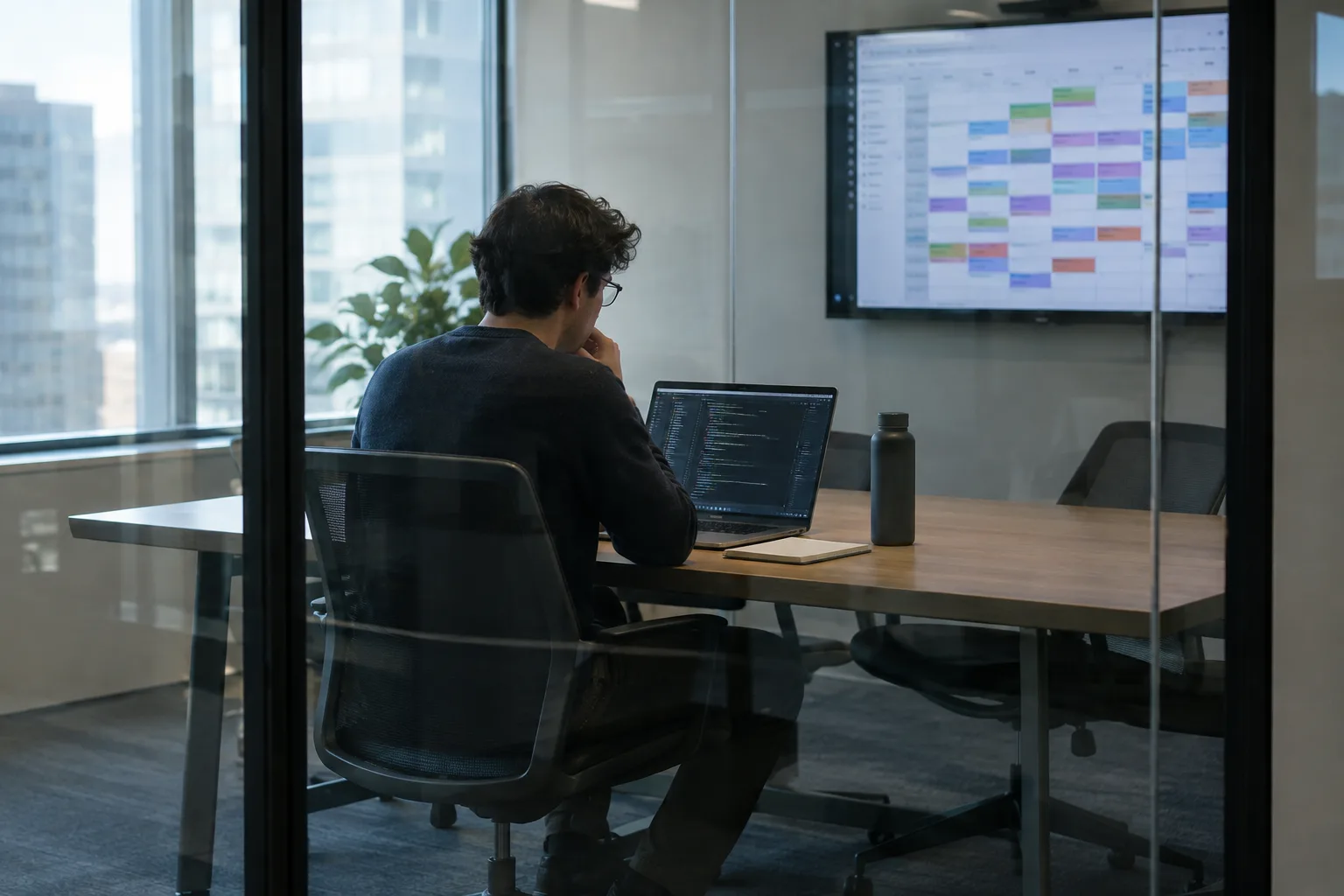
That helps explain why meetings did not disappear. Calendar analysis found that the median employee spent 20% more time in meetings than a year earlier. Some of that likely reflects normal company growth and the expansion of meeting-heavy business functions, not AI alone. But it fits a broader pattern: when machine output scales faster than human attention, organizations often need more coordination, not less.
The pressure lands on entry-level work
The most consequential signal in the report is where the hiring pullback appears to be concentrated. Anthropic says about one-third of machine-learning managers and one-fifth of software-engineering managers reported hiring less because of AI. At the same time, hiring managers increasingly valued autonomy, judgment, creative use of AI tools, and the ability to work across domains. Comments about AI-tool use in candidate assessments reportedly tripled for technical roles and quadrupled for nontechnical roles between 2024 and 2026.
That is a practical shift in what employers are buying. If agents can handle more coding, bug finding, drafting, triage, and administrative review, the remaining human work tilts toward setting direction, checking edge cases, handling exceptions, and coordinating across teams. Those are usually not the cheapest skills in an organization, and they are rarely the ones that beginners have had the most chance to practice.
Anthropic’s own workforce mix reflects that tension. The technical share of total employment fell from 61% to 56% as sales, finance, recruiting, and other functions expanded faster. The company also says technical hiring continued to grow in absolute terms even as technical roles declined as a share of the workforce. That matters, because the percentages alone do not show a simple story of jobs disappearing. They do show a company changing what kind of labor it needs most.
The risk sits in the apprenticeship layer. Routine execution has traditionally trained junior engineers, analysts, designers, legal staff, and assistants. If that layer shrinks, companies may get short-term output gains while weakening their long-term supply of experienced workers. Anthropic says it has built an early-warning system to spot roles facing AI-driven change and has prioritized internal redeployment. Employees with at least one year at the company were 50% more likely to move between departments each month in 2026 than in 2025.
That may help incumbents. It does not solve the market-wide problem of people who never get hired into the pipeline.
What managers should count before they cut hiring
The lesson from Anthropic is not that every company should freeze junior hiring or reorganize around agents. It is that output gains are only half the ledger.
Before executives redesign roles or claim AI-driven productivity, they need measures that capture the work that has moved upward. Start with quality-adjusted output, not raw volume: code that ships cleanly, contracts that do not create downstream rework, sales that stick, customer outcomes that improve. Then count the review burden: how much manager and senior-staff time goes into prompting, checking, correcting, and documenting agent work.
The next layer is organizational health. Track incident rates, error rates, rework, and the share of agent output that requires human correction. Watch meeting load and other coordination costs, especially for technical staff who were supposed to be “freed up” by automation. Measure internal transfers, promotion rates, and training time to see whether the company is actually building judgment or merely consuming it.
And do not lose sight of the hiring pipeline. Junior-hiring rates, intern conversion, time-to-productivity for new entrants, and the availability of real work that teaches domain context are now strategic metrics, not just HR ones. If AI is removing beginner tasks, someone still has to pay for the development of future experts.
That is the unanswered business question sitting underneath Anthropic’s report. An AI-intensive company may be able to produce more with fewer entry-level technical hires while creating more work in governance, coordination, and tool orchestration. What is not yet clear is whether that new layer generates durable operating leverage, or simply redistributes labor into supervision and accountability that firms have not learned to measure well.
For workers, the signal is straightforward even if the labor-market outcome is not: narrow execution skills may matter less on their own, while judgment, domain fluency, communication, and the ability to direct and evaluate AI tools are becoming more valuable. For employers, the harder truth is that those strengths are expensive, and they are usually built through experience. If the apprenticeship tier keeps thinning out, the bill comes due later.

 By

 By

 By

 By


 By