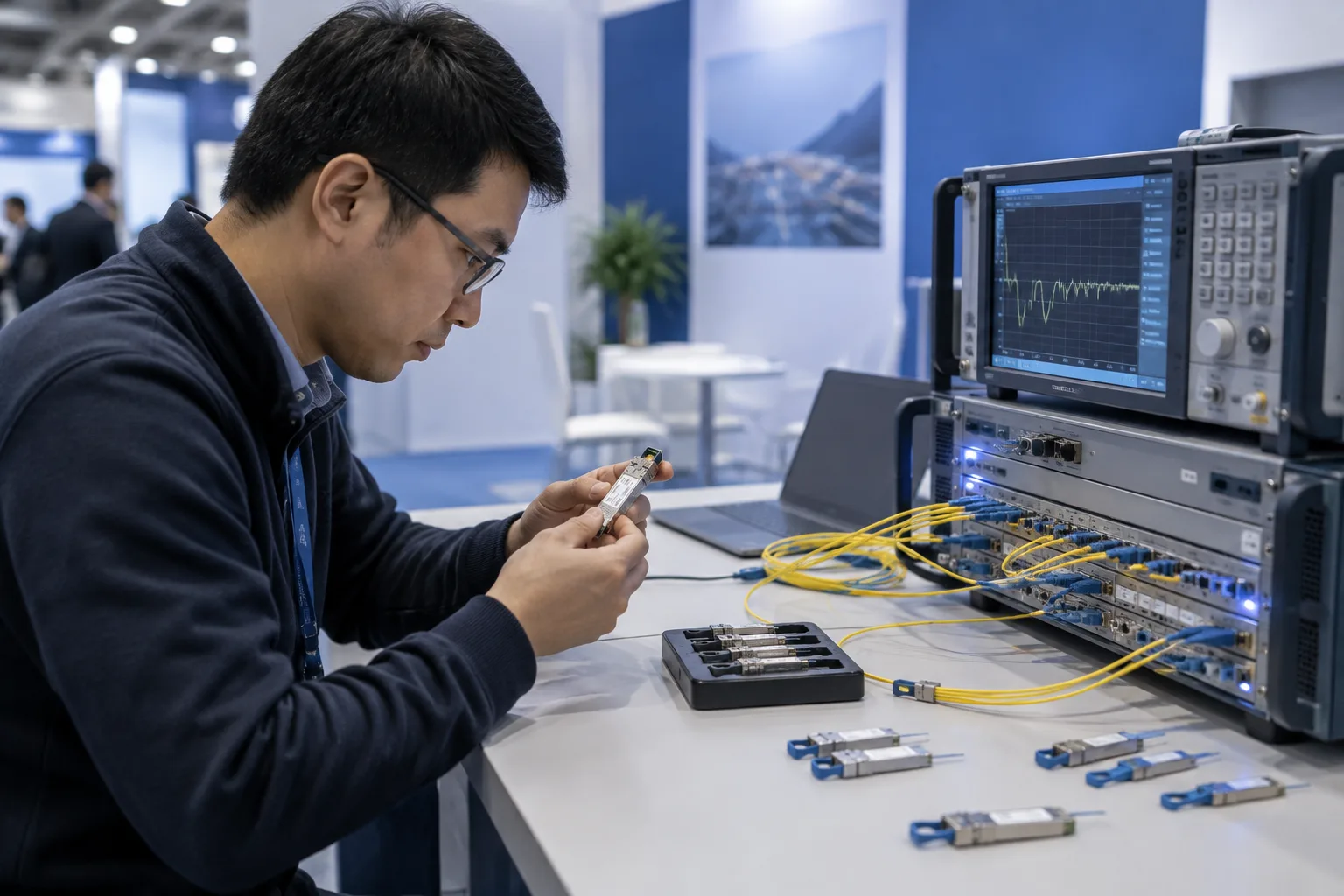

Marvell arrived at ECOC 2026 with a broad optical pitch for the AI data center: 38 demonstrations, including what it calls the first 2nm 400G-per-lane optical PAM4 demo, a live 2nm 800G ZR/ZR+ pluggable with MACsec, 2nm 1.6T ZR and coherent-lite O-band demonstrations, and a 102.4-terabit-per-second co-packaged-optics platform using 200G-per-lane silicon photonics. The immediate significance is clear. AI clusters are running into networking limits as fast as they run into compute limits, and Marvell wants to show it has a path from today’s 1.6T links toward 3.2T connectivity.
The harder question is the one buyers actually care about: do these demonstrations show a deployable path to AI-factory networking at the next speed tier, or do they mostly shift the bottleneck to interoperability, thermal design, qualification and cost? On the evidence Marvell has put forward, the answer is mixed. The portfolio looks like a meaningful component roadmap. It is not yet the same thing as volume-ready infrastructure.
What Marvell is actually showing
In its ECOC 2026 announcement, Marvell framed this year’s lineup as the next step in a progression it has been building for several years: 5nm 200G-per-lane 1.6T Nova DSPs in 2023, a 3nm 1.6T Ara platform in 2024, and 2nm 800G Libra DSPs announced earlier in 2026. That arc matters because it shows the company is not presenting 2nm optics as a one-off lab stunt. It is trying to establish continuity from SerDes and DSP development through pluggables, coherent links and co-packaged optics.
Each part of the lineup targets a different piece of the AI-networking problem. PAM4 increases the amount of data carried per optical lane. Coherent ZR and ZR+ serve longer reaches. Coherent-lite is aimed at shorter or intermediate reaches. MACsec, included in the announced 800G design, brings link-layer encryption into the performance conversation. Co-packaged optics moves optical components closer to accelerator and switch silicon, which is why it is being watched closely as port speeds keep rising.
That range is one reason the announcement deserves attention. Marvell is not only chasing a bigger single number on a booth placard; it is trying to show relevance across the stack that links accelerators, switches and fiber plant inside and between AI clusters.
But it is still a demonstration slate. Marvell did not say these are all shipping products, did not identify which systems are prototypes versus engineering samples versus productized designs, and did not provide the operating details that turn a technology milestone into a procurement decision.
Why this matters to AI factories
For AI infrastructure operators, networking is no longer a background line item. Large clusters depend on moving data among accelerators, racks and switching layers without turning expensive compute into idle silicon. Optical links matter here because they can carry more bandwidth over distance than copper, but higher optical speeds do not automatically make a data center cheaper or easier to run.
That is why the 2nm claim is important but incomplete. A smaller process node can help enable new bandwidth targets, yet it does not by itself settle the questions that dominate deployment: transceiver cost, thermal behavior, fiber requirements, switch compatibility, manufacturing yield, reliability and serviceability. A live booth demo proves a design can be shown under selected conditions. It does not prove the design can be qualified across a fleet, produced at scale, or supported economically over time.
The same caution applies to the 102.4T co-packaged-optics platform. It is a notable signal that Marvell sees co-packaged optics as part of the route from 1.6T toward 3.2T-era AI connectivity. It is not, on the information released, a complete description of a production AI system. Buyers still need to know how that figure maps to switch designs, thermal envelopes, field service models and failure domains.
MACsec is another example of why the details matter. Link-layer encryption is increasingly relevant in modern infrastructure, but operators will want to test what it does to power and latency in real deployments, not just whether it can be demonstrated on stage.
Where the proof burden shifts next
The cleanest way to understand Marvell’s announcement is to compare a component milestone with a network milestone. At the same event, the Ethernet Alliance’s ECOC 2026 demonstration spans 400G, 800G and 1.6T Ethernet, 224G SerDes, link training, and an 800G lossless link using Link Layer Retry and Credit-Based Flow Control, with participation from multiple vendors across switches, modules, cables and test platforms.
That contrast is the real industry story. Faster DSPs and optical engines are necessary, but they are only one part of an AI-factory network. The burden now shifts to interoperability across vendors, firmware maturity, standards alignment and operational fit at rack and cluster scale. As speeds climb, the limiting layer can move from raw component capability to the less glamorous work of qualification and integration.
Marvell’s announcement leaves several buyer-grade questions open. There are no published measurements for power per bit, latency, bit-error rate, thermal envelope, optical reach or test duration. The company did not disclose manufacturing yield, production schedule, pricing, named customers or qualification status. It also did not explain how far along each demonstration is on the path from roadmap to revenue hardware.
Those omissions do not invalidate the technology. They define the next stage of scrutiny. For operators and system designers evaluating 1.6T-to-3.2T roadmaps, the practical checklist is straightforward: compare solutions at rack and cluster level rather than module level; verify switch, firmware and fiber compatibility; test MACsec’s impact on power and latency; and separate an impressive public demo from hardware that is actually qualified for fleet deployment.
So Marvell’s ECOC showing should be read as a strong signal that optical interconnect is becoming a central competitive layer in AI infrastructure, and that 2nm is now part of that race. It should not be read as proof that the economics and operations are solved. The company appears to be moving the state of the art forward at the component level. The market still has to prove that those gains survive contact with multi-vendor networks, thermal limits and production reality.
 By
By
 By
By
 By
By


 By
By

 By
By