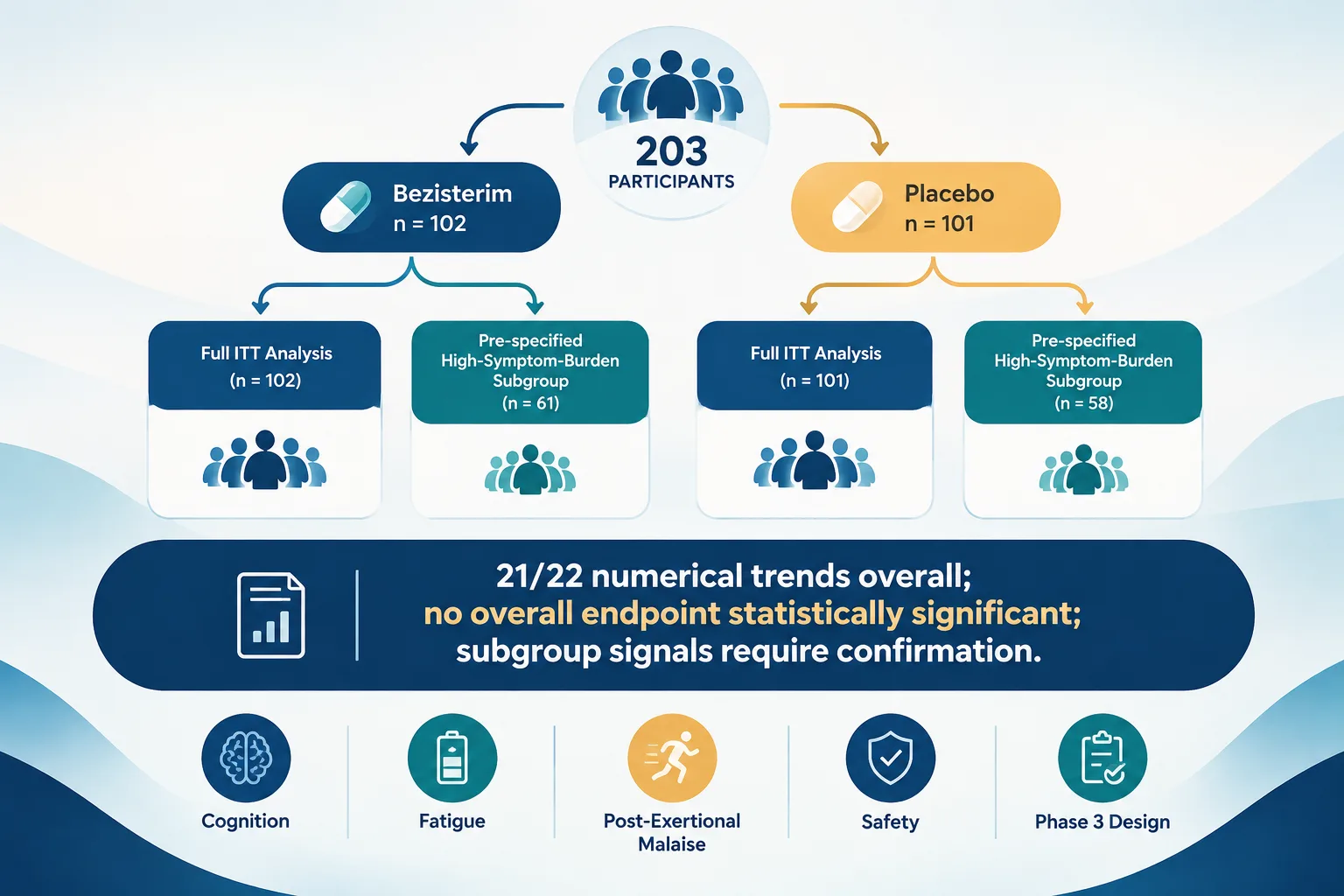

BioVie has delivered the kind of Long COVID readout that can sound stronger in a headline than it is in a trial report. On Sept. 15, the company said its Phase 2 ADDRESS-LC study of bezisterim, also known as NE3107, showed numerical advantages over placebo on 21 of 22 measured outcomes. But it also said something more important: no endpoint reached statistical significance in the full intent-to-treat population.
What made the release consequential anyway was the second half of the story. BioVie reported statistically significant improvements in pre-specified subgroups of patients who entered the trial with heavier fatigue, post-exertional malaise, and objective cognitive impairment. For Long COVID, where symptom burden is uneven and “all-comers” studies can wash out a signal, that is a plausible basis for a better-targeted Phase 3 program.
That leaves readers with the real question: did BioVie uncover a reproducible treatment hypothesis, or did it package an exploratory subgroup result in a more flattering “21 of 22” frame? Based on what is public now, the answer is somewhere in between. The data look meaningful enough to justify Phase 3 planning, but not close to enough to treat bezisterim as proven.
What the Phase 2 trial actually showed
According to the ClinicalTrials.gov listing and the published BMJ Open protocol, ADDRESS-LC was designed as a multicenter, randomized, placebo-controlled, triple-masked exploratory study. It enrolled 203 participants, who received either a 20 mg bezisterim capsule or matching placebo twice daily for 12 weeks.
That design detail matters because this was not a classic registrational-style trial built around a single make-or-break endpoint. The registry describes the primary outcome, based on change from baseline in the Cogstate computerized cognition battery, as an estimation and hypothesis-generation tool rather than a definitive success test. The protocol also cast a wide net: 22 clinical outcome measures spanning objective and subjective cognition, fatigue, post-exertional malaise, sleep, quality of life, and related symptoms, along with biomarkers.
In the full study population, BioVie said none of those individual endpoints hit p<0.05. The company’s “21 of 22” statement refers to directional trends, not 21 statistically proven benefits.
The more interesting findings came from subgroups that BioVie says were specified and submitted to the FDA before unblinding. In patients with the highest baseline post-exertional malaise, the company reported significant improvements across malaise, fatigue, and objective cognition measures. In patients with substantial baseline cognitive impairment, it reported four significant objective cognitive endpoints. In the most severe half of the baseline fatigue group, it reported five statistically significant endpoints. BioVie also said the broader higher-burden population represented about 78% of participants.
Safety, on the topline numbers provided, did not raise an obvious short-term problem. Treatment-emergent adverse events were reported in 41.6% of patients on bezisterim versus 55.9% on placebo. Headache was reported in 4.0% versus 4.9%, and no serious adverse events occurred in the bezisterim arm versus one in placebo.
Why the subgroup result matters more than the headline
Long COVID is not one uniform disease state. A patient whose biggest problem is exertion-triggered symptom collapse is not necessarily the same as a patient whose most measurable deficit is slowed cognition, and neither may resemble someone with milder symptoms fluctuating around baseline. In that setting, an all-comers study can fail for two very different reasons: the drug does not work, or the trial enrolled too many patients who were unlikely to show measurable improvement on the chosen endpoints.
BioVie’s case for moving forward rests on the idea that ADDRESS-LC found the second scenario. The reported subgroup effects are not random-seeming one-offs on unrelated measures; they appear, from the topline description, to cluster around a clinically coherent phenotype of heavier fatigue, PEM, and objective cognitive impairment. That is exactly the kind of pattern companies and regulators look for when deciding whether a negative-or-mixed exploratory study still contains a usable development path.
Still, coherence is not confirmation. Subgroup analyses use smaller samples, which makes results more volatile. A study that tests many endpoints and many cuts of the data can generate apparently significant findings by chance unless the analysis plan is tightly locked and multiplicity is handled rigorously. BioVie says the subgroup definitions were pre-specified before unblinding, which is a material point in its favor, but the public topline does not provide the full statistical architecture needed to judge robustness.
Missing from the release are exact subgroup sizes, confidence intervals, complete p-value tables, per-arm outcome distributions, effect sizes, missing-data handling, baseline balance, and any clear accounting of how clinically meaningful improvement was defined. Those omissions do not negate the signal; they limit how much outsiders can trust its magnitude. They also make it impossible to know whether benefits were modest but consistent, or large enough to matter in daily functioning.
The 12-week treatment window is another constraint. A therapy for Long COVID needs more than short-term movement on symptom and cognition scales. It needs to show durability, tolerability with longer exposure, and ideally an effect that patients would recognize in work, activity, and quality of life.
What a credible Phase 3 needs to look like
If BioVie wants ADDRESS-LC to become more than an intriguing proof-of-concept, Phase 3 cannot simply repeat the Phase 2 headline with more patients. It needs a narrower, more disciplined design.
First, the enrollment criteria should lock in the phenotype that appeared to benefit: patients with clearly defined baseline fatigue, post-exertional malaise, and/or objective cognitive impairment. If the company broadens back to a general Long COVID population, it risks diluting the very effect it now says it found.
Second, the trial needs a primary endpoint that regulators, clinicians, and patients can all understand. An exploratory study can afford 22 measures; a confirmatory one needs a declared hierarchy. That means one primary endpoint, key secondary endpoints, and a multiplicity plan clear enough that a positive result will not be dismissed as statistical overreach.
Third, BioVie will need to show clinical meaning, not just statistical separation. A future dataset should make clear how many patients improved by thresholds that matter in practice, not only whether average scores moved.
Fourth, the study has to be powered for the population actually being tested. If roughly four-fifths of ADDRESS-LC fit the higher-burden profile, that is commercially and operationally encouraging. It suggests the subgroup is not a tiny salvage story. But the exact effect sizes and variance in those patients will determine whether Phase 3 is realistically sized or financially punishing.
Finally, transparency will matter almost as much as the topline. Investors, clinicians, and patient groups will want the full tables, site consistency, demographic breakdowns, and longer safety follow-up. Independent researchers will want to see whether the signal holds when the same subgroup rules are prospectively applied, rather than rediscovered in a fresh analytic frame.
For now, BioVie’s result supports a sharper question, not an answer: can bezisterim help the subset of Long COVID patients whose fatigue, PEM, and measurable cognitive deficits are prominent enough to be tracked and changed? ADDRESS-LC gives the company a reason to test that question in Phase 3. It does not yet give the market, doctors, or patients a reason to assume the drug works.

 By
By
 By
By
 By
By
 By
By
 By
By