

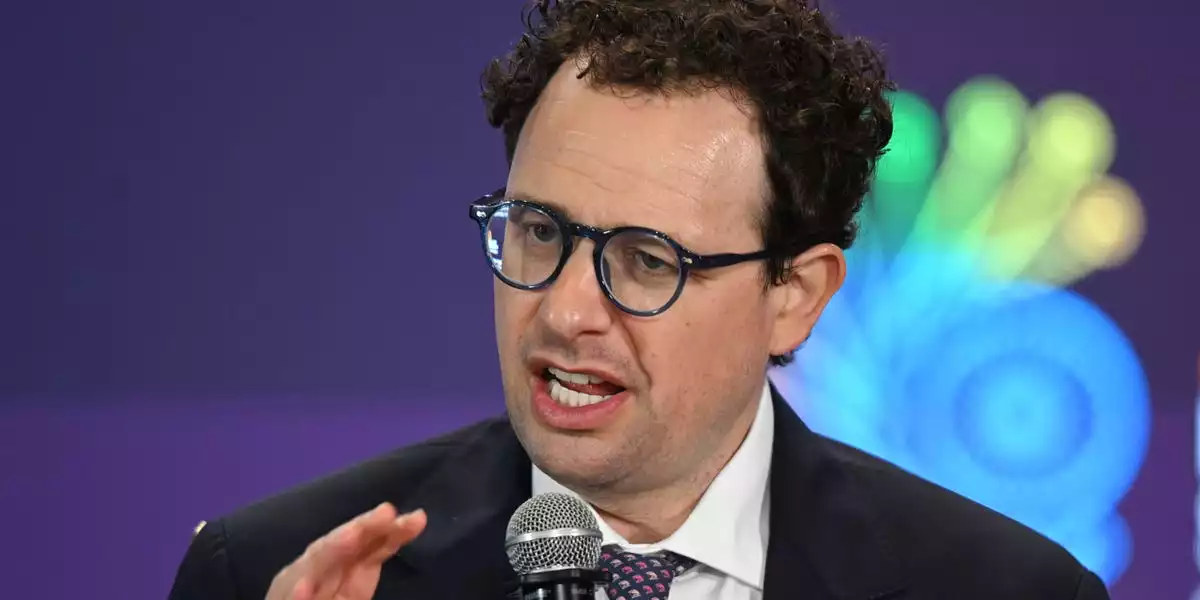

From AI hype cycles to proof-based credibility: why Amodei’s message lands now
Dario Amodei, CEO of Anthropic, has articulated a rare admission in a sector often defined by confident forecasts: AI has overpromised and underdelivered, and the reputational cost is now visible in public skepticism and policy scrutiny. The argument is not merely rhetorical. It reflects a market reality in which AI’s legitimacy is increasingly judged by verifiable outcomes, not model demos, benchmark scores, or aspirational roadmaps.
Amodei’s central claim—that only substantive scientific breakthroughs (he invokes the archetypal example of “curing cancer”) can restore trust—speaks to a widening gap between what AI is marketed to do and what it reliably delivers in high-stakes settings. Pew Research and similar surveys capturing public anxiety about AI’s societal impact underscore the timing: people are not only curious about AI’s capabilities; they are increasingly concerned about safety, jobs, misinformation, and concentrated power.
This is also a strategic moment for Anthropic. With deeper investments in biological and medical research and the backdrop of a potential IPO trajectory, the company’s posture on trust is not abstract—it is tied to valuation, regulatory risk, and long-term adoption. In public markets, “promise” is discounted quickly; durable trust becomes a balance-sheet asset.
The new competitive frontier: domain-defining applications in medicine, biosecurity, and industry
The next inflection point for frontier AI is shifting from “who has the best model” to “who can prove impact where failure is costly.” In practice, that means moving beyond generalized capability claims toward domain-defining applications with measurable endpoints—especially in life sciences, where proof standards are unusually strict.
Areas likely to become the industry’s most consequential proving grounds include:
- Drug discovery and target identification, where AI must translate predictions into reproducible lab results and clinically meaningful candidates
- Precision oncology and clinical decision support, where accuracy, bias controls, and explainability are not optional add-ons but prerequisites
- Biodefense and pathogen monitoring, where misuse risks and false positives carry national-security implications
- Operational productivity in regulated industries (finance, insurance, critical infrastructure), where auditability and reliability determine procurement
Amodei’s framing implicitly challenges a benchmark-centric culture. Benchmarks can be gamed, narrow, or detached from real-world constraints. By contrast, life-sciences validation resembles a “truth machine”: peer review, replication, and regulatory oversight impose discipline. If AI companies can demonstrate credible gains—faster discovery cycles, improved diagnostic accuracy, safer workflows—public trust may follow not because the public suddenly loves AI, but because outcomes become difficult to dismiss.
Yet critics of the “breakthroughs will fix trust” thesis raise a practical counterpoint: impact without equitable access can deepen distrust. A cancer breakthrough that is unaffordable, unavailable, or unevenly distributed may reinforce the perception that AI primarily benefits elites and shareholders. The pharmaceutical analogy is instructive: scientific success and social legitimacy are not the same achievement.
Closed models, open ecosystems, and the emerging “trust architecture” of AI
Anthropic’s more guarded approach to model release sits at the center of a defining industry tension: control versus transparency. Amodei’s caution reflects legitimate concerns—misuse, cybersecurity threats, and the scaling of harmful capabilities. But closed ecosystems can also create a credibility deficit, especially when independent researchers and developers cannot audit behavior, reproduce results, or stress-test claims.
This is where the debate with open-source advocates such as Yann LeCun becomes more than ideology; it becomes an argument about how trust is manufactured. Open ecosystems can enable:
- Third-party validation and broader red-teaming
- Faster identification of failure modes and bias patterns
- A culture of reproducibility closer to scientific norms
- Wider developer participation, which can accelerate adoption and innovation
Closed systems, meanwhile, can offer:
- Tighter safeguards against misuse and model theft
- More consistent governance and deployment controls
- Clearer accountability when something goes wrong
The likely destination is not a binary choice but a trust architecture: standardized evaluation protocols, independent audits, controlled research access, and post-deployment monitoring that resembles pharmacovigilance in biotech. Policymakers are already moving toward “trust-by-design” expectations—model documentation, transparency audits, and registration-like mechanisms. Companies that adopt credible voluntary compliance early may shape the rules rather than inherit them.
Capital markets, regulation, and the bio-digital pivot shaping Anthropic’s next chapter
As AI ventures enter a “realization phase,” capital allocation is becoming more conditional. Investors and prospective public-market buyers increasingly ask: Where is the durable revenue, the defensible moat, and the measurable value creation? In that environment, reputational capital can function as a competitive moat—especially for companies selling into regulated domains.
Several forces now converge around Anthropic’s strategy:
- IPO readiness and narrative discipline: public markets reward repeatable performance and punish vague futurism
- Regulatory fragmentation: the EU AI Act, U.S. initiatives, and China’s cybersecurity regime create divergent compliance burdens, pushing multinational firms toward modular governance
- Public–private partnerships: cross-sector consortia can distribute legitimacy, create shared standards, and reduce the perception of self-policing
- Labor market disruption: workforce displacement concerns are becoming inseparable from AI adoption; reskilling and transition programs are moving from CSR to operational necessity
- Bio-digital convergence: AI fused with genomics and synthetic biology can create new value chains, but also amplifies safety, ethics, and access questions
Amodei’s wager is that measured caution plus undeniable breakthroughs can reset the public conversation. The harder truth is that breakthroughs may be necessary but not sufficient: trust will be awarded to the AI companies that can prove not only that their systems work, but that they work safely, affordably, and accountably—under scrutiny, at scale, and in the places where society feels the consequences most.

 By
By
 By
By

 By
By
 By
By

 By
By
 By
By







