

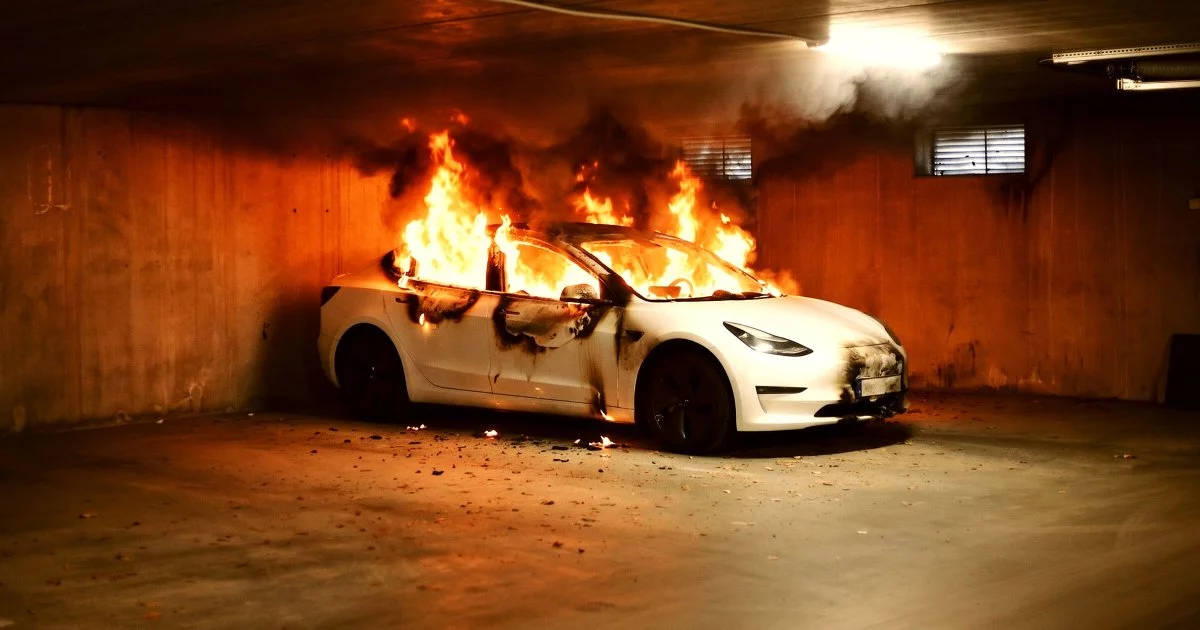

A sobering benchmark: why the humble firehose still wins against EV thermal runaway
A new 150-page study from the Fire Safety Research Institute (FSRI), part of UL Research Institutes, offers one of the clearest empirical snapshots yet of a problem that has been discussed more than it has been measured: how to suppress electric vehicle (EV) lithium-ion battery fires once thermal runaway begins. Across 18 controlled battery-fire experiments and nine suppression tactics—including chemical agents, insulating blankets, and submersion-style approaches—the report’s most consequential finding is also its most uncomfortable: conventional high-volume water streams remain the most effective tool for immediate fire knockdown.
That “win,” however, is narrowly defined. Water can reduce visible flames and cool surfaces, but it often fails to stop the underlying cell-to-cell propagation inside a battery pack. The study underscores a central operational reality for firefighters and incident commanders: extinguishment is not the same as stabilization. Even after flames appear controlled, residual heat and internal reactions can trigger re-ignition, sometimes in adjacent cells that were never directly cooled.
The real-world implications are illustrated by the widely cited 2024 Tesla Semi fire, where suppression reportedly required around 50,000 gallons of water and contributed to a 15-hour freeway closure. The incident has become a shorthand for the logistical burden of EV battery fires—not because such events are necessarily frequent, but because when they do occur, they can be resource-intensive, disruptive, and unusually persistent.
The chemistry and physics that make lithium-ion fires uniquely stubborn
The FSRI findings reinforce what battery engineers and fire scientists have long known: thermal runaway is an auto-accelerating failure mode, not a conventional fuel fire. Once initiated, a lithium-ion cell can generate heat faster than it can dissipate it, releasing combustible electrolyte vapors and producing hazardous byproducts, including metal fluorides. The result is a fire scenario that behaves less like a surface blaze and more like a distributed internal reaction—one that is difficult to reach and harder to cool.
Several suppression approaches evaluated in the study appear constrained by fundamental limitations:
- Insulating blankets can reduce oxygen access and contain flames, but they often lack the thermal capacity to pull enough heat out of densely packed cells.
- Foams and chemical agents may suppress open flames, yet struggle with penetration into battery modules where the most critical reactions occur.
- Submersion containers can be effective in certain contexts, but introduce practical barriers: availability, transport, and the complexity of handling damaged high-voltage systems at scale.
Water, by contrast, is widely available and has high heat absorption—making it a pragmatic choice even if it is not a complete solution. The study’s nuance is important for public understanding and policy: the firehose is not “best” because it solves the problem, but because alternatives are not yet consistently better under field-like constraints.
This gap between knockdown and true mitigation is where the next wave of innovation must land: stopping propagation inside the pack, not merely controlling what is visible from the outside.
The innovation deficit becomes a market signal for automakers, suppliers, and startups
The report reads as both a safety assessment and an industrial roadmap. If high-volume water is the default because purpose-built tools underperform, then the opportunity is clear: battery-specific suppression chemistry, pack-level engineering changes, and responder-grade diagnostics.
For automakers and tier-one suppliers, the engineering agenda is increasingly concrete:
- Battery compartmentalization and propagation barriers to slow or isolate cell-to-cell failure
- Integrated cooling pathways designed not only for performance but for emergency heat extraction
- Early-warning sensors and pack diagnostics that detect abnormal thermal signatures before runaway cascades
- Materials innovation—such as nanomaterial coatings or improved separators—that reduce flammability or delay runaway onset
The report also points to a growing role for digital integration in emergency response. Real-time telemetry, thermal imaging, and drone-assisted assessment can help responders identify hotspots and apply cooling more precisely—potentially reducing both water consumption and time on scene. Over time, this could evolve into a standardized interface between vehicles and first responders: a safety-focused data layer that translates pack conditions into actionable guidance.
Commercially, the implications extend beyond R&D budgets. A credible, validated suppression ecosystem could become a new competitive dimension in EV platforms—especially for heavy-duty fleets, where incident scale, cargo risk, and downtime costs are magnified.
Cost, regulation, and trust: the hidden balance sheet of EV fire response
FSRI’s findings land amid a broader recalibration of EV total cost of ownership (TCO). For municipalities, the operational burden of prolonged incidents—water usage, specialized equipment, extended road closures, hazmat considerations, and personnel exposure—creates budget pressure that is difficult to ignore. For insurers and fleet operators, the question becomes less about headline risk and more about loss severity and operational disruption.
Key second-order effects are already taking shape:
- Insurance repricing for commercial fleets as models incorporate EV-specific fire dynamics
- Residual-value sensitivity in used EV markets if perception outpaces demonstrated mitigation
- A larger addressable market for battery-fire suppression technology, from portable containment to novel agents and pack-integrated safety modules
- Increased scrutiny of charging depots, tunnels, ferries, and enclosed parking structures, where access, ventilation, and water supply constraints can amplify risk
Regulators and standards bodies are likely to respond with EV-specific guidance that goes beyond today’s generalized fire codes. Expect movement toward standardized responder training, clearer protocols for post-fire monitoring and re-ignition risk, and potentially requirements for suppression readiness at high-density charging locations. The most effective policy outcomes will be those that drive innovation without freezing deployment—encouraging measurable safety improvements while avoiding compliance regimes that inadvertently slow electrification.
The FSRI study ultimately reframes the conversation: EV adoption is not only a battery supply-chain and charging-infrastructure story, but also a fire-response capability story. Until suppression tools catch up with battery energy density and pack complexity, the industry’s most advanced vehicles may still depend on the oldest technology at the scene—a high-volume hose line—while engineers, regulators, and investors race to make that dependence obsolete.

 By
By
 By
By

 By
By


 By
By
 By
By







