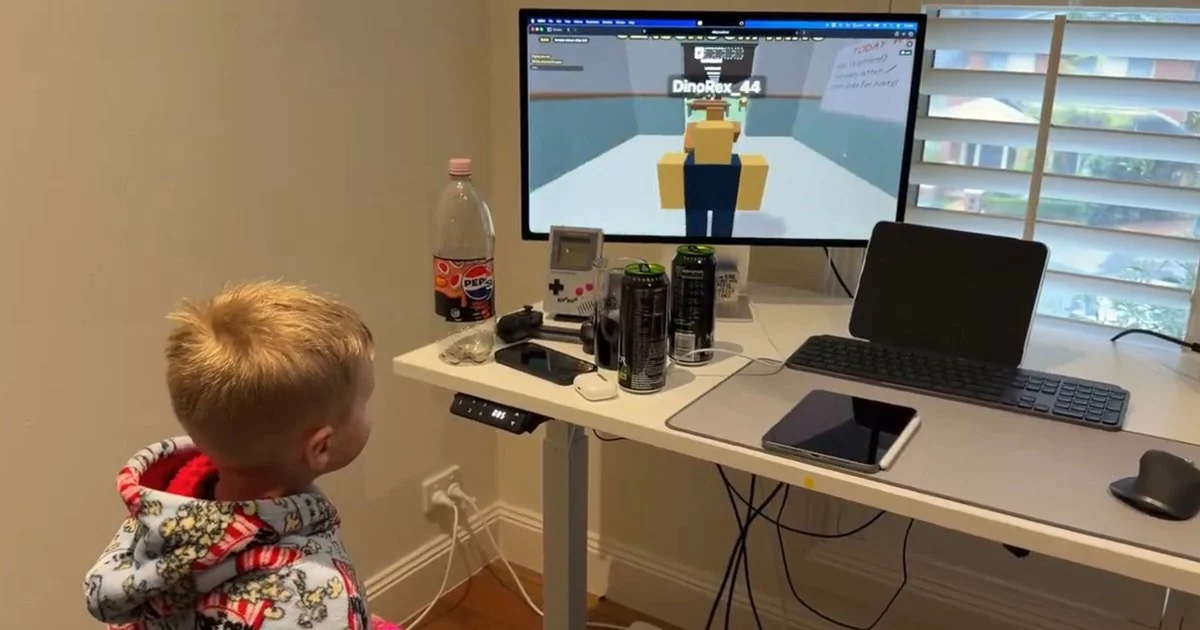

A “safer Roblox” experiment that exposes a deeper fault line in digital childhood
Adam Lyttle’s decision to build a fully AI-generated Roblox clone for his young son reads, on the surface, like a clever parental workaround: remove the unpredictable risks of open multiplayer play while preserving the look and feel of the game. Yet the detail that makes the project technically striking—every avatar is a bot powered by ChatGPT, and every interaction is stitched from pre-recorded gameplay—is also what makes it socially combustible.
The controversy is not primarily about Roblox as a platform, but about the substitution of authentic social reality with a simulated one, without disclosure to the child. Critics’ “Truman Show” analogy lands because it captures the core issue: the child is not merely being protected from strangers; he is being placed inside a curated world that *presents itself* as real peer interaction. That distinction matters in parenting, and it matters even more as AI becomes capable of producing convincing social presence at scale.
This episode arrives amid a broader cultural shift toward AI-assisted parenting, popularized by high-profile technologists and increasingly normalized through consumer tools—bedtime-story generators, tutoring bots, content filters, and conversation companions. Lyttle’s project pushes that trajectory to its edge case: not AI as a helper, but AI as an invisible replacement for the social internet.
—
From NPCs to social stand-ins: what the technology signals for gaming and AI
Technically, the “safer Roblox” clone illustrates how far generative AI has moved beyond novelty chatbots into world simulation. Historically, game studios used scripted non-player characters (NPCs) and limited bots for testing or to populate low-traffic servers. Today, off-the-shelf large language models and multimodal systems can generate dialogue, role-play, and behavioral variety that feels plausibly human—especially to children.
Several implications stand out for business and technology leaders watching the convergence of gaming, AI, and child safety:
- Generative gaming environments are becoming consumer-grade. What once required a studio pipeline can now be assembled by an individual developer using APIs and recorded data. This democratization accelerates innovation—and expands the surface area for misuse.
- NPCs are evolving into “social proxies.” Lyttle’s clone demonstrates a design pattern where bots don’t just fill space; they simulate community. That could reshape multiplayer design by blending real and synthetic participants, changing expectations of what “online” means.
- Recorded gameplay as behavioral scaffolding bridges synthetic and authentic. By drawing from pre-recorded sessions, the clone borrows the texture of real play—timing, slang, conversational rhythms—creating a hybrid that can feel more credible than purely generated content.
- Operational incentives may follow. Studios could be tempted to use AI “traffic padding” to reduce server strain, smooth matchmaking, or keep regions lively during off-peak hours. The business case is clear; the disclosure obligations are not.
For platforms, this is a strategic inflection point: the industry is drifting toward mixed-population worlds where humans and AI agents coexist. The question is whether that future is built with transparent labeling and governance—or arrives through ad hoc experiments and underground clones.
—
Trust, consent, and child development: why the ethics debate won’t fade
The most enduring impact of Lyttle’s experiment may be the way it spotlights a new category of family ethics: AI-mediated deception in the name of safety. Traditional parental controls—time limits, whitelists, restricted chat—operate as boundaries around reality. This approach alters reality itself.
Key concerns raised by child-safety advocates and critics include:
- Erosion of parent-child trust. Even well-intentioned deception can backfire if a child later learns that “friends” were bots. Trust is not a soft value in digital life; it is a long-term asset that shapes how children interpret guidance, risk, and autonomy.
- Psychological externalities of simulated socialization. Childhood is when negotiation, empathy, conflict resolution, and resilience are learned through real feedback loops. Substituting peers with compliant or curated AI agents may reduce exposure to harm, but it can also reduce exposure to *growth*.
- Consent and transparency standards for minors. If adults deserve to know when they are interacting with AI, minors arguably deserve stronger protections—not weaker ones. The lack of disclosure is what transforms a safety intervention into a governance problem.
This is where the debate extends beyond one household. As AI companions become more lifelike, the line between supportive scaffolding and behavioral control becomes harder to see. That ambiguity is precisely what regulators, educators, and platforms are beginning to target.
—
Market pressure, platform liability, and the race to formalize “AI-safe” childhood
Economically, the incident underscores demand for more adaptive child-safety tooling. The global market for child-focused digital safety and monitoring is projected to surpass $20 billion by 2027, and Lyttle’s workaround is a signal that many parents view existing controls as insufficiently nuanced for real-time multiplayer environments.
Several market dynamics are likely to intensify:
- Emergent “AI nanny” services offering content curation, conversational monitoring, and virtual companionship—positioned as convenience for time-strapped households under economic pressure.
- Platform liability and brand risk as major gaming companies confront both IP infringement from unlicensed clones and reputational damage if families perceive official safety features as lagging.
- Regulatory momentum as child online protection regimes expand to include manipulative AI behavior, dark patterns, and undisclosed synthetic interaction—raising compliance costs for late movers.
For industry stakeholders, the strategic play is not to fight the existence of AI-driven social simulation—it is to control its terms. That means building trust signals directly into the user experience:
- Clear AI interaction labels and persistent indicators when a user is engaging with bots
- Verified-human options for parents and communities that want strictly human-to-human play
- Co-developed ethical guardrails with child-development experts, not just policy teams
- Certification pathways for “AI-for-kids” features tested under transparent standards
Lyttle’s clone is provocative because it compresses the future into a single family experiment: AI is no longer just moderating the playground; it can quietly replace it. The next phase of digital childhood will be defined by which institutions—parents, platforms, or regulators—set the rules for that replacement, and whether trust is treated as a feature or as collateral.

 By
By
 By
By
 By
By


 By
By

 By
By