
A kickball-shaped sentinel signals a new phase in autonomous security robotics
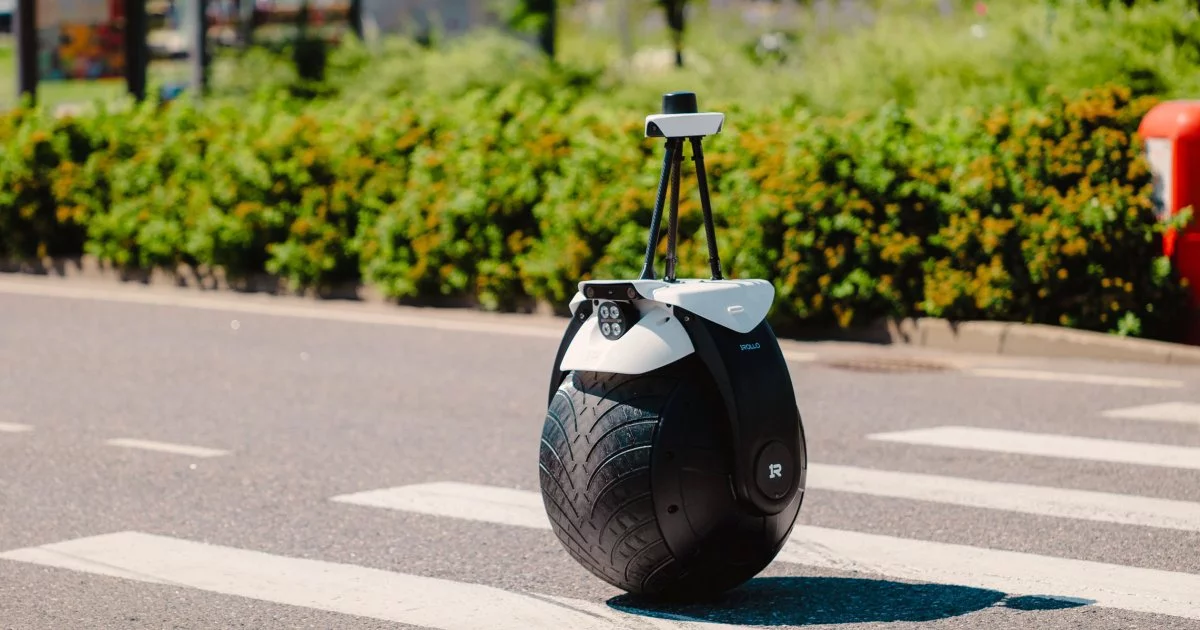
Estonian startup Rollo Robotics has introduced the “1Rollo,” a mono-wheel, AI-driven surveillance robot that looks less like a militarized machine and more like a piece of playground equipment. That design choice is not a trivial aesthetic flourish; it is a strategic bet on how autonomous surveillance will be perceived, deployed, and ultimately governed. Standing roughly 3.5 feet tall, reaching speeds near 19 mph, and topped with a 360-degree camera antenna, 1Rollo positions itself as a mobile, always-on observer for environments that historically relied on human patrols and fixed CCTV.
The company’s central claim—over 80% labor-cost savings versus human guards—lands at a moment when security providers and facility operators are under pressure to do more with less. Yet the product also arrives amid intensifying public unease about AI surveillance, especially when it becomes visible in everyday spaces. That tension—between operational efficiency and social acceptance—may define whether 1Rollo becomes a scalable category leader or a niche experiment.
From a technology standpoint, the robot reflects a broader industry pivot: security is moving from static infrastructure (cameras on walls) toward autonomous, sensor-rich platforms that can reposition themselves, change vantage points, and stream data continuously. The question is no longer whether machines can patrol, but whether organizations can deploy them reliably, securely, and legitimately.
Mono-wheel engineering meets edge AI: agility, but with concentrated risk
The most distinctive element of 1Rollo is its single-wheel form factor, stabilized by gyroscope-based dynamic control. In a market crowded with multi-wheel rovers and legged “robo-dogs,” mono-wheel mobility signals confidence in modern control algorithms and compact inertial systems. The upside is clear: a spherical or near-spherical platform can be nimble in tight urban terrain, rotate quickly, and potentially handle uneven surfaces with fewer mechanical appendages.
But the same design concentrates operational risk. A mono-wheel robot has fewer redundant mobility pathways; if the wheel-drive system, stabilization, or balance sensors fail, the platform may be immobilized. That makes maintenance discipline, diagnostics, and parts availability central to real-world performance—especially for customers expecting “guard replacement” reliability.
Equally important is the robot’s AI architecture. 1Rollo’s embedded intelligence—autonomous navigation, object detection, and wireless real-time transmission—fits the accelerating shift toward edge computing, where inference happens on-device rather than in a distant cloud. Edge AI can reduce latency and bandwidth costs, and it can keep operations running even with intermittent connectivity. However, it also raises a different class of risk: on-device compute security.
For enterprise buyers and public-sector agencies, the due diligence checklist will likely include:
- Firmware integrity and secure update protocols (to prevent tampering or persistent compromise)
- Encryption and authentication for video streams and command channels
- Model governance (how detection models are trained, updated, and audited)
- Data retention and access controls, especially under GDPR and comparable privacy regimes
Rollo Robotics also emphasizes weatherproofing and ruggedized seals, a practical requirement for Northern European climates. Yet durability is not only about rain and dust; it is also about human behavior. A robot that resembles a rubber kickball may be less intimidating, but it may also invite curiosity, pranks, and deliberate strikes—a non-obvious trade-off between approachability and physical resilience.
The economics behind “80% savings”: fleet math, uptime, and hidden OPEX
The promise of dramatic labor-cost reduction is compelling, particularly in a global security market supported by an estimated 28.5 million frontline workers. But the economics of autonomous surveillance rarely hinge on sticker price alone. They hinge on coverage equivalence: how many robots, charging stations, remote operators, and maintenance cycles are required to match the outcomes of a human team.
The eight-hour battery life is a pivotal detail. If continuous 24/7 coverage is the goal, organizations must account for charging downtime, rotation schedules, and contingency capacity. The summary’s operational comparison—three units to cover the equivalent of nine staff on 24-hour duty—highlights how quickly “labor replacement” becomes fleet logistics.
For buyers, the cost model will likely expand to include:
- Capital expenditure (robot units, spares, docking/charging infrastructure)
- Maintenance and repairs, including vandalism-related incidents
- Software licensing and analytics subscriptions (often the real margin center in robotics)
- Connectivity costs (LTE/5G data plans, private networks, or secure Wi-Fi)
- Remote operations staffing, escalation procedures, and incident response integration
This is where many robotics deployments succeed or fail: not in the demo, but in the operational envelope. A robot that patrols well but requires frequent intervention can shift costs from guards to technicians and remote operators without delivering net savings. Conversely, a well-managed fleet—paired with strong alert triage and clear response playbooks—can reduce routine patrol labor while improving documentation and incident traceability.
Social license, regulation, and the next competitive battleground in AI surveillance
Even if 1Rollo proves mechanically sound and economically attractive, its market trajectory will be shaped by public acceptance and regulatory scrutiny. Visible backlash against surveillance technologies—ranging from attacks on cameras to hostility toward patrol robots—signals that adoption is not purely a procurement decision. It is a legitimacy question: who is being watched, why, and under what safeguards?
In Europe, GDPR and related national frameworks elevate requirements around proportionality, transparency, and data minimization. In the United States, a patchwork of state and municipal rules is emerging, often driven by concerns about facial recognition, automated decision-making, and the chilling effects of pervasive monitoring. For any autonomous surveillance robot, the compliance challenge is not only legal—it is reputational.
This is also where partnerships may determine winners. 1Rollo could become more viable as part of security-as-a-service bundles that combine:
- autonomous patrol and detection,
- human-in-the-loop oversight,
- rapid response coordination, and
- auditable reporting for governance and community accountability.
At the same time, competition will be intense. Drones, fixed CCTV with analytics, and legged robots will all compete for the same budgets, often with aggressive bundling and pricing. The differentiator may not be novelty, but trust: demonstrable cybersecurity, clear privacy controls, and operational transparency that can withstand both regulators and public scrutiny.
1Rollo’s playful silhouette may be its most revealing feature: it embodies the industry’s attempt to normalize AI surveillance by making it feel familiar. Whether that familiarity becomes acceptance—or an invitation to test its limits—will determine how far this mono-wheel experiment rolls into the mainstream of modern security.

 By
By
 By
By
 By
By


 By
By
 By
By
 By
By