
Back-to-school pricing as a strategic wedge in the smart home calendar market
Skylight’s week-long promotion (August 2–9) is more than a seasonal sale; it reads like a deliberate customer-acquisition play aimed at a moment when household schedules become visibly complex. The company is offering tiered discounts across three family-focused smart calendar models: the 10-inch at $119.99 (–$50), the 15-inch Calendar 2 at $259.99 (–$20), and the 27-inch Calendar Max at $479.99 (–$90). The pricing ladder signals an effort to capture multiple household segments—from apartment kitchens to large, high-traffic family spaces—while reducing the friction of “trying” a dedicated home scheduling device.
In a market crowded with general-purpose smart displays, Skylight is leaning into a narrower promise: family coordination as a primary product, not a feature buried inside a broader voice-assistant ecosystem. That focus matters in today’s consumer environment. With elevated interest rates and tighter discretionary budgets, buyers increasingly demand a clear return on spend. Skylight’s bet is that the ROI is measurable in time saved, fewer missed commitments, and reduced household logistics overhead—a value proposition that tends to resonate most during back-to-school resets.
Key product elements reinforce that positioning:
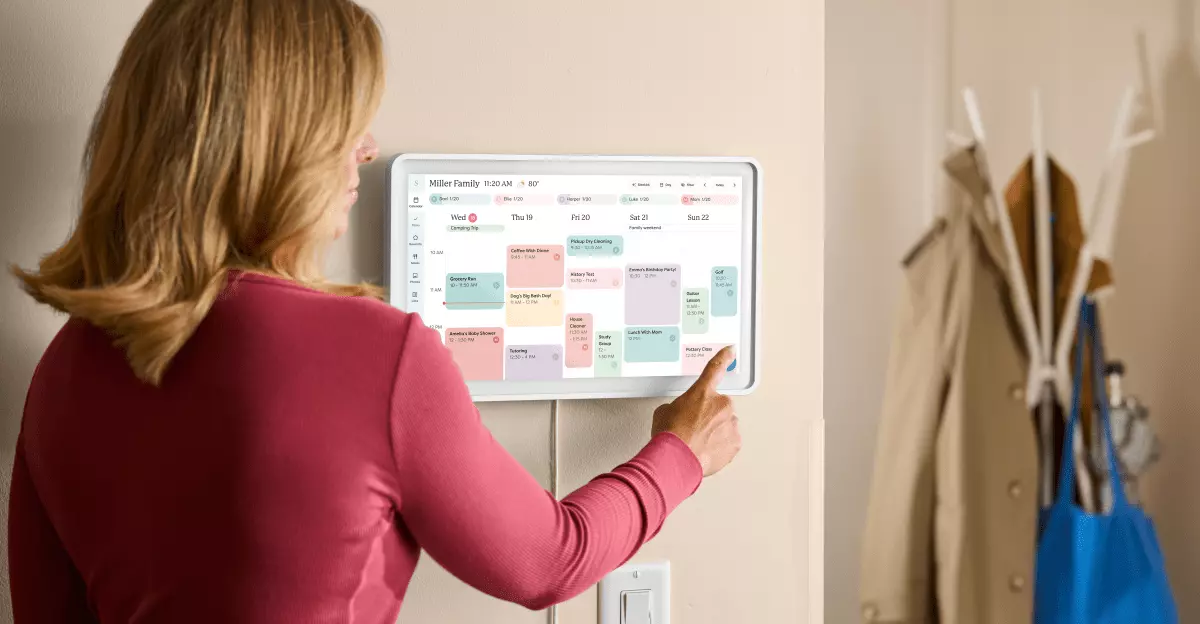
- Color-coded profiles designed for multi-person visibility and quick comprehension
- Two-way sync with major calendar platforms: Google, Outlook, Apple, Cozi, and Yahoo
- Shared lists for groceries and chores, plus weather forecasts for daily planning context
- Mobile app access, including Instacart list-sharing, extending the calendar into commerce-adjacent workflows
From passive display to “home operations layer”: AI ingestion and interoperability
The most consequential differentiator is not the screen size—it’s the attempt to move from a static family dashboard to an intelligent intake-and-organize system. Skylight’s $79/year Plus Plan (with a one-month free trial) layers on AI-driven capabilities that convert unstructured inputs—emails, photos, flyers, spreadsheets—into structured calendar entries. This is a direct application of modern NLP and document understanding trends to consumer IoT, reframing the device as a household “front office” that can reduce manual entry and the cognitive load of coordination.
That shift is strategically aligned with where AI value is increasingly realized: not in novelty, but in automation of small, repeated tasks that compound into meaningful time savings. If the AI capture works reliably, it becomes a habit-forming feature—one that can justify a subscription and deepen retention.
Interoperability is the other pillar. Supporting five major calendar ecosystems is not just a checklist item; it’s a hedge against the reality of heterogeneous family tech stacks—parents on Outlook, kids’ activities in Google Calendar, extended family on Apple Calendar, and legacy household routines living in Cozi. By reducing switching costs, Skylight positions itself as a neutral coordination layer rather than a walled garden.
The Instacart integration is also telling. It suggests a broader API partnership strategy where the calendar becomes a trigger point for downstream actions—shopping, reminders, and potentially delivery scheduling. Over time, this kind of integration can evolve from list-sharing into more contextual workflows (for example, groceries prompted by meal plans, or replenishment reminders tied to household routines), depending on how far Skylight and partners choose to push automation.
Hardware segmentation and the economics of subscription-led consumer IoT
Skylight’s three-tier form-factor strategy—10-inch, 15-inch, and 27-inch—maps neatly to different household use cases: personal or small-space visibility, a central family hub, and a large shared-space command center. The Calendar 2’s magnetic frames add a subtle but important dimension: consumer electronics that live in kitchens and hallways are increasingly expected to function as home décor, not just gadgets. Personalization can be a conversion lever, particularly for devices that remain on display all day.
Yet the deeper economic story is the familiar transformation of hardware into a subscription-augmented business model. The Plus Plan creates recurring revenue and raises lifetime value beyond the one-time device purchase. Skylight bundles multiple perceived benefits into that subscription—AI ingestion, meal planning, chore-management incentives, and even a digital photo frame mode—which helps defend the price against “subscription fatigue” by framing it as a multi-use household service.
This approach also reflects a broader industry reality: hardware margins are pressured by commoditization, while software and services provide stability. The risk, however, is that consumers increasingly scrutinize recurring fees. Skylight’s long-term success will likely depend on:
- Demonstrable accuracy and reliability of AI-powered event capture
- Clear differentiation between free functionality and paid value
- Thoughtful packaging that avoids forcing casual users into a one-size subscription
A modular tiering strategy—such as separating “basic AI capture” from more advanced household management—could expand adoption without sacrificing upsell potential, particularly in budget-sensitive periods.
Competitive implications: a vertical “family COO” and the data flywheel question
Skylight is carving out a niche between generalist smart displays (such as Amazon Echo Show and Google Nest Hub) and single-purpose digital calendars. The company’s advantage is focus: by optimizing for family routines—chores, meal planning, shared lists, and multi-calendar synchronization—it targets a lower-competition vertical where user expectations are specific and measurable.
If adoption grows, Skylight also gains access to a valuable behavioral dataset: shared calendar entries, list interactions, chore completion patterns, and household rhythms. In principle, this can create data network effects, improving AI suggestions and enabling new services—contextual reminders, routine templates, or even consumption analytics tied to shopping integrations. That said, the same data flywheel that enables personalization also raises the bar on privacy governance. As regulators and consumers become more sensitive to household data usage, transparent controls and clear data-handling policies will become competitive differentiators, not compliance afterthoughts.
The most intriguing forward path is ecosystem expansion. Integrations with:
- Education platforms (assignment feeds, school calendars, extracurricular schedules)
- Healthcare and eldercare (medication reminders, appointment coordination)
- Workplace scheduling (parent-teacher conference coordination, shift planning)
could broaden Skylight’s relevance across life stages and deepen its role as a true “home productivity” platform. The companies that win this category won’t merely display time—they’ll reduce the cost of managing it, turning the household calendar into a living operating system for modern family life.

 By
By


 By
By

 By
By
 By
By
 By
By