
Atlanta’s ALPR saturation meets a hard test: measurable public-safety outcomes
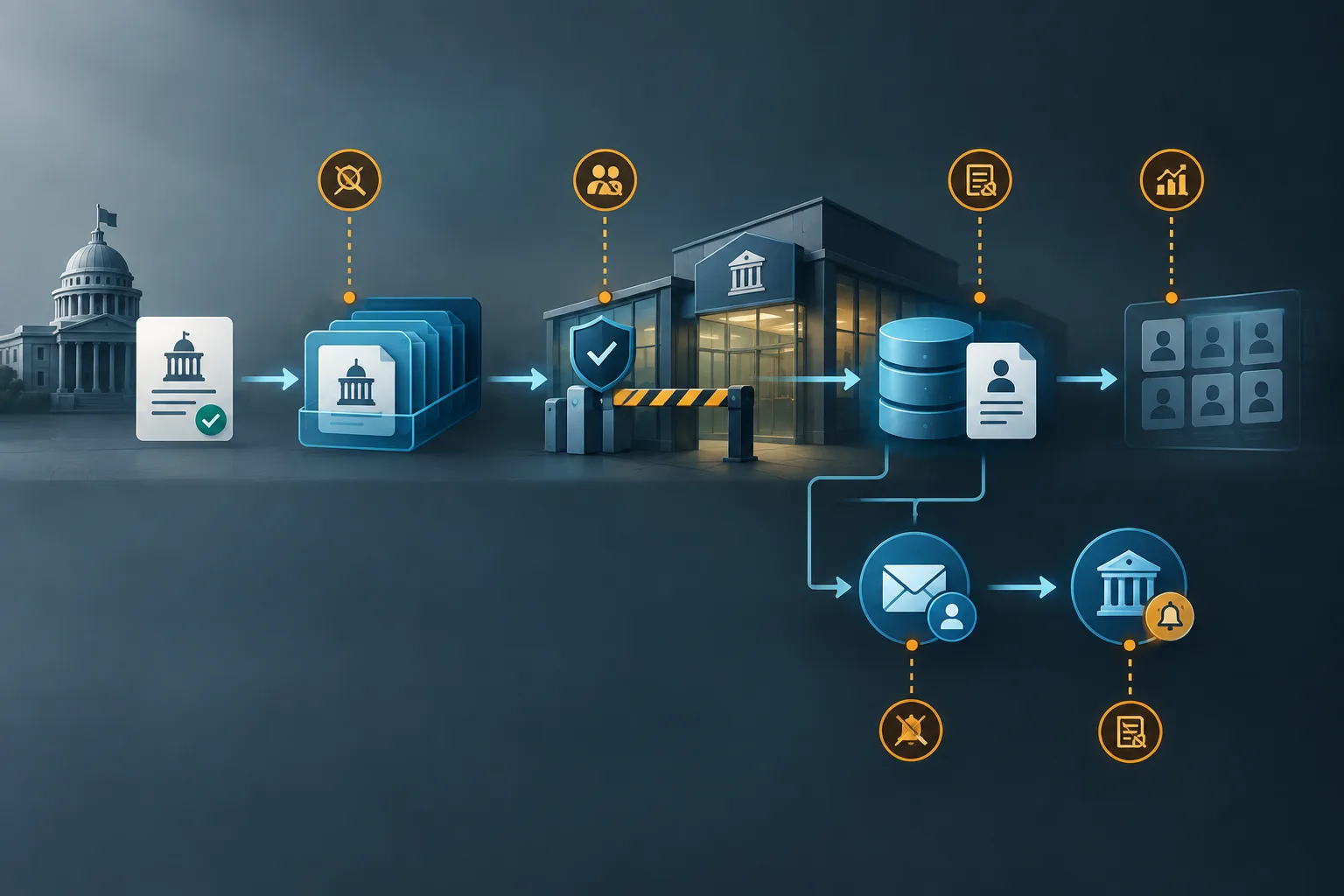
Since 2017, Flock Safety has deployed roughly 100,000 automatic license plate readers (ALPRs) across the United States, with Atlanta emerging as one of the most concentrated urban testbeds—more than 5,000 units embedded into the city’s streetscape. The promise is straightforward and politically resonant: ubiquitous cameras that can rapidly flag stolen vehicles or “hot list” plates, compress investigative timelines, and deter crime through perceived certainty of detection.
Yet the most consequential metric for any public-safety technology is not how much data it collects, but whether it changes outcomes. Recent FBI clearance-rate data cited in the material points to a troubling disconnect between surveillance density and case resolution:
- Homicide clearance in Atlanta reportedly fell from 53.4% (2021) to 48% (2025).
- Rape clearance remained largely flat at about 37.7%.
- Auto-theft recovery/solving stagnated around 10%.
These figures do not, on their own, “disprove” ALPR utility—clearance rates are influenced by staffing, witness cooperation, investigative practices, community trust, and broader socio-economic conditions. But they do sharpen a central question now facing city leaders and technology vendors alike: If a city becomes one of the most surveilled environments in the country, what should residents reasonably expect in return—and how quickly should that return be demonstrable?
Civil-liberties advocates, including DeFlock Atlanta, argue that the public was sold a false bargain: more surveillance in exchange for safety, with limited evidence of improved clearance rates. Their critique is not merely philosophical; it is operational. If the technology’s benefits are narrow—primarily alerting on known plates—then the societal cost of ubiquitous tracking becomes harder to justify.
The technology gap: high-volume capture, limited intelligence, and fragmented systems
ALPR systems are exceptionally good at what they were originally designed to do: capture license plates at scale and compare them against watchlists. The challenge is that modern policing problems—especially violent crime—rarely reduce to a single “plate hit.” The material highlights a critical technical distinction: data capture versus insight generation.
Key limitations described include:
- Hot-list dependence: Many deployments function as “if-then” alerting systems (if plate matches list, then alert). That is useful for stolen vehicles, Amber Alerts, or known suspects, but less effective for crimes where the suspect vehicle is unknown.
- Underutilized analytics: Without embedded AI for contextual pattern recognition—such as anomaly detection, spatiotemporal clustering, or network analysis—ALPRs can become a firehose of hashed images with limited investigative lift.
- Cloud-centric latency and bottlenecks: Reliance on cloud architectures can introduce delays or connectivity constraints. The material suggests edge compute augmentation could reduce latency and enable more privacy-preserving processing, but it remains unevenly adopted.
Equally important is the interoperability problem. Even when cameras are plentiful, value is diluted if data is siloed across jurisdictions or vendors:
- Disparate installations can create fragmented datasets that impede cross-department analytics.
- Non-standard APIs and data-sharing protocols inhibit real-time intelligence sharing between municipal, county, and state systems.
In practical terms, a dense ALPR network can still behave like a patchwork—powerful in isolated moments, but inconsistent as a citywide investigative backbone. For residents, that inconsistency reads as a broken promise; for investigators, it can mean more time reconciling systems than solving cases.
The business reality: ROI scrutiny, capital markets, and the pull toward adjacent surveillance uses
The ALPR market has been buoyed by strong investor appetite for “smart city” infrastructure and public-safety technology. The material notes Flock Safety has raised over $200 million, emblematic of a sector that has been priced on growth expectations and the assumption that data-driven policing scales efficiently.
But the Atlanta numbers—paired with public backlash—introduce a more investor-relevant lens: return on investment (ROI) under political and fiscal constraint. City councils are increasingly forced to choose among:
- hiring and retention of officers and investigators,
- community-based violence interruption and social services,
- alternative technologies (body-worn cameras, gunshot detection, case-management tools),
- and continued expansion of ALPR networks.
If clearance rates remain flat or decline, the fiscal argument for ubiquitous ALPR deployment weakens, especially when the technology’s most visible effect is more tracking rather than more solved cases. That dynamic can trigger a familiar cycle in enterprise tech: procurement slows, renewals become contested, and vendors are pressured to prove outcomes rather than activity.
The material also points to a likely market adaptation: diversification into adjacent use cases. ALPR infrastructure can be repurposed for:
- logistics and fleet monitoring,
- insurance telematics and risk scoring,
- retail and parking management,
- transportation analytics and anomaly detection.
From a business standpoint, these are rational expansions that “soften the blow” if public-safety ROI is questioned. From a governance standpoint, they blur the boundary between public policing infrastructure and commercial surveillance ecosystems, raising new questions about consent, data retention, and secondary use.
Governance and competitive pressure: privacy-by-design becomes a market requirement
The Atlanta debate is increasingly a proxy for a national policy shift: surveillance technologies are moving from permissive adoption to contested legitimacy. The material anticipates rising regulatory and legal risk—potentially including moratoria, stricter retention limits, and rules resembling GDPR-style protections for identifiers.
For vendors and agencies, the next phase is likely to be shaped by three forces:
- Public trust as a prerequisite: Low efficacy metrics combined with ubiquitous tracking can erode the “social license” needed for deployment.
- Auditability and responsible data practices: Privacy-by-design, clear retention schedules, and tamper-evident audit trails become not just compliance features but competitive differentiators.
- A bifurcating market: Incumbents optimized for scale and data accumulation may face challengers offering privacy-first architectures, such as on-device processing, stronger anonymization, and governance controls that limit misuse.
What Atlanta illustrates—more sharply than most cities—is that the future of ALPRs will not be decided by camera counts. It will be decided by whether the technology can credibly evolve from mass collection to measurable investigative value, while operating inside a governance framework that communities can accept as legitimate.

 By
By
 By
By

 By
By



 By
By