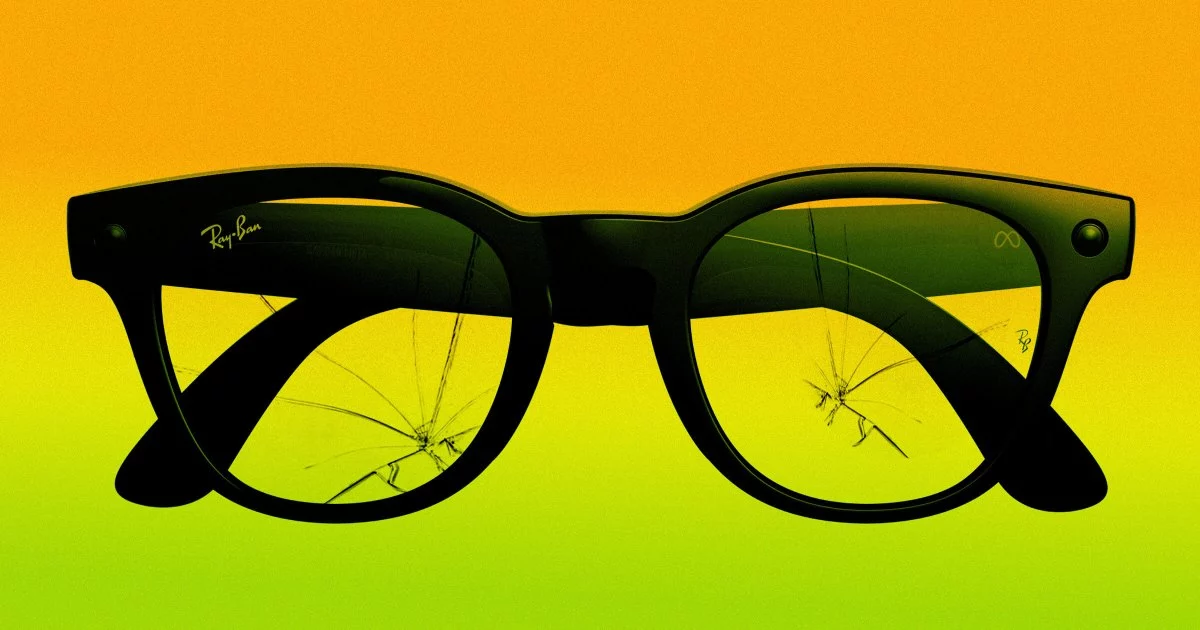

When AI wearables meet the real world: a privacy stress test for Meta’s camera glasses
Meta’s AI-powered camera spectacles were pitched as a step toward frictionless computing—hands-free capture, on-device intelligence, and a subtle bridge between the physical and digital worlds. Yet the latest backlash underscores a recurring truth in consumer technology: the most consequential product risks are often social, not technical.
An *Oligarch Watch* investigation documented hundreds of videos in which self-styled “pickup artists” used the glasses to film women in public and subject them to degrading commentary—sometimes involving minors—then distributed the footage across Meta’s platforms. The reporting is especially damaging because it suggests not only misuse at the edge, but persistence and visibility at the platform core: content remained accessible until journalistic scrutiny prompted action.
Meta has pointed to built-in privacy cues—most notably an LED recording indicator—and says it has removed some accounts and content. But the episode raises a broader question that will follow the entire wearable AI category: What does “privacy by design” mean when the design assumes good-faith behavior? In a world where adversarial use is predictable, social compliance is not a safeguard; it is a vulnerability.
Key tensions now defining the product narrative include:
- Consent versus capture: the device lowers the friction of recording, while consent remains high-friction and ambiguous in public spaces.
- Visibility versus enforceability: an LED indicator can signal recording, but it cannot prevent harassment—or guarantee that bystanders notice, understand, or can challenge it safely.
- Policy versus practice: even with a policy ban on this behavior, enforcement appears reactive, relying on reporting and post-hoc moderation rather than prevention.
For Meta, the reputational risk is not confined to one product line. Camera-enabled wearables sit at the intersection of computer vision, social norms, and platform distribution, meaning failures cascade quickly from hardware to content ecosystems.
The dual-use dilemma: edge AI can’t outvote intent
From a technology standpoint, these spectacles embody the promise of edge AI—processing closer to the device to reduce latency and, in theory, limit data exposure. But the controversy illustrates a hard boundary: edge intelligence does not neutralize malicious intent. A wide-angle, high-resolution camera paired with AI-driven scene understanding can enable accessibility, memory aids, and augmented experiences; it can also enable intrusive surveillance and targeted harassment.
This is the dual-use challenge of modern computer vision, now packaged into a socially acceptable form factor. Smartphones already record everything, critics may argue—but wearables change the equation in three ways:
- Stealth and deniability: glasses normalize the camera’s presence and reduce the social “tell” of filming.
- Always-available capture: hands-free recording makes opportunistic misuse easier and faster.
- Distribution gravity: when the same company sells the device and hosts the content, the pathway from capture to amplification is short.
The investigation also spotlights a design failure mode: privacy features that depend on bystander awareness. An LED indicator is only as effective as the social context around it—lighting conditions, distance, attention, and the willingness of a target to confront a stranger. In harassment scenarios, that willingness is often the first thing taken away.
What emerges is a product category that may require a new baseline: not just “privacy indicators,” but privacy enforcement—mechanisms that reduce the payoff of misuse, not merely signal it.
Moderation can’t be an afterthought when the hardware is the camera
Meta’s response—removing flagged accounts and content—reflects the familiar posture of platform governance: detect, review, remove. But AI wearables compress the timeline between harm and distribution. If enforcement remains primarily post-hoc, the system effectively tolerates a window in which harm can be recorded, uploaded, and copied.
That gap is driving calls for hardware-layer and on-device interventions, though each comes with technical and ethical trade-offs:
- Tamper-resistant recording alerts: stronger, harder-to-disable indicators could reduce covert recording, but may still fail in crowded environments.
- On-device detection of prohibited behavior: models could flag patterns such as persistent zooming on bodies or harassment cues, but risk false positives and raise questions about continuous behavioral monitoring.
- Consent-aware capture: face detection and consent prompts sound appealing, yet are difficult at scale, culturally variable, and potentially reliant on biometric processing—precisely the area regulators are tightening.
The deeper issue is governance architecture. If a company’s business model spans device sales, social distribution, and algorithmic recommendation, then trust and safety cannot sit downstream. It must be integrated into the product lifecycle: threat modeling, adversarial testing, and measurable enforcement outcomes. Otherwise, the market learns the wrong lesson—that wearable AI is inherently predatory—when the real failure is insufficient governance for predictable misuse.
Market fallout and regulatory gravity: trust is now the adoption bottleneck
Economically, the “pervert glasses” stigma is not just a PR problem; it is a demand constraint. Wearables depend on social permission—the willingness of non-users to accept the device in shared spaces. If bystanders feel surveilled, adoption slows regardless of feature quality. That dynamic threatens broader AR/VR and wearable AI projections, where growth assumptions often hinge on mainstream normalization by the late 2020s.
For Meta, the costs compound across multiple fronts:
- Higher moderation and compliance spend as enforcement scales across new capture surfaces.
- Brand drag that celebrity marketing cannot easily offset if the social risk remains unresolved.
- Competitive exposure as Apple, Google, and Snap can position stricter privacy controls as product differentiation rather than constraint.
- Legal and regulatory escalation, particularly as jurisdictions advance rules on biometric data, non-consensual recording, and platform liability.
Strategically, Meta may find safer near-term traction by emphasizing enterprise and industrial deployments—remote assistance, training, field service—where consent frameworks are clearer and environments are controlled. But consumer ambitions won’t disappear; they will simply be delayed until the company can credibly demonstrate that safeguards are not symbolic.
The central lesson for the business and technology sector is stark: AI wearables are not merely gadgets—they are governance systems you can buy. Companies that treat trust as a feature will keep relearning the same outcome: the market doesn’t punish innovation; it punishes innovation that externalizes its social costs onto everyone else.

 By
By
 By
By

 By
By

 By
By
 By
By
 By
By