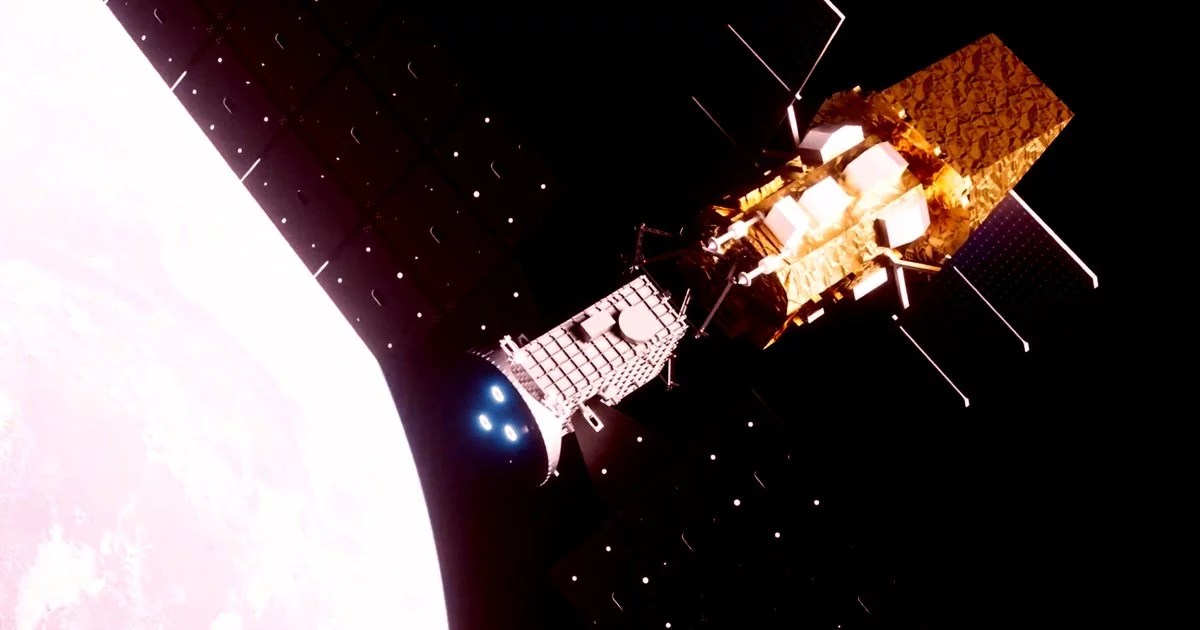

A high-stakes test for on-orbit servicing as NASA moves to save Swift
NASA’s decision to deploy the LINK space tug, built by Katalyst Space Technologies, was designed to be a pragmatic act of stewardship: extend the life of the Swift gamma-ray burst observatory, now in its 22nd year and still scientifically distinctive in its ability to detect and rapidly localize high-energy cosmic explosions. Instead, the mission has quickly become a stress test of the emerging on-orbit servicing industry after LINK suffered a loss of attitude control and entered an uncontrolled spin soon after launch.
The immediate facts are stark. Communications remain intact, but early diagnostics indicate two failed reaction wheels alongside partial cold-gas thruster malfunctions—a combination that undermines the tug’s ability to point, stabilize, and execute the precise proximity operations required before any orbit-raising maneuver can even be contemplated. For mission controllers, the timeline pressure is defined by physics: Swift’s orbital decay continues, and every delay compresses the window for a safe, effective boost.
While the contract value—$30 million—is modest relative to NASA’s multi-billion-dollar annual portfolio, the broader stakes are outsized. The potential loss of Swift would mean more than the retirement of an aging spacecraft; it would represent the premature disappearance of a proven scientific capability, and a public setback for a servicing approach that NASA and industry increasingly view as essential to sustainable space operations.
What LINK’s attitude-control failures reveal about reliability, redundancy, and design philosophy
At the technical core of the incident is a familiar spaceflight lesson: attitude control is mission control. A servicing tug is not merely a satellite with propulsion; it is a spacecraft expected to perform precision navigation, docking or close-approach operations, and controlled thrusting—all of which depend on stable pointing and robust fault management.
Several implications emerge from the reported failure modes:
- Reaction-wheel redundancy is not optional in servicing-class spacecraft. The apparent loss of two reaction wheels highlights the vulnerability of single-string or minimally redundant architectures. For a vehicle tasked with stabilizing itself near another spacecraft, reaction-wheel resilience is not just about mission success—it is about preventing a servicing asset from becoming an additional hazard in orbit.
- Thruster anomalies compound control risk rather than substituting for it. Cold-gas thrusters can provide attitude control authority, but partial malfunctions reduce the ability to despin, damp oscillations, and execute controlled slews. In practice, degraded thrusters can turn a recoverable wheel failure into a broader loss of controllability.
- Servicing legacy spacecraft magnifies integration uncertainty. Swift was not designed in an era where standardized docking fixtures and servicing interfaces were assumed. That mismatch forces modern tugs to operate with tighter margins and more bespoke procedures, increasing the premium on stable guidance, navigation, and control (GNC) performance.
- Cost and mass discipline can collide with mission assurance. Commercial builders are incentivized to minimize mass, complexity, and unit cost. Yet on-orbit servicing is inherently a “high-consequence” domain, where a single-point failure can erase the economic rationale of the mission and damage market confidence. LINK’s predicament underscores how quickly innovation velocity can be overtaken by the unforgiving arithmetic of reliability engineering.
For the broader aerospace sector, the episode will likely sharpen attention on diverse attitude-control architectures—including combinations of reaction wheels, thrusters, and potentially control-moment gyros (CMGs)—as well as deeper fault-tolerant avionics and more exhaustive end-to-end validation of GNC behavior under off-nominal conditions.
The economics behind a $30 million rescue—and why the reputational cost may dominate
From a budgetary standpoint, LINK’s price tag is small. From a strategic standpoint, it is a bellwether. NASA’s willingness to fund a targeted life-extension effort signals that the agency sees value in preserving high-performing legacy assets when replacement timelines are long and scientific uniqueness is high. Swift’s continued relevance makes that logic easy to defend—until the servicing mission itself becomes the risk.
The economic and market reverberations extend beyond NASA:
- Scientific value vs. replacement cost: Even if a successor mission could be conceived, funded, built, and launched, the lead time would likely be measured in years. The opportunity cost of losing Swift’s continuous monitoring capability—particularly for transient astrophysical events—can exceed the apparent savings of “letting it go.”
- Commercial on-orbit servicing credibility: Insurers, investors, and prospective customers will treat LINK as a live case study in operational risk. The outcome may influence:
– underwriting assumptions and premium pricing for servicing missions,
– investor appetite for companies positioned in life-extension, refueling, and debris-removal,
– procurement confidence among government and commercial satellite operators.
- Programmatic precedent: NASA’s response—how it manages contingency funding, risk acceptance, and contractor accountability—will help define what “normal” looks like when a servicing mission goes sideways. That precedent matters because on-orbit servicing is not a one-off experiment; it is increasingly framed as infrastructure for a more resilient space economy.
In this context, LINK is not merely trying to save Swift. It is also trying to validate a business proposition: that spacecraft can be maintained, repositioned, and extended in ways that change lifecycle economics across civil, commercial, and potentially national-security space.
The operational playbook NASA writes next will shape the future of space asset rescue
The LINK–Swift episode is already forcing a more mature conversation about how to operationalize servicing at scale. Several forward-looking priorities stand out as likely takeaways—regardless of whether LINK ultimately recovers:
- Standardized servicing interfaces: Accelerating universal mechanical and data interface standards would reduce bespoke integration risk and make future rescues less improvisational.
- Fault-tolerant control as a baseline requirement: Servicing vehicles should be designed with multiple independent pathways to maintain attitude control and safe-mode stability, not merely to meet minimum mission requirements.
- Contracts that anticipate pivots: Service agreements can be structured with explicit contingency pathways—stabilization-only objectives, staged milestones, and predefined exit criteria—to reduce ambiguity when primary goals become temporarily unattainable.
- Clearer decision frameworks for legacy extension: Agencies and operators benefit from disciplined models that compare the cost and risk of extending a legacy spacecraft against the schedule, budget, and performance uncertainty of a new build—especially for “unique capability” observatories.
What happens next—whether LINK can be despun, stabilized, and ultimately used to boost Swift—will be watched as a referendum on the readiness of on-orbit servicing. The mission’s most enduring impact may be the standards, redundancies, and contractual norms that emerge from this moment, because the future of space operations increasingly depends on treating satellites not as disposable endpoints, but as serviceable assets worth saving.

 By
By

 By
By

 By
By
 By
By
 By
By