
From emergency arms recipient to frontline defense innovator
Since 2022, Ukraine’s defense posture has undergone a striking metamorphosis: from relying on aging Soviet-era inventories and donated legacy platforms to becoming a high-velocity laboratory for modern warfare. The early phase of the conflict demanded immediate capability—whatever could be fielded quickly to slow territorial losses. Yet by 2023, Kyiv’s trajectory began to bend toward something more structural: building a domestic defense-industrial engine designed for speed, adaptability, and battlefield relevance.
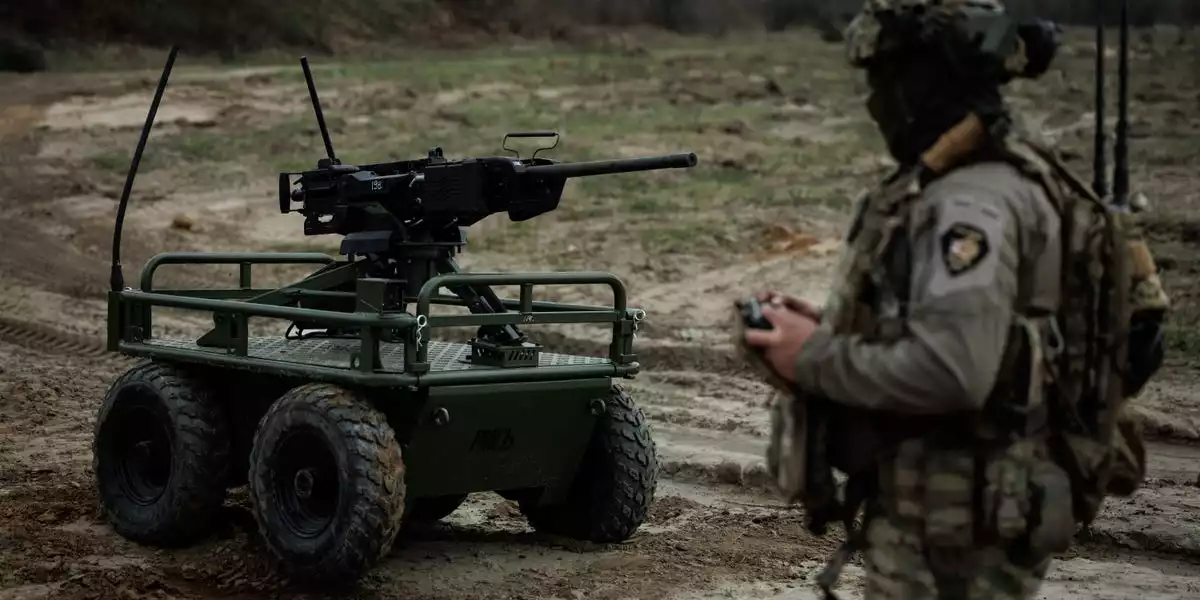
By 2024, Ukraine was mass-producing combat drones at scale. In 2025, it expanded into robotic ground vehicles for logistics and casualty evacuation—tasks traditionally constrained by risk, terrain, and manpower. By 2026, the introduction of AI-enabled command-and-control and decision-support tools signaled a broader shift: the battlefield was no longer defined only by platforms, but by software, data, and the ability to compress the sensor-to-shooter timeline.
For NATO and Western governments, the implication is not merely that Ukraine is “using” advanced technology—it is co-authoring the playbook. Ukrainian lessons in drone swarm tactics, electronic warfare, and rapid production cycles are increasingly treated as inputs into Western force modernization, procurement reform, and industrial resilience planning. In effect, Ukraine is evolving into a strategic partner and R&D testbed, where operational feedback is immediate and innovation is measured in days, not years.
The new mechanics of warfare: drones, autonomy, and the digital battlespace
Ukraine’s most consequential contribution may be methodological rather than purely technological: a shift toward agile, iterative defense production that resembles startup engineering more than traditional military acquisition. Small and mid-sized enterprises, alongside military factories, have adopted rapid prototyping and modular design principles—often aligned with Industry 4.0 practices such as digital twins, additive manufacturing, and distributed supply chains.
Several dynamics stand out for defense planners and technology executives:
- Agile production loops with frontline validation: Units request modifications, test parts quickly, and feed performance data back to engineers—creating a continuous improvement cycle that shortens deployment timelines dramatically.
- Unmanned and autonomous systems built from hybrid supply chains: Ukraine has leveraged off-the-shelf components—GPS modules, commercial cameras, 5G radios—paired with Ukrainian-designed frames and software to field a spectrum of capabilities, from ISR drones to loitering munitions and ground robots.
- Democratization of drone warfare: The tight operator-developer feedback loop has lowered barriers to iteration and scaled battlefield learning, making drone tactics less dependent on a single prime contractor’s development cadence.
- Electronic warfare and cyber integration as standard combined arms: Jamming, spoofing, cyber intrusions, and decoy networks are fused with kinetic effects to degrade adversary sensors and communications, forcing operational pauses and raising the cost of maneuver.
This is not simply “more drones.” It is a systems-level transformation in how militaries generate combat power: distributed sensing, rapid targeting, contested communications, and constant adaptation. The modern battlefield increasingly rewards those who can update faster than the adversary can counter.
Industrial and investment spillovers reshaping Europe’s defense economy
The economic implications extend well beyond Ukraine’s borders. Western defense contractors are exploring joint ventures, licensing arrangements, and co-development pathways with Ukrainian firms—not only to access specific products, but to internalize a different production philosophy: lean manufacturing, on-demand output, and modular architectures that can be upgraded continuously.
This collaboration also intersects with a broader strategic priority: supply chain resilience. Diversifying away from single-point suppliers—particularly in sensitive areas like microelectronics—has become a central concern across NATO and the EU. Ukraine’s distributed production model, born of necessity, offers a template for building redundancy under pressure.
At the same time, Ukraine’s crisis-driven innovation has catalyzed an emerging dual-use investment ecosystem:
- Venture capital and grant-backed accelerators in Kyiv, Lviv, and Odesa are supporting drones, robotics, and AI with both military and civilian applications.
- Civilian technology spillovers—from agricultural drones to infrastructure monitoring and smart energy systems—mirror historical patterns of wartime innovation diffusion, where defense R&D seeds post-conflict economic modernization.
- Workforce acceleration is creating deep pools of engineers, software developers, and drone operators, with potential for structured exchange programs and joint research initiatives with Western partners.
For European policymakers, this is also a question of strategic autonomy. Integrating Ukrainian firms into EU frameworks—such as the European Defence Fund and multinational procurement initiatives—could strengthen Europe’s industrial independence while anchoring Ukraine more firmly inside the continent’s security and technology architecture.
NATO procurement, asymmetric deterrence, and the governance challenge ahead
Ukraine’s experience is already pressuring NATO to rethink long-standing procurement paradigms. Traditional acquisition cycles—often measured in decades—struggle to keep pace with systems that evolve monthly. As a result, alliance officials are exploring reforms aligned with Ukrainian battlefield realities: plug-and-play standards, open data architectures, and contracting authorities closer to the tactical edge.
Strategically, Ukraine’s ability to “punch above its weight” using low-cost drones, bespoke electronics, and distributed sensing offers a compelling model of asymmetric deterrence. Smaller states facing larger adversaries—particularly in the Indo-Pacific—are studying these lessons closely. The appeal is clear: scalable, software-driven capabilities that complicate an opponent’s planning and raise the cost of aggression without requiring symmetric force structures.
Yet deeper collaboration also introduces governance complexity. As Western engagement intensifies, both sides must manage:
- Intellectual property ownership and licensing terms
- Export controls and technology transfer restrictions
- Security of sensitive software, data, and AI models
- Standards alignment for interoperability across NATO and EU forces
The next phase of Ukraine’s defense evolution will be shaped not only by engineering prowess, but by the ability to build trusted frameworks that protect sensitive capabilities while preserving the speed that made Ukraine’s model so influential.
What is emerging is a new center of gravity in defense innovation—one where battlefield feedback, industrial agility, and digital warfare integration converge. Ukraine’s transformation is no longer a wartime anomaly; it is becoming a reference case for how 21st-century militaries and defense industries may be forced to operate when time, scale, and adaptation are the decisive weapons.


 By
By

 By
By

 By
By
 By
By
 By
By