
The Rose Garden as an executive stage: how design choices become governance signals
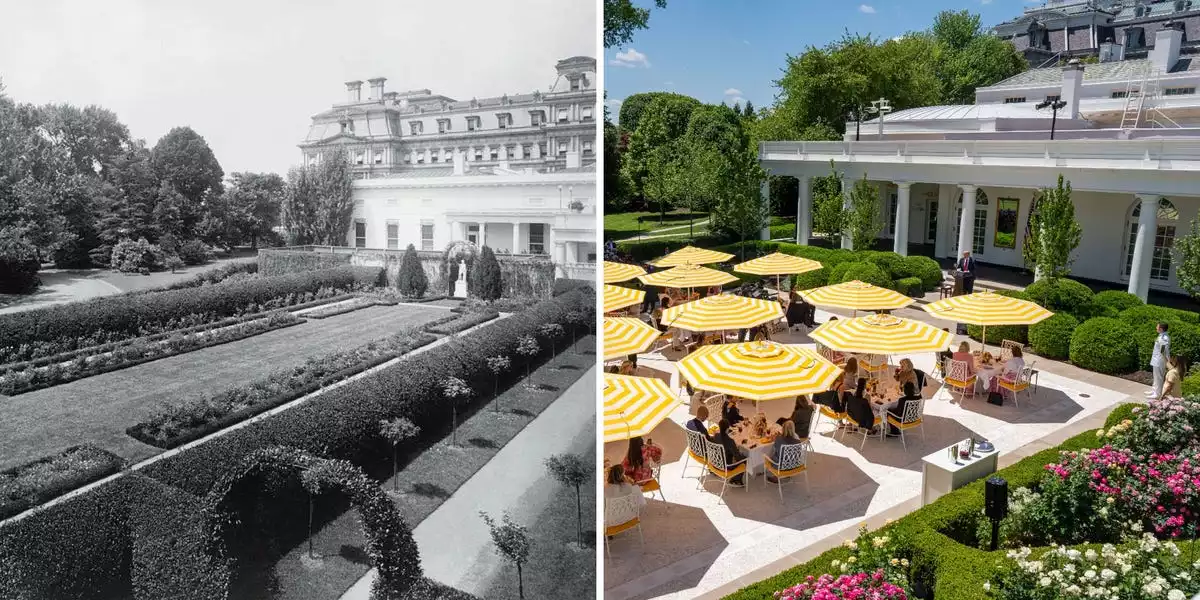
The White House Rose Garden has never been a static backdrop. Since its 1913 inauguration under Ellen Wilson and later refinement by renowned landscape architect Beatrix Farrand, the space has repeatedly been treated as a high-visibility instrument of presidential communication—a place where aesthetics, symbolism, and operational needs converge under intense public scrutiny.
The most consequential redesigns read like a timeline of shifting leadership priorities. The Kennedy-era transformation led by Rachel Lambert Mellon (1961–63) introduced a more European sensibility and a softer, more informal lawn-centered setting—an approach that aligned with a broader cultural emphasis on taste, diplomacy, and curated modernity. Decades later, Melania Trump’s 2020 updates emphasized event readiness, reportedly improving the garden’s technology and staging capacity while maintaining a restrained, pastel-forward palette.
Then came the August 2025 overhaul under Donald Trump: a decisive pivot from garden-as-landscape to garden-as-venue. By replacing turf with a stone patio and layering in presidential seal tiles, striped umbrellas, table seating, Founding Father sculptures, and gold-lettered legacy plaques, the redesign effectively reframed the Rose Garden as a branded environment—explicitly dubbed “The Rose Garden Club.” Whatever one’s political interpretation, the design move is legible as a modern communications strategy: the space is no longer merely where announcements happen; it is engineered to *be* part of the announcement.
From horticulture to hardscape: the operational logic of a broadcast-first public venue
Beyond symbolism, the 2020 and 2025 changes reflect a pragmatic trend reshaping institutional real estate: spaces optimized for hybrid events, heavy production, and rapid reconfiguration. In an era where a press moment is simultaneously a live event, a streaming product, and a social-media asset, the physical environment increasingly functions like a studio.
Melania Trump’s “improved event technology” is broadly described, but in contemporary venue terms it typically implies capabilities such as:
- Upgraded audiovisual routing for multi-camera coverage and clean audio capture
- High-density wireless networking to support press, staff, and live transmission demands
- Modern lighting controls enabling consistent visuals across changing weather and time-of-day conditions
- Infrastructure for staging and accessibility, reducing setup friction for major ceremonies
Donald Trump’s 2025 turf-to-tile conversion extends that logic. A load-bearing stone surface is materially different from grass: it supports camera platforms, risers, lighting trusses, temporary seating, and heavier equipment with fewer constraints. It also reduces weather-related variability—mud, turf damage, and uneven footing—making the venue more predictable for high-frequency programming.
This is the same design philosophy driving corporate campuses and flagship venues: build once, broadcast often. The Rose Garden’s evolution underscores how even the most tradition-laden civic spaces are being retooled for a world where visibility, repeatability, and production value are strategic assets.
Spatial branding and curated heritage: when public architecture adopts private-club cues
The 2025 redesign’s most debated dimension is not the engineering—it is the branding grammar. “The Rose Garden Club,” with its club-like furniture cues and overt iconography, borrows from hospitality and private membership aesthetics. In business terms, it resembles a shift from a “public commons” design language to an “experiential venue” design language—one that prioritizes controlled narrative, recognizable motifs, and photogenic consistency.
Key visual signifiers do more than decorate; they encode meaning:
- Presidential seals function as authority markers and compositional anchors for photography
- Founding Father sculptures imply lineage and ideological continuity through material culture
- Legacy plaques formalize a narrative of permanence, authorship, and institutional imprint
This is a familiar mechanism in corporate storytelling. Executive briefing centers, innovation hubs, and customer experience studios increasingly use heritage branding—founder iconography, milestone walls, curated artifacts—to convey legitimacy and continuity. The Rose Garden’s redesign demonstrates the same principle at national scale: the environment becomes a narrative gallery, shaping what audiences remember and how they contextualize leadership.
For observers of political communications and brand strategy alike, the key takeaway is structural: design is no longer “set dressing.” It is a form of message architecture, where materials and objects act as durable talking points.
Capital expenditure, supply chains, and the new economics of institutional place-making
A transformation involving specialized stonework, custom tiles, bespoke sculpture, and high-end landscaping services signals a multi-million-dollar procurement footprint, with real downstream effects. Such projects activate a network of:
- Local and regional contractors and fabricators
- Artisans and sculptors producing custom heritage elements
- Horticultural suppliers and landscape engineering services
- Logistics providers managing specialty materials and installation timelines
From a finance perspective, the Rose Garden’s hardscape shift also illustrates a classic capex-versus-opex trade. Replacing living turf with stone can reduce recurring costs tied to mowing, irrigation, reseeding, and seasonal replanting—while increasing upfront capital costs and potentially introducing new maintenance categories (surface cleaning, repairs, heat management, drainage performance).
It also raises contemporary ESG questions that many institutions now face: how do you balance durability and event flexibility with environmental considerations such as stormwater runoff, heat-island effects, and biodiversity loss? The business analogue is clear. Whether designing a corporate courtyard or a government ceremonial space, leaders are increasingly pushed toward solutions like:
- Permeable pavers to manage water responsibly
- Sustainable material sourcing and lifecycle accounting
- IoT-enabled microclimate monitoring for comfort and efficiency
The Rose Garden’s century-long redesign cycle—culminating in a 2025 shift toward a club-like, production-ready terrace—captures a broader reality: power is communicated not only through policy and speech, but through the engineered environments that frame them. In a media economy where every setting is a signal, the most consequential renovations are the ones that quietly rewrite what an institution is *for*, and how it intends to be seen.

 By
By
 By
By

 By
By

 By
By
 By
By