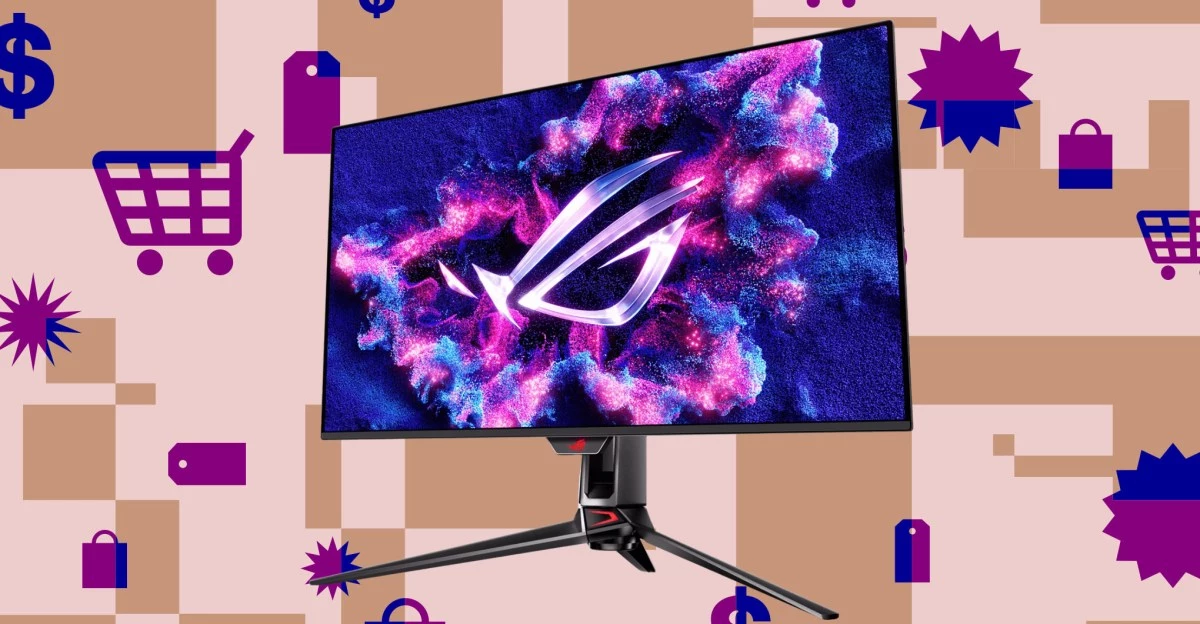

A rare price rupture in premium displays—and what it signals about the next upgrade cycle
Asus’s ROG Swift 32-inch 4K QD-OLED gaming monitor dropping to $899.99 from $1,299.99 is more than a compelling deal; it is a visible stress test of how quickly the premium display market is moving. For a product positioned at the intersection of enthusiast gaming and professional-grade visual work, a discount of this magnitude—so soon after its summer launch window—reads like a deliberate channel reset rather than a routine promotion.
The monitor’s headline proposition remains intact at the new price: 4K resolution paired with a 240 Hz refresh rate, tuned for high-frame-rate PC gaming while also catering to creators who want dense pixel detail and OLED-class contrast. The inclusion of NVIDIA G-Sync further reinforces its role as a performance-first display, designed to minimize tearing and stutter in demanding titles.
Yet the deeper story is strategic. Aggressive markdowns on a flagship panel typically imply one of two realities: either demand is softer than anticipated at the original premium, or the industry is preparing buyers—retailers included—for a near-term successor. Current market chatter points to the latter, with expectations of a follow-on model featuring Tandem QD-OLED technology and incremental specification upgrades. In that context, today’s pricing looks like inventory digestion ahead of a generational handoff.
Why QD-OLED is tightening the vise on LCD—and reshaping buyer expectations
QD-OLED (quantum-dot OLED) has steadily become the benchmark for “wow factor” displays because it addresses the trade-offs that have historically split the market between OLED and high-end LCD variants. By combining an OLED emissive layer with quantum-dot enhancement, QD-OLED can deliver:
- Near-perfect black levels and contrast, a long-standing OLED advantage over LCD
- High color saturation and wide gamut, where quantum dots help preserve color volume
- A more convincing case for premium HDR and cinematic gaming, even when peak brightness remains a nuanced, model-dependent conversation
In practical terms, this is why QD-OLED is increasingly viewed as the new reference tier for immersive gaming monitors and high-fidelity visualization. It also raises the competitive pressure on LCD incumbents—especially Mini-LED—whose strengths in brightness and burn-in immunity must now compete against OLED’s clarity in dark scenes, instantaneous pixel response, and perceived “depth” in motion.
For the broader industry, the implication is clear: as QD-OLED pricing becomes more elastic, the category stops being a niche indulgence and starts becoming a default aspiration. That shift forces display makers to accelerate roadmaps in Mini-LED refinement, MicroLED investment, and next-gen OLED stacks—not merely to win spec-sheet battles, but to defend margins as premium differentiation becomes harder to sustain.
Burn-in anxiety meets product engineering: sensors, warranties, and trust as a feature
OLED’s most persistent adoption barrier in desktop use has been longevity concerns—especially burn-in risk in scenarios with static UI elements. Asus’s approach here is notable because it blends engineering mitigation with explicit commercial reassurance.
Two elements stand out:
- A proximity sensor that powers down or reduces panel activity when the user steps away, lowering idle exposure and helping preserve panel health
- A three-year warranty that explicitly covers burn-in under normal usage, which reframes burn-in from a vague fear into a managed risk with defined accountability
This pairing reflects a broader industry pivot: premium hardware is increasingly sold not only on performance, but on risk reduction. As more buyers use gaming-class monitors for hybrid work—spreadsheets, timelines, chat windows, IDEs—confidence mechanisms like sensor-driven power management and clearer warranty language become competitive differentiators.
Expect this pattern to proliferate. As OLED and QD-OLED expand into mainstream premium desks, manufacturers that can quantify and underwrite reliability will likely win share, particularly among professionals and enterprise-adjacent buyers who treat displays as multi-year capital purchases rather than seasonal upgrades.
One cable, many roles: connectivity as the bridge between gaming rigs and hybrid workstations
The monitor’s I/O configuration is also a tell: premium displays are no longer built solely around a desktop tower and a single GPU. Asus includes DisplayPort 2.1, dual HDMI 2.1, and USB-C with 90 W power delivery, enabling a more fluid mix of devices—PCs, consoles, and laptops—without forcing users into dongle sprawl.
This matters because it aligns with a larger convergence trend: gaming-grade hardware is migrating into hybrid-work ecosystems, and vice versa. USB-C with high power delivery and video support is effectively a nod to the “single-cable docking” expectation that laptop users now bring to every desk—home office, studio, or gaming setup.
The retail environment reinforces that convergence. The simultaneous promotion of complementary items—games and peripherals—signals a coordinated attempt to capture a larger share of discretionary tech spending. In a mature consumer electronics market shaped by post-pandemic normalization and persistent price competition, retailers increasingly rely on:
- Basket-building (monitor + game + accessory) to improve unit economics
- High-interest flagship items to pull demand toward higher-margin add-ons
- Timed markdowns that align with product cadence and anticipated successor launches
At $899.99, Asus’s 32-inch 4K QD-OLED becomes a case study in how quickly “premium” can be redefined when innovation cycles compress. The discount is compelling, but the more durable takeaway is what it reveals: the display industry is entering a phase where panel technology, lifecycle assurance, and connectivity convergence are no longer separate selling points—they are the combined baseline for the next generation of high-end monitors.

 By
By

 By
By
 By
By
 By
By


 By
By