
From concert halls to command screens: a case study in wartime talent redeployment
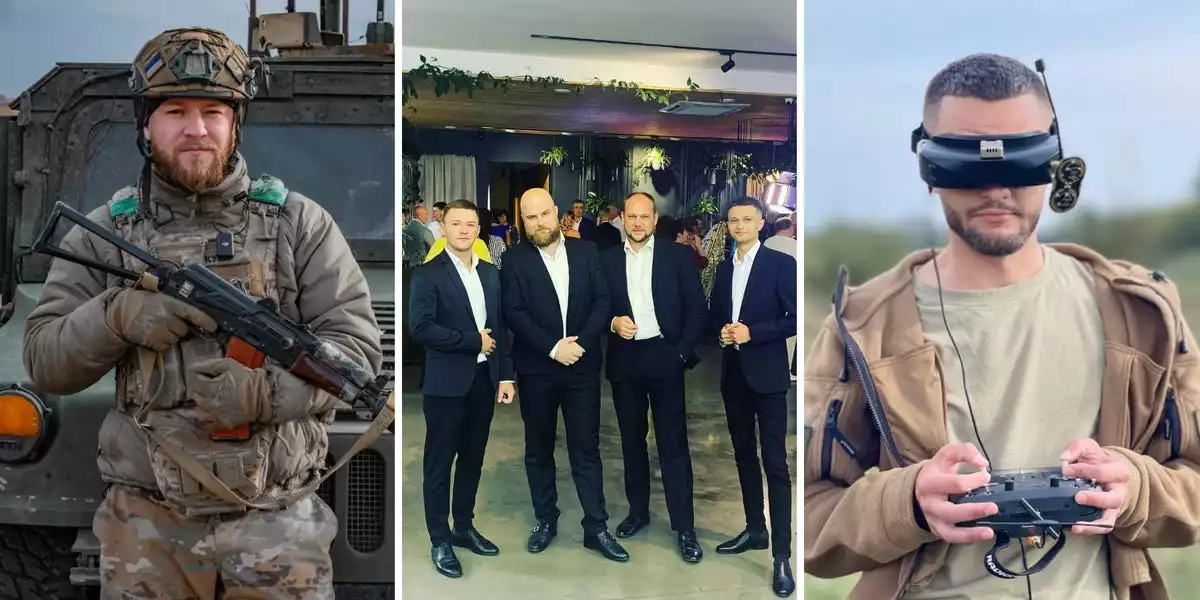
The story of Vlad and Andriy—former professional vocalists in Ukraine’s Luciano quartet—now serving in a drone battalion captures a defining feature of modern conflict: the rapid reallocation of human capital under extreme pressure. Their pivot began not with the battlefield, but with the economic shock of the 2020 COVID-19 lockdowns, which erased performance income and destabilized creative livelihoods. When Russia’s full-scale invasion escalated in February 2022, that earlier disruption became a prelude to a far more consequential shift—one that moved them from stagecraft to operational planning, and from audience engagement to battlefield communications.
Vlad enlisted in mid-2022 and now serves as deputy commander in the VORON drone battalion within Ukraine’s 100th Mechanized Brigade, directing reconnaissance and precision strike missions. Andriy joined later, in 2024, taking responsibility for a role that is increasingly central to contemporary military effectiveness: digital communications, mission documentation, and crowdfunding for UAV supplies. Their trajectory illustrates how war compresses career timelines and accelerates reskilling, turning previously “non-military” competencies—discipline, coordination, performance under pressure—into operational assets.
For business and technology observers, the significance is not merely personal transformation. It is a window into how labor markets, innovation pathways, and organizational structures adapt when survival becomes the primary constraint and speed becomes the primary advantage.
The drone battalion as a modular technology stack, not a single weapon system
VORON’s evolution—from traditional scouts to a multi-role unmanned systems force—mirrors a broader shift in defense technology: drones are no longer niche tools for surveillance; they are becoming an integrated, modular “stack” combining airframes, sensors, communications links, targeting workflows, and rapid field iteration.
Several technological implications stand out:
- Rapid UAV adoption and operational dominance
The transition from ground reconnaissance to unmanned aerial platforms reflects drones’ superiority in contested environments: they reduce risk to personnel while expanding visibility and strike precision. The battalion’s use of multiple drone categories—from light quadcopters to longer-endurance fixed-wing systems—signals a move toward scalable fleets rather than reliance on a single platform.
- Civilian-to-military technology transfer at battlefield speed
The use of commercially available drones and sensors underscores how the consumer drone ecosystem has become a de facto incubator for wartime innovation. The critical dynamic is the feedback loop: frontline operators identify failure points and tactical needs, and solutions are iterated quickly—often faster than traditional defense procurement cycles allow.
- Open-ended R&D cycles with post-war spillovers
This kind of rapid iteration can outlive the conflict. Improvements in navigation resilience, sensor fusion, and operator workflows can translate into commercial applications later—particularly in industrial inspection, emergency response, agriculture, and logistics, where autonomy and low-cost sensing are already reshaping markets.
In strategic terms, the drone battalion is best understood as an adaptive system: hardware is replaceable; learning velocity is the differentiator. That reality has implications for defense contractors, startups, and investors evaluating where durable advantage truly resides—often in integration, training, and iteration rather than in any single airframe.
Social media as logistics: the rise of crowd-sourced procurement and narrative operations
Andriy’s responsibility for social media and fundraising highlights a second front in modern warfare: information operations intertwined with supply chains. Platforms such as Telegram and Instagram are not merely channels for updates; they are becoming mechanisms for resource mobilization, shaping public attention and converting it into tangible battlefield capability.
This model carries several business-relevant signals:
- Crowd-sourced logistics as a hybrid financing mechanism
Crowdfunding for drones resembles early-stage tech funding in structure: many small contributions aggregated at scale to finance mission-critical assets quickly. In conflict zones where needs are immediate and bureaucratic cycles are slow, this approach can function as an agile procurement layer—parallel to state support and international aid.
- Data-driven engagement as a strategic capability
The operational value is not only money. Consistent documentation and narrative framing can sustain morale, reinforce legitimacy, and maintain international attention—factors that influence sanctions, diplomatic pressure, and the continuity of external assistance.
- A blueprint for transparency-driven support models
The battalion’s public-facing content strategy suggests an emerging expectation: stakeholders increasingly want visibility into outcomes. For policymakers and institutional donors, this points toward future procurement models that blend auditable reporting, rapid disbursement, and measurable impact—potentially even integrating fintech rails or blockchain-based transparency tools where appropriate.
The deeper lesson is that modern defense effectiveness increasingly depends on communications competence—not as public relations, but as operational infrastructure that connects people, funding, and technology.
Ukraine’s defense-industrial trajectory and what it signals for global markets
Vlad’s contemplation of a post-war future in a rapidly scaling Ukrainian defense industry reflects a broader economic reality: wartime necessity has catalyzed domestic capacity in UAVs, electronic warfare, and ammunition production, while drawing attention from global defense primes seeking resilient partnerships and near-frontline innovation.
Key forward-looking implications for business and technology leaders include:
- Ukraine as a potential exporter of cost-effective unmanned systems
If domestic manufacturing matures and standardizes, Ukraine could emerge as a competitive supplier of UAV platforms and battlefield-tested operational know-how—challenging incumbents and reshaping procurement conversations across NATO and beyond.
- A workforce shaped by extreme adaptability
The redeployment of cultural professionals into technical-military roles underscores the value of transferable skills: teamwork, iterative practice, and performance under stress. Post-conflict, this human capital may seed innovation clusters at the intersection of defense tech, digital media, and advanced manufacturing.
- A doctrinal shift toward decentralized precision
VORON’s model points to smaller, autonomous units empowered by unmanned systems—an approach likely to drive adversary investment in counter-UAV defenses, electronic warfare, and AI-enabled airspace denial. For the defense sector, this is not a temporary trend but a structural change in how capability is distributed and scaled.
What makes Vlad and Andriy’s story so analytically valuable is its compression of multiple macro-trends into a single narrative: dual-use technology repurposed under pressure, new funding mechanisms emerging from digital platforms, and a defense-industrial base being forged in real time. The war has forced Ukraine to innovate quickly; the rest of the world is watching a live demonstration of how modern conflict reshapes technology adoption, organizational design, and the economics of resilience.

 By
By
 By
By
 By
By

 By
By

 By
By