
A patriotic price promise meets the physics of the fuel market
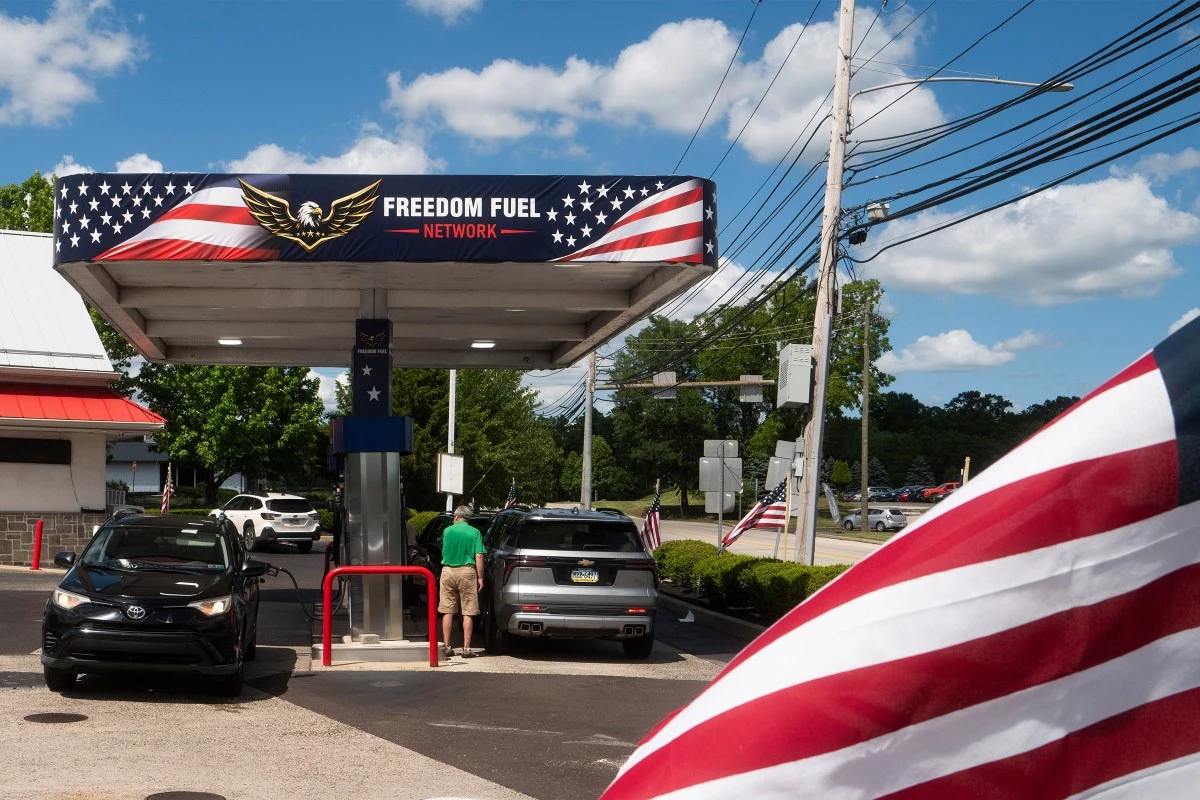
The White House’s rollout of the “Freedom Fuel” network arrived with a simple, emotionally resonant proposition: gasoline at $3.47 per gallon, framed as a form of patriotic consumer relief. Yet within days, the initiative collided with the realities of U.S. retail fuel pricing. Independent tracking from GasBuddy, cited by *The Hill*, showed prices at participating pumps ranging roughly from $3.57 to $4.49, a spread that looks less like a national guarantee and more like ordinary, location-specific volatility.
That gap is not merely a messaging problem; it highlights a structural truth about gasoline economics. Retail prices are the downstream expression of a complex stack—global crude benchmarks, refinery utilization, regional fuel specifications, distribution constraints, taxes, and station-level competition. Even if a central brand wants a uniform number on the sign, the market rarely cooperates without a mechanism to absorb losses.
White House spokespeople have pointed to local market forces as the explanation for the divergence. That is plausible, but it also implicitly concedes the central challenge: a fixed national pump price is not a policy lever; it is an operational commitment. If the commitment is not backed by supply control, enforceable contracts, or explicit fiscal support, the “network” risks being judged not by its intent, but by the price motorists actually pay.
Why crude oil and geopolitics make “fixed” pump prices hard to sustain
Energy analysts caution that the timing is unforgiving. Crude prices have been under upward pressure, supported by OPEC+ supply discipline and recurring geopolitical flashpoints—particularly in the Middle East and Eastern Europe—that can quickly reprice risk into oil markets. When crude rises, retail gasoline typically follows with a lag, and the lag is not a cushion so much as a countdown.
For consumers, the political appeal of price relief is obvious. Gasoline is a high-frequency purchase and a psychological inflation marker. For policymakers and operators, however, the economics are less pliable:
- Crude price pass-through is relentless: Even well-run retailers can’t sustainably sell below replacement cost without compensation.
- Regional constraints matter: Refinery outages, boutique fuel requirements, and pipeline bottlenecks can widen local spreads regardless of national messaging.
- Demand elasticity cuts both ways: Temporary discounts may boost local spending power, but if prices rebound—as markets often do—households feel the whiplash, and the program’s credibility becomes the casualty.
The deeper policy risk is that any attempt to hold prices down through subsidies or quasi-caps can distort incentives. Artificially suppressing retail prices may reduce the signal that encourages investment in refining capacity, logistics resilience, or alternative fuels. If Freedom Fuel depends on Treasury-linked support—explicitly or implicitly—it could also invite scrutiny over fiscal cost, distributional fairness, and precedent.
Rebranding versus reinvention: the operational questions investors and regulators will ask
Early reporting suggests Freedom Fuel may rely heavily on existing stations rebranded into a network, rather than a newly built, vertically integrated fuel enterprise. That distinction is decisive. A rebranding overlay can be fast and politically telegenic, but it raises immediate questions about who controls pricing and who eats the margin when the advertised number is below local market clearing levels.
Key operational uncertainties now sit at the center of the story:
- Business model ambiguity: Are station operators franchisees, marketing affiliates, or contractually bound sellers with enforceable pricing terms?
- Margin and subsidy mechanics: If a station sells at $3.47 while wholesale costs imply $3.90, who pays the difference—the operator, a central fund, or a temporary promotional budget?
- Scale and consistency: A patchwork of independent operators will face different rack prices and tax regimes, making a uniform national offer difficult to execute without sophisticated hedging and settlement systems.
- Advertising and compliance exposure: If consumers encounter prices materially above the promoted figure, the initiative could draw attention from state consumer protection authorities and regulators focused on misleading marketing claims.
This is where politically linked consumer ventures often struggle: the brand promise is national, but the delivery is local and operationally constrained. Critics have already drawn parallels to prior high-profile, publicity-forward ventures—meme coins and repackaged consumer tech—that generated attention but faced skepticism on durability. Whether those comparisons are fair or not, they underscore a reputational dynamic: a consumer staple like gasoline punishes overpromising quickly, because the receipt is immediate and the price is public.
Data-driven fuel retailing is the real battleground—politics is only the wrapper
Modern fuel networks increasingly compete on analytics, dynamic pricing, and digital engagement, not slogans. If Freedom Fuel aims to be more than a headline, it will need the infrastructure that sophisticated retailers use to manage volatility and customer retention.
That means capabilities such as:
- Real-time pricing intelligence: Integrating wholesale feeds, refinery margins, and local competitor pricing to adjust offers without breaking station economics.
- IoT-enabled operations: Monitoring tank levels, delivery timing, and shrink to reduce costs that otherwise force higher pump prices.
- A credible digital layer: A loyalty or subscription app could, in theory, offer targeted discounts funded by higher-margin convenience purchases—turning “price relief” into a measurable customer acquisition strategy.
- Supply chain transparency tools: Emerging pilots using distributed ledgers to track fuel origin and quality could reinforce any “American-made” narrative—if implemented with verifiable standards rather than marketing gloss.
The broader context matters, too. Persistent focus on gasoline prices can compete with the energy transition narrative, potentially slowing consumer urgency around EV adoption and charging buildout. At the same time, the Federal Reserve and markets watch energy prices as an inflation input, meaning any large-scale subsidy scheme—real or perceived—could become part of the macroeconomic debate.
Freedom Fuel’s early turbulence is less a surprise than a case study: branding can launch a network, but only supply strategy, transparent economics, and data-enabled execution can sustain it. In a market where geopolitics can move prices overnight and consumers verify claims at the pump, credibility is not a communications asset—it is an operational outcome.

 By
By
 By
By
 By
By
 By
By
 By
By