
A $2 Trillion SpaceX IPO Rewrites the Playbook for Frontier-Tech Capital Markets
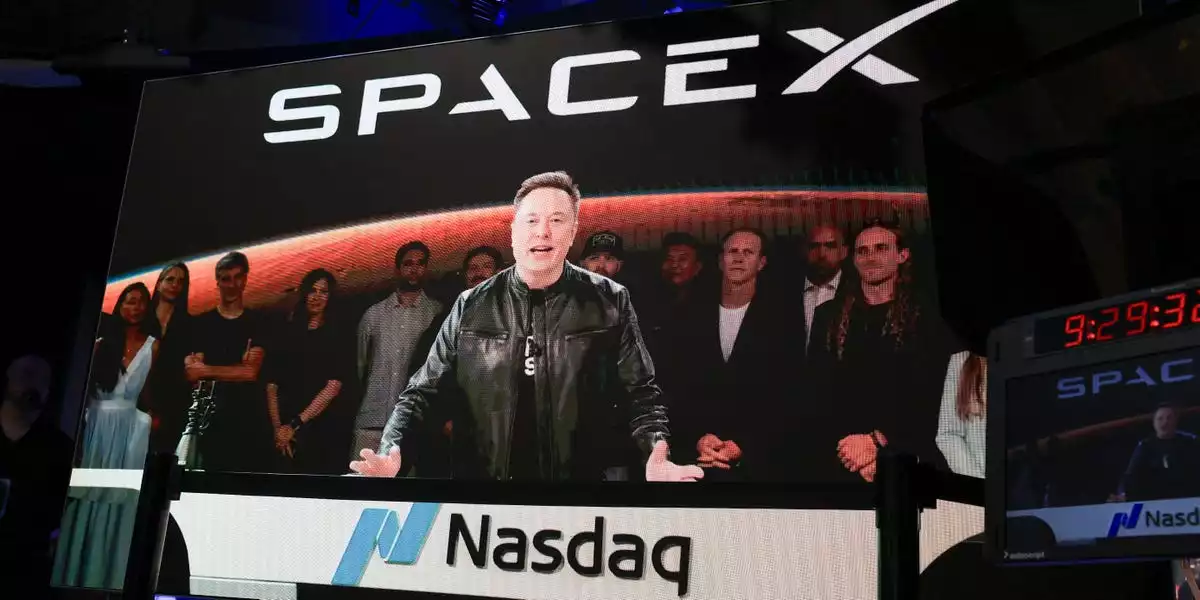
Elon Musk’s confirmation that SpaceX’s June IPO valued the company at roughly $2 trillion marks a watershed moment for public markets and for the broader business of space. Priced at $135 per share, the stock’s rapid climb above $200 before settling near $148 signals more than exuberance—it reflects a market repricing of what “infrastructure” means when the infrastructure is orbital, cislunar, and eventually interplanetary.
For investors, SpaceX’s debut functions as a high-visibility benchmark for capital-intensive innovation: a company with enormous fixed costs, long development cycles, and regulatory exposure nonetheless earning a valuation typically reserved for the most dominant platform businesses. That comparison is imperfect—rockets are not software—but the market is increasingly treating SpaceX as a multi-domain transportation and communications backbone, not merely a launch provider.
This reset has immediate second-order effects:
- Valuation gravity: late-stage private space and defense-adjacent ventures may face pressure to justify higher multiples, potentially inflating deal terms across launch, satellites, and space infrastructure.
- Portfolio rotation: asset managers who previously accessed the “space trade” through venture funds or private rounds can now do so via public equity, reshaping venture capital dynamics and liquidity expectations.
- Risk appetite signal: the IPO suggests renewed tolerance for frontier-tech risk even amid tighter monetary conditions, a notable message for deep-tech founders and CFOs calibrating fundraising strategies.
Equity Wealth Creation Meets Workforce Strategy—And a New Model of Corporate Citizenship
Perhaps the most socially resonant detail is not the valuation itself, but the distribution of upside. Routine stock option grants—at hiring, annually, and upon promotion—combined with biannual private liquidity events created a pipeline of wealth that reportedly produced about 4,400 new millionaires and more than 400 centimillionaires among early employees. In an industry known for burnout, long cycles, and intense competition for specialized talent, SpaceX has turned equity into a retention engine with unusual potency.
This approach carries implications well beyond Hawthorne:
- Talent alignment as strategy: equity is not simply compensation; it is a governance mechanism that binds execution culture to long-term outcomes.
- Recruiting leverage: for engineers weighing offers from legacy aerospace, defense primes, or top-tier AI firms, the prospect of meaningful ownership can outweigh base salary differentials.
- Competitive pressure: incumbents such as Boeing and Lockheed Martin—and challengers like Blue Origin—may need to modernize compensation and iteration models to remain competitive in both government and commercial arenas.
Alongside internal wealth creation, SpaceX leadership is also shaping a public-facing narrative about participation. CEO Gwynne Shotwell and her husband’s reported $300 million commitment of SpaceX stock to a U.S. children’s savings-account program stands out as a novel form of corporate citizenship: not a traditional cash donation, but an equity-linked bet on long-term value creation. If replicated, such mechanisms could become a template for governments and companies seeking to:
- broaden public buy-in for space programs,
- cultivate STEM pipelines through tangible financial participation,
- and build durable constituencies around industrial policy.
Starship as the Strategic Kernel: Vertical Integration, Dual-Use Transport, and the ISRU Bottleneck
Musk’s reiterated ambition—a lunar base, mass cargo transport via Starship, and a potential crewed Mars mission within five years with a self-sustaining settlement within a decade—is as much an industrial roadmap as it is a vision statement. The critical business insight is that Starship is positioned as a unified architecture: one heavy-lift system intended to serve multiple markets, from lunar logistics to Earth-to-Earth point-to-point transport.
That consolidation matters because it implies scale economics: fewer vehicle families, tighter learning loops, and a clearer path to lowering unit costs. Yet it also concentrates execution risk. Starship’s promise rests on two interlocking strategic choices:
- Vertical integration over modular supply chains: SpaceX’s internalization of key subsystems—engines, tanks, and core manufacturing—accelerates iteration and reduces dependency on slow-moving suppliers. The trade-off is that scaling production stresses internal capacity and creates new choke points in specialized inputs such as carbon composites, advanced alloys, and semiconductors.
- In-situ resource utilization (ISRU) as the hidden prerequisite: sustained lunar and Martian operations require local production of essentials—especially propellant. Musk’s timeline implicitly assumes breakthroughs in resource extraction, processing, and autonomous operations. Here, the most pragmatic near-term pathway is a broader ecosystem approach: public investment, academic partnerships, and early commercial pilots that de-risk ISRU before it becomes mission-critical.
For technology leaders, this is a reminder that the “space economy” is not only rockets and satellites; it is also mining, robotics, energy systems, materials science, and supply-chain resilience—disciplines that will determine whether ambitious timelines become repeatable operations.
Regulation, Geopolitics, and the New Reality of a $2 Trillion Private Space Power
A SpaceX valued at $2 trillion is not merely a company; it is a strategic actor with the capacity to shape standards, timelines, and national capabilities. That reality intensifies pressure on regulators and policymakers facing an expanding mission cadence and a more crowded orbital environment. The likely friction points are well-known but increasingly urgent:
- FAA licensing throughput as launch frequency rises
- FCC spectrum management amid competition with satellite constellations and terrestrial networks
- space traffic coordination and debris mitigation, where fragmented national rules risk creating operational uncertainty
- international norms for cislunar activity, where frameworks like the Artemis Accords will be tested by commercial scale
Meanwhile, SpaceX’s expansion will continue to generate regional economic spillovers—manufacturing, logistics, hospitality, and specialized services—especially around launch and testing sites. Local governments that treat spaceports as long-horizon industrial anchors, rather than episodic projects, may capture outsized benefits.
SpaceX’s IPO ultimately crystallizes a new paradigm: deep-tech enterprises can now reach mega-cap scale by combining aggressive equity alignment, vertically integrated R&D, and a platform-like approach to physical infrastructure. The next phase will be defined less by whether space is “commercial” and more by who sets the rules, who controls the bottlenecks, and which ecosystems form around the supply chains that make off-world logistics a repeatable business rather than a heroic exception.

 By
By
 By
By
 By
By

 By
By
 By
By