

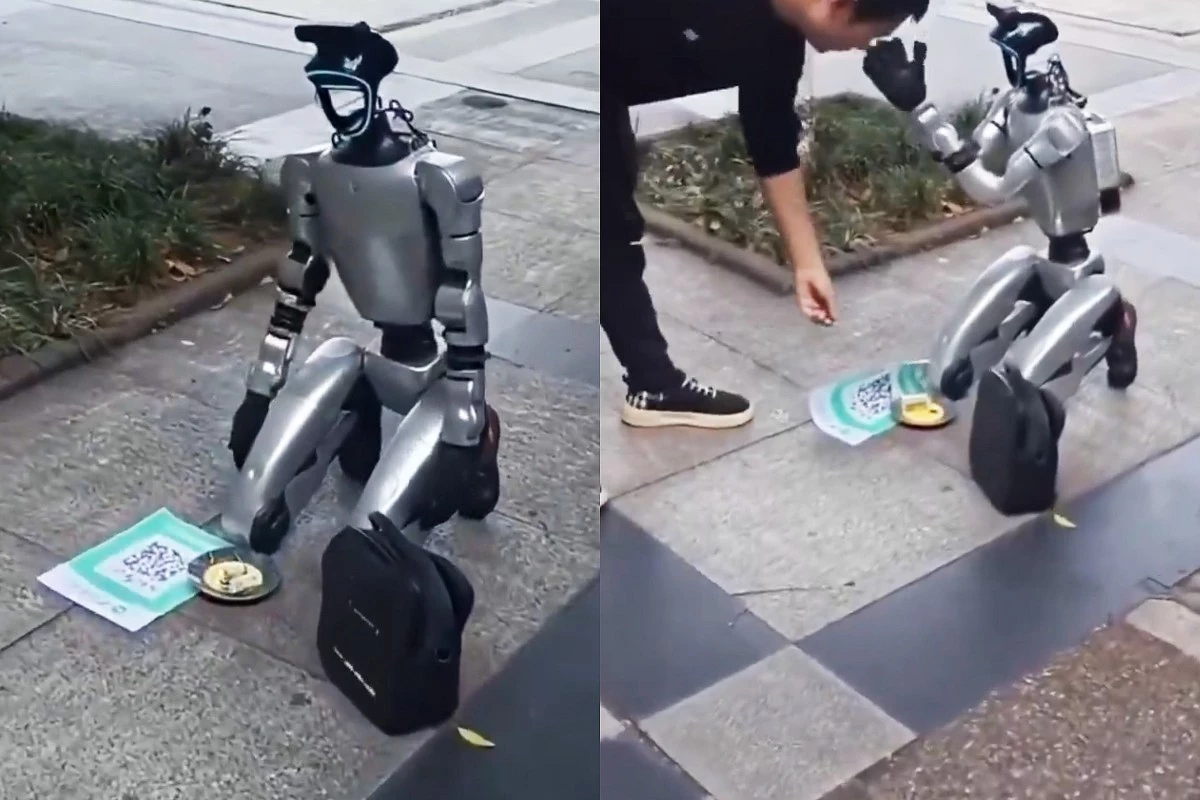

A viral humanoid in Chengdu exposes the real bottleneck: power, not personality
Footage from Chengdu showing a Unitree G1 humanoid robot apparently “begging” for help to pay its electricity bill has traveled quickly across Chinese social platforms, notably Rednote. The scene is comedic on its face—an expensive machine performing a human-coded act of vulnerability—yet it lands because it spotlights a constraint the robotics industry still struggles to disguise: energy endurance.
The robot’s reported two-hour battery life is consistent with many high-mobility humanoid prototypes, but it also underscores the gap between public-facing humanoids and the industrial robots that already dominate factory productivity. Fixed industrial systems are engineered for predictable duty cycles, controlled environments, and near-continuous uptime. Humanoids, by contrast, are often optimized for mobility, balance, and human interaction, all of which are power-hungry.
What makes the Chengdu clip strategically interesting is that it turns a technical limitation into a narrative hook. By framing battery depletion as a “bill” the robot cannot pay, the stunt translates engineering reality into a social metaphor that audiences instantly understand—and share.
Key technical signals embedded in the episode include:
- Battery endurance as the gating factor for real-world humanoid deployment (especially in public spaces where charging is non-trivial).
- Human-machine interaction (HMI) as the product, with anthropomorphism doing more work than payload, precision, or speed.
- Field exposure as informal testing, where public reactions become data—measuring empathy, discomfort, humor, and perceived agency.
Whether orchestrated or not, the moment functions like a live A/B test for the social acceptability of humanoids: not in a lab, but in the street.
Attention economics meets China’s robotics boom—and humanoids remain the showpiece
The unanswered question—who sponsored or authorized the stunt—is not a footnote; it is central to understanding the modern robotics market. If the episode was a guerrilla marketing move, it reflects a sector increasingly shaped by the attention economy, where visibility can be as valuable as technical milestones. If it was an unsanctioned prank, it still demonstrates how humanoids are becoming cultural objects that people feel entitled to remix, parody, and deploy as props.
This arrives at a moment when China is seeing record growth in industrial robotics deployment, with robot density rising and automation becoming a core competitiveness strategy. Yet humanoid robots remain, for most buyers, promotional rather than production-grade. The return on investment is often indirect:
- Media reach and brand differentiation in a crowded field of robotics OEMs and startups
- Investor signaling, where compelling demos can substitute for near-term unit economics
- Recruiting and ecosystem pull, attracting partners, developers, and enterprise pilots
The Chengdu “electricity bill” framing also hints at a deeper economic reality: robots do not merely replace labor; they shift costs into infrastructure. As humanoids proliferate—even before they become broadly useful—markets will increasingly price in the supporting stack: charging logistics, battery supply chains, maintenance networks, and electricity demand.
For business leaders, the practical takeaway is that robotics adoption is no longer just a capex decision. It is an opex and infrastructure planning decision, with energy as a recurring line item rather than an afterthought.
The ethics of engineered “distress” and the volatility of public trust
A humanoid robot performing distress—pleading for help—sits in an ethical gray zone that regulators and corporate governance teams are only beginning to map. The public is primed to interpret humanoid behavior socially, even when the system has no inner experience. That creates a new class of reputational and policy risk: machines that look like social actors will be treated like social actors, regardless of what engineers intend.
The viral response—amusement mixed with skepticism and discomfort—points to several societal fault lines:
- Automation anxiety reframed: not only “robots taking jobs,” but “robots needing resources,” competing for power, space, and attention.
- Empathy manipulation concerns: if a robot can convincingly perform need, who is accountable for the emotional effect on bystanders?
- Public-space governance: cities may respond with tighter rules on where and how humanoids can operate, especially if stunts blur entertainment, advertising, and autonomy.
For companies building or deploying humanoids, this is not theoretical. The more humanlike the interface, the more stakeholders will demand clarity on consent, disclosure, safety, and liability. A robot that appears to solicit help can trigger questions that a warehouse arm never will: Is it supervised? Is it collecting data? Is it advertising? Is it safe around children? Who pays if it causes harm?
The strategic implication is that narrative control becomes operational control. Firms will need rapid-response communications playbooks, clear labeling standards, and internal policies that anticipate viral moments rather than react to them.
What the Chengdu moment suggests about the next phase of humanoid robotics
China’s recent humanoid demonstrations—from half-marathon running to staged factory tasks—signal a national ambition to normalize robots in everyday life. The Chengdu clip fits that trajectory: it places a humanoid not behind glass, but in the social stream, where meaning is negotiated in real time.
Over the next several years, expect a bifurcation that this episode quietly foreshadows:
- Enterprise-grade humanoids that are less theatrical and more modular—built around service-level guarantees, swappable power systems, and constrained use cases (logistics, healthcare support, hazardous environments).
- Cultural-interface humanoids designed to be seen as much as used—appearing in retail, events, media, and public campaigns where interaction quality matters more than throughput.
The Chengdu “begging robot” is memorable because it compresses the industry’s contradictions into a single scene: breathtaking engineering paired with fragile endurance; grand narratives of autonomy paired with the mundane need to recharge; a machine marketed as the future, performing one of humanity’s oldest gestures of dependence.

 By
By
 By
By

 By
By
 By
By
 By
By
 By
By
 By
By







