


A century-long stewardship gives way to a new era of coastal capital
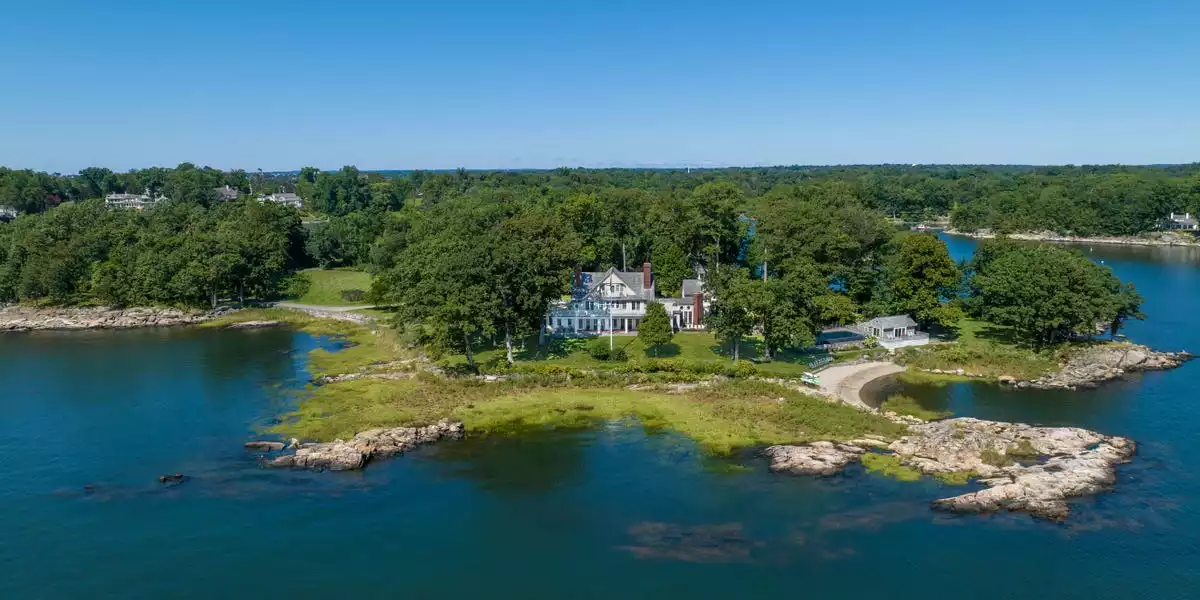
The Ziegler family’s sale of Hay Island, an 18-acre private estate off Connecticut’s coast, is more than a high-end real estate transaction—it is a signal event in how legacy wealth is being reorganized amid shifting risk, technology, and liquidity priorities. The property changed hands in November 2025 for $26.5 million, acquired by Hay Island CT II LLC, closing the final chapter of the family’s Connecticut island holdings after the 2023 sale of Great Island for $85 million.
On its face, Hay Island reads like a quintessential Long Island Sound retreat: an 8,684-square-foot New England colonial residence (built in 2010), a two-bedroom guest house, an infinity pool, and dual beachfronts. Yet the deeper story lies in what the divestiture represents. Multi-generational families are increasingly treating trophy properties less as permanent anchors and more as rebalancing levers—assets to be monetized when geographic dispersion, governance complexity, and opportunity cost begin to outweigh tradition.
For Connecticut’s coastal luxury market, the sale also underscores a subtle but important recalibration: buyers remain willing to pay for scarcity, access, and build quality, but they are increasingly pricing in the realities of climate exposure, insurance friction, and regulatory uncertainty. In that sense, Hay Island is not only a storied estate—it is a case study in how elite waterfront real estate is being repriced for a more data-driven era.
Luxury design as performance engineering, not just aesthetics
Architecturally, Hay Island’s main residence—attributed to Austin Patterson Disston—embodies a contemporary pattern in ultra-high-end construction: heritage styling paired with modern building science. The home’s library, chef’s kitchen, multiple fireplaces, and panoramic views of Long Island Sound are the visible markers of luxury. Less visible, but increasingly decisive for valuation, are the performance choices implied by the property’s positioning and era of construction.
In coastal markets, “beautiful” is no longer enough; resilience and maintainability have become part of the luxury definition. High-end waterfront estates now compete on their ability to withstand salt exposure, wind events, and moisture intrusion—factors that can materially affect long-term capex and insurability.
Key elements that typically differentiate properties at this tier include:
- High-performance building envelopes designed to reduce energy loss and mitigate humidity-driven degradation
- Coastal-grade materials selected for corrosion resistance and longevity in marine environments
- Advanced fenestration systems balancing views with wind performance and thermal efficiency
- Mechanical systems engineered for year-round occupancy, not just seasonal use
Technology is the other quiet driver. While specific smart-home features were not detailed, estates of this caliber increasingly operate as integrated systems—security, lighting, HVAC, pool operations, and remote monitoring unified under a single automation layer. With the new owner reportedly intent on further development, the next phase is likely to reflect the broader luxury-tech trajectory: IoT sensor networks, AI-assisted energy optimization, and predictive maintenance that reduces downtime and protects asset value.
Just as important is the island’s unusual logistical advantage: it is drivable from the mainland. That single attribute lowers operational complexity, expands year-round usability, and reduces dependence on marine transport—an infrastructural edge that can translate directly into higher functional value and smoother construction timelines for future upgrades.
What the $26.5 million sale says about the trophy-asset market in 2025
At roughly $1.53 million per acre, the Hay Island transaction sits comfortably within upper-tier coastal benchmarks, yet it also reflects a market that has become more selective. The post-pandemic surge in trophy pricing has not vanished, but it has matured into a more segmented landscape where buyers differentiate sharply between:
- Private retreats with limited optionality beyond personal use
- Assets with conversion potential, such as public access, conservation, or community integration
- Properties with infrastructure advantages, including road access, utilities, and buildable expansion capacity
The contrast with the family’s earlier divestiture is telling. The $85 million Great Island sale to the town of Darien for parkland use illustrates how public-sector or quasi-public outcomes can command premium pricing when they unlock broader civic value—recreation, tourism, and long-term community amenity. That dynamic is increasingly relevant as municipalities explore structured acquisitions, land swaps, and public-private partnership models to preserve shoreline access and environmental buffers.
For private buyers, meanwhile, the calculus has become more finance-forward. Higher interest rates and tighter underwriting standards have made even wealthy purchasers more attentive to carrying costs, insurance availability, and the future cost of compliance. In this environment, trophy assets still trade—but the premium increasingly goes to properties that can demonstrate durable usability, manageable risk, and upgrade pathways.
Family office strategy, climate risk modeling, and the rise of LLC-based ownership
The Ziegler family’s exit aligns with a broader family office trend: reducing concentration in illiquid legacy real assets and reallocating toward vehicles that offer scalability, diversification, and governance clarity—often private equity, venture exposure, or structured credit. As families disperse geographically, the “shared use” model that once justified large estates can become harder to sustain, especially when maintenance, staffing, and capital improvements require centralized decision-making.
Climate and regulation now sit at the center of that decision-making. Waterfront estates face growing scrutiny through:
- Climate risk analytics (flood mapping, storm surge modeling, sea-level projections)
- Evolving coastal-zone regulations affecting renovation, shoreline protection, and expansion
- Insurance market volatility, including higher premiums, exclusions, and stricter underwriting
- Emerging financial tools such as parametric insurance and resilience-linked financing structures
The buyer’s use of a single-purpose LLC—Hay Island CT II LLC—also reflects the enduring mechanics of high-net-worth real estate: liability containment, privacy, and transactional flexibility. That structure is not merely a legal footnote; it is part of how modern wealth manages exposure in an era where physical assets are increasingly evaluated alongside cyber risk, data privacy, and reputational considerations.
Hay Island’s sale ultimately captures a broader shift: luxury real estate is no longer just a symbol of permanence. It is being treated as a strategic holding—measured against climate-adjusted risk, technology-enabled operability, and the opportunity cost of capital in a market where the next decade’s winners may be defined less by what they own, and more by how quickly they can adapt.

 By
By
 By
By

 By
By
 By
By

 By
By
 By
By







