

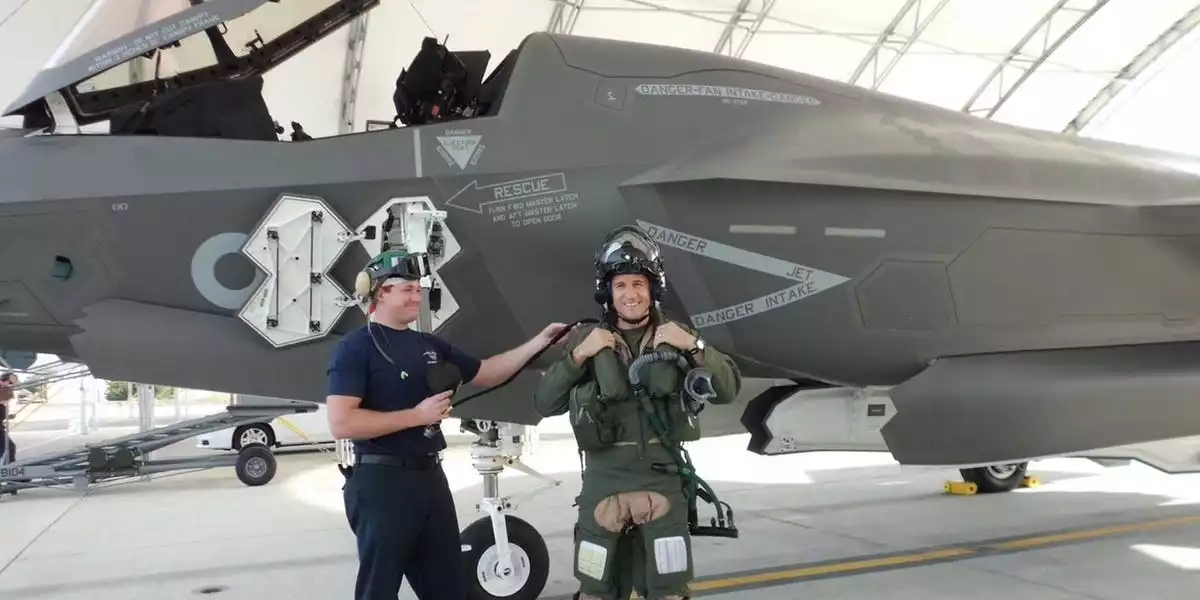

A pilot’s arc that tracks the industry’s pivot from airframes to information
Dave Berke’s 23-year career as a U.S. Marine Corps fighter pilot—roughly 3,000 flight hours across the F/A-18 Hornet, F-16 Fighting Falcon, F-22 Raptor, and F-35B Lightning II—reads less like a personal résumé and more like a compressed history of modern combat aviation’s central transformation: the shift from platform-centric performance to data-centric advantage.
In fourth-generation aircraft, tactical excellence was often expressed through kinetic fundamentals: energy management, visual-range decision-making, and the mechanical limits of radar and weapons employment. Berke’s reflections highlight how those strengths remain relevant—yet increasingly subordinate to a new determinant of airpower: situational awareness at machine speed.
What emerges from his experience is a clear throughline for defense planners and aerospace executives alike: the fighter is no longer merely a fast jet with missiles. It is a networked sensor-and-shooter node, competing in a battlespace where detection, classification, electronic survivability, and secure data-sharing can decide outcomes before a pilot ever sees an adversary.
—
Fourth- to fifth-generation capability: why stealth and sensors changed the math
Berke’s comparisons between aircraft underscore a crucial point for understanding fifth-generation value: the leap is not incremental. It is architectural.
Fourth-generation strengths—as represented by the Hornet and F-16—reflect a mature era of aerodynamic performance and multi-role flexibility:
- F/A-18 Hornet: widely regarded as a pragmatic multi-role workhorse, balancing payload, carrier compatibility, and mission versatility.
- F-16 Fighting Falcon: emblematic of “raw performance uplift,” with high agility and a reputation for pilot-favored handling.
Yet Berke’s assessment that the F-22 Raptor is “peerless” points to the specific combination that redefined air combat:
- Low observability (stealth): reducing detection range and compressing an opponent’s decision window.
- Thrust-vectoring super-maneuverability: enabling post-stall maneuvers that disrupt traditional “energy-state” assumptions.
- Advanced sensor suite and fusion: allowing the aircraft to build a more coherent tactical picture faster than a human can assemble from separate inputs.
The deeper implication is that stealth is not simply about being “hard to see.” It is about controlling the engagement timeline—who detects first, who tracks first, who shoots first, and who can disengage without being targeted. In that context, the Raptor’s blend of signature management and kinematic authority becomes a force multiplier rather than a feature list.
The F-35B, meanwhile—where Berke became the first operational Marine to fly it—represents the operationalization of that information-centric approach at scale. If the F-22 previewed the fusion of stealth and sensors, the F-35 institutionalizes it through a design philosophy that treats software, data links, and sensor integration as core combat systems rather than add-ons.
—
The business of fifth-generation airpower: cost curves, supply chains, and the software-defined jet
Berke’s career also illuminates the economic reality behind the technological leap: fifth-generation capability carries a life-cycle price tag that reshapes procurement strategy, sustainment models, and industrial planning.
Key pressures shaping the defense aviation market include:
- High acquisition and sustainment costs: fifth-generation fighters often exceed $100 million per aircraft, with operating costs measured in tens of thousands of dollars per flight hour. This forces hard trade-offs between fleet size and high-end capability.
- Supply chain volatility: advanced composites, microelectronics, and high-thrust engines are exposed to inflation, constrained capacity, and geopolitical risk—factors that can ripple into readiness rates and delivery schedules.
- Workforce skill premiums: exploiting sensor fusion, electronic warfare systems, and mission-data tuning requires not only pilots, but also maintainers, software engineers, and data specialists—talent pools that are globally competitive and increasingly scarce.
Just as important is the industry’s shift toward continuous modernization. The F-35’s trajectory reflects a broader aerospace pattern: capability is increasingly delivered through software-defined upgrades rather than discrete, hardware-centric “block” leaps. For primes and suppliers, this changes revenue timing, certification burdens, cybersecurity obligations, and the cadence of integration testing. For governments, it reframes readiness as a function of update velocity and data integrity, not only airframe availability.
Interoperability also becomes an industrial and organizational challenge. Cross-service exchanges—such as Marine aviators flying Air Force Raptors—create valuable knowledge spillovers, but they also raise the stakes for common data standards, unified training pipelines, and coalition-compatible networking.
—
Where the trajectory points next: manned-unmanned teaming and the race for information dominance
Berke’s progression—from kinetic fighter tactics to network-centric combat—maps directly onto the strategic direction now shaping sixth-generation programs and force design debates. The emerging consensus is that future air superiority will be determined by information dominance, resilient connectivity, and the ability to integrate diverse assets into a coherent kill chain.
Several non-obvious connections stand out for business and technology stakeholders:
- Platforms as nodes in an information mesh: fighters, unmanned systems, electronic-attack aircraft, and space-based sensors increasingly function as a single distributed system—making C4ISR investment as decisive as airframe procurement.
- Balancing exquisite and attritable assets: high-end fighters like the F-22 and F-35 may be paired with lower-cost unmanned systems to extend coverage, absorb risk, and complicate adversary targeting—an approach that could improve cost-effectiveness without diluting capability.
- Industrial base resilience as strategic leverage: reliance on a small number of prime contractors and specialized suppliers creates concentration risk. Momentum toward modular open-systems architectures and more competitive mid-tier participation is not just an efficiency play; it is a hedge against disruption.
For executives tracking defense-adjacent innovation, the likely growth areas are clear: embedded AI decision aids, digital twins, additive manufacturing, and end-to-end component provenance and cybersecurity. For defense leaders, the human factor remains decisive: pilots like Berke are valuable not only for hours flown, but for the operational intuition required to translate sensor fusion and networked warfare into real advantage—an edge that must be cultivated through advanced training ecosystems, not assumed.
Air combat is still about speed, skill, and survivability—but the decisive arena has expanded. The aircraft that wins is increasingly the one that knows more, sooner, and shares it securely, turning information into action before the opponent realizes the fight has already begun.


 By
By
 By
By
 By
By
 By
By


 By
By







