
A blockbuster SpaceX IPO meets the market’s demand for measurable cash flow
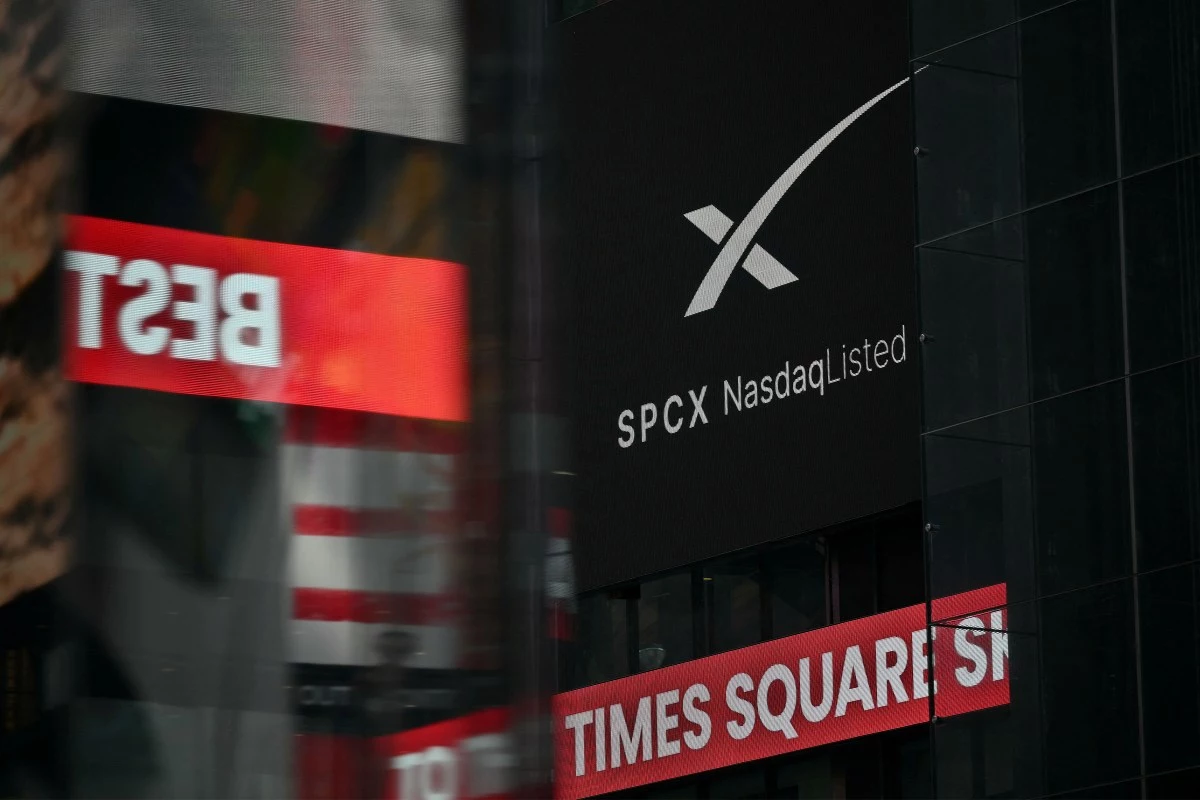
SpaceX’s June 12 public-market debut delivered the kind of opening act that modern growth investors have been conditioned to chase: shares opened at $150, surged past $225, and briefly implied a near-$3 trillion valuation. The reversal was just as dramatic. Within days, the stock suffered a 17% one-day drop, slid to an all-time low just above the IPO price, and erased the entire post-IPO gain before stabilizing in the mid-$150s—a rebound that has done little to calm the underlying volatility.
This price action is less a verdict on SpaceX’s engineering prowess than a real-time stress test of how public markets price capital-intensive frontier technology. The company is being valued not only on what it sells today—launch services and Starlink broadband—but on what it promises tomorrow: an AI-enabled space economy featuring autonomous orbital data centers, interplanetary networking, and space-based analytics. The correction suggests investors are now asking a sharper question: what portion of that future is financeable, provable, and monetizable on a public-company timeline?
Several forces appear to be converging:
- Narrative compression: the market rapidly priced in multiple future businesses that are not yet de-risked.
- Risk-off contagion: the sell-off coincided with broader pressure across AI-adjacent tech names, from AMD to Nvidia, as “AI bubble” concerns resurfaced.
- Valuation friction: comparisons to early Tesla—particularly around P/E gaps and expectation-setting—are increasingly shaping investor skepticism.
The technology roadmap: proven launch economics versus speculative orbital compute
SpaceX’s current commercial foundation is comparatively legible: a high-cadence launch business and a fast-scaling satellite broadband network. Starlink, in particular, provides recurring revenue dynamics that traditional aerospace rarely achieves. Yet the market’s most aggressive valuation assumptions appear tied to a different thesis: SpaceX as the backbone of space-based AI infrastructure, including orbital data centers and edge-compute nodes.
That vision is not implausible, but it is early. The key issue is a proof-point deficit: limited public evidence of prototypes, anchor customers, or unit economics for orbital compute at scale. Without those, investors are left to price a concept rather than a product—an uncomfortable posture in a market that has become less tolerant of long-duration bets.
At the same time, SpaceX is not building in a vacuum. Competitive and institutional crosscurrents are intensifying:
- LEO broadband competition: Amazon’s Project Kuiper and players like OneWeb continue to expand the low-Earth-orbit connectivity race, narrowing the narrative that Starlink is the only credible global option.
- Defense-driven demand: governments are exploring space-based ISR (intelligence, surveillance, reconnaissance) and resilient communications—use cases that could support edge computing in orbit, but often come with procurement complexity and policy constraints.
- Platform tension: SpaceX must balance its “pipeline” business (launch cadence and satellite deployment) with “platform” ambitions (services layered on top of orbital infrastructure). Execution missteps in one can quickly undermine confidence in the other.
For public-market investors, the distinction matters: launch and broadband can be modeled, while orbital data centers remain largely speculative until milestones—technical demonstrations, contracted demand, and operational reliability—become visible.
Valuation, cash burn, and the cost of capital: the real gravity problem
The post-IPO surge looked like a classic “story stock” moment—where brand, vision, and category leadership overwhelm near-term financial scrutiny. The subsequent repricing suggests the market is reasserting a more traditional discipline: cash flow matters, and capital is not free.
Analysts’ warnings that tens of billions in additional capital may be required to fund orbital infrastructure, satellite manufacturing, and R&D go to the heart of the matter. If SpaceX is not yet generating positive free cash flow, the company’s strategic freedom becomes tethered to financing conditions—particularly in an environment of higher interest rates and more selective equity markets.
Key financial dynamics now shaping sentiment include:
- Dilution risk: large equity raises can pressure per-share value, especially if tied to ventures without near-term revenue.
- Cost-of-capital pressure: debt financing becomes more expensive as rates rise, and lenders demand clearer cash-flow pathways.
- Multiple compression: when markets rotate away from high-growth, low-profitability equities, valuation multiples can fall faster than fundamentals change.
This is where the Tesla analogy becomes instructive but incomplete. Tesla ultimately benefited from a massive, addressable consumer market and a clear manufacturing learning curve. SpaceX’s addressable markets—launch, broadband, defense, and potential orbital compute—are substantial, but they are also more regulated, more capital intensive, and more geopolitically entangled.
What executives, partners, and regulators will watch next
For corporate leaders evaluating SpaceX as a supplier, partner, or strategic dependency, the IPO volatility is not just a trading story—it is a signal about execution risk and financing durability. The most consequential near-term catalysts are likely to be operational, not rhetorical: Starship progress, Starlink margin trajectory, and credible steps toward new service lines.
Three non-obvious linkages may become increasingly central to SpaceX’s investment case and partnership appeal:
- Data center decarbonization pressure: as terrestrial data centers face tightening carbon rules, orbital compute—powered by solar and aided by radiative cooling—could become a niche complement for specific workloads, if latency, reliability, and economics can be proven.
- Resilient edge infrastructure: space-based compute nodes could serve as hardened backstops for critical systems amid cyber and physical threats, aligning with defense modernization and disaster recovery priorities.
- Regulatory and geopolitical gating factors: spectrum allocation, space-traffic coordination, and U.S.–China rivalry can delay deployments or reshape economics, making proactive regulatory engagement a strategic necessity rather than a compliance afterthought.
For investors and boards, the practical takeaway is that SpaceX’s public-market era will reward communication discipline and milestone-driven credibility. Transparent timelines toward cash-flow breakeven, clearer disclosure on Starlink profitability, and demonstrable progress on orbital data center feasibility would do more to stabilize valuation than any expansion of the narrative. The market has shown it will fund ambition—but only at the price of proof.

 By
By
 By
By
 By
By


 By
By
 By
By
 By
By