

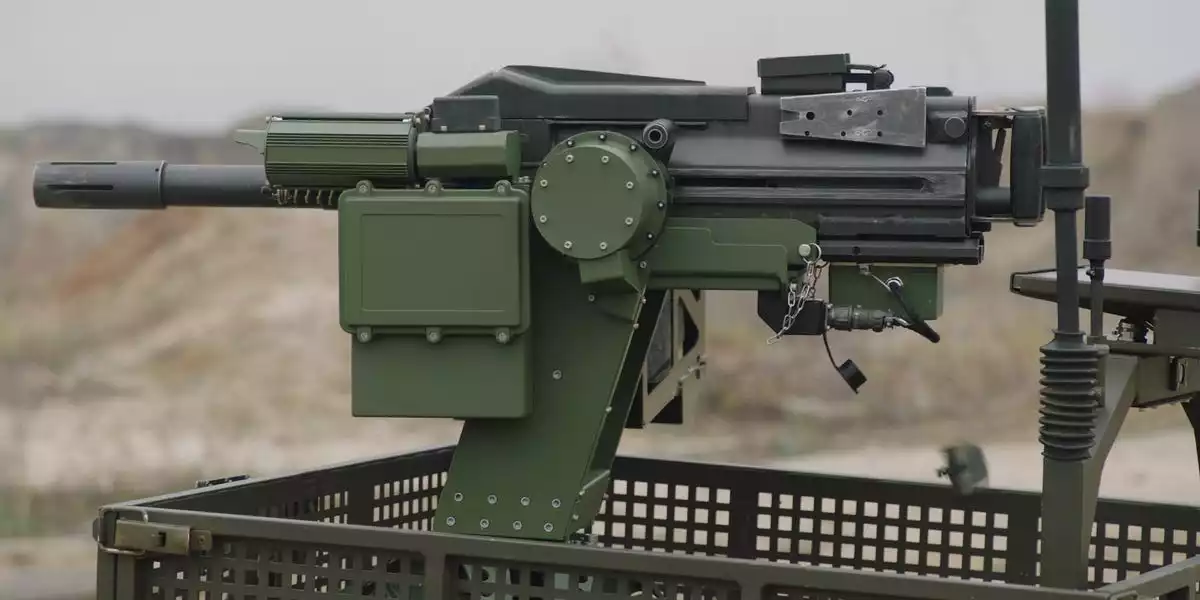

Ukraine’s weaponized ground robots signal a new era of battlefield labor—and battlefield economics
Ukraine’s rapid deployment of weaponized unmanned ground systems (UGSs)—including compact “small tank” platforms retrofitted with Frontline Robotics’ Buria turrets—is more than a tactical adaptation to a drone-saturated front. It is an early, high-visibility case study in how modern warfare is being reorganized around distributed robotics, compressed innovation cycles, and industrial resilience.
Operationally, these ground robots are being used for a spectrum of missions that historically forced soldiers into exposed positions: reconnaissance, direct fire support, casualty evacuation, and resupply. Their reported ability to operate at standoff ranges of roughly 20–50 kilometers and traverse forested terrain underscores a key point: UGS value is not limited to open-field maneuver warfare. It extends into the cluttered environments—tree lines, villages, broken urban edges—where drones, mines, and artillery have made human movement increasingly costly.
The scale of use is equally telling. With tens of thousands of evacuation and logistics sorties reported this year, Ukraine appears to be treating UGS not as a niche capability but as a repeatable operational utility—a kind of ground-layer counterpart to the proliferation of aerial drones. In practice, this shifts robotics from “special equipment” to infrastructure, altering how commanders think about tempo, sustainment, and acceptable risk.
Agile defense engineering moves from slogan to battlefield operating system
Perhaps the most consequential development is not the turret or the chassis, but the development model behind them. Ukraine’s defense robotics ecosystem is demonstrating a form of combat-driven agile engineering that resembles commercial software practices—DevOps, continuous integration/continuous delivery (CI/CD), and rapid iteration—translated into hardware and mixed hardware-software systems.
Reports of up to 20 incremental iterations per month and major upgrades on a biannual cadence suggest a feedback loop where frontline operators effectively become product managers, and battlefield telemetry becomes a continuous requirements document. Competing firms such as DevDroid adopting similar rhythms indicates this is not a one-off success story; it is an emerging industry pattern.
This matters because traditional defense procurement in many countries is optimized for:
- Long certification cycles
- Fixed requirements
- Platform longevity measured in decades
- Centralized prime-contractor control
Ukraine’s approach points toward a different equilibrium—one where survivability and relevance come from fast adaptation rather than exquisite, high-cost platforms. In a contested environment shaped by electronic warfare, loitering munitions, and ubiquitous ISR, the “best” system is often the one that can be updated, repaired, and redeployed quickly, even if individual units are expendable.
For Western defense establishments and OEMs, the implication is uncomfortable but clear: the competitive benchmark is shifting from “performance at delivery” to performance over time, driven by how quickly a system can absorb new sensors, new countermeasures, and new operator workflows.
From remote control to autonomy: sensor fusion as the gateway capability
Today’s Ukrainian ground robots are described as human-operated, which is an important constraint in both ethics and reliability. Yet the architecture being fielded—advanced optics, thermal imaging, encrypted command links, and modular weapon stations—is precisely the substrate needed for higher autonomy.
The near-term trajectory is less about fully autonomous “killer robots” and more about semi-autonomous functions that reduce operator burden and speed decision cycles, such as:
- Assisted navigation (route following, obstacle avoidance, return-to-home behaviors)
- Stabilized targeting and tracking using fused electro-optical/thermal feeds
- Operator cueing (alerts for movement, heat signatures, or likely threats)
- Degraded-communications modes that maintain safety and mission continuity under jamming
In parallel, the battlefield is already an adversarial laboratory for electronic warfare hardening. As reliance on remote links grows, so does exposure to jamming, spoofing, interception, and cyber intrusion. That makes resilience features—frequency hopping, robust encryption, authentication, and fail-safe behaviors—not optional add-ons but core design requirements. The side that best integrates autonomy with communications resilience will compress its “observe–orient–decide–act” loop while maintaining control and accountability.
Industrial localization, dual-use spillover, and the global arms market’s next benchmark
Ukraine’s UGS surge also highlights a strategic industrial lesson: localized supply chains and domestic engineering capacity can be decisive in prolonged conflict. By building and iterating systems closer to the point of need, manufacturers reduce dependency on fragile international logistics and can respond to battlefield-driven design changes without waiting for multi-quarter procurement amendments.
This localization has broader economic implications. Many of the enabling components—electric drivetrains, remote-control stacks, modular payload interfaces, ruggedized communications—are inherently dual-use. The same robotics platforms that move ammunition under fire can, in a different context, support:
- Mining and heavy industry (remote operations in hazardous zones)
- Agriculture (autonomous hauling, precision field logistics)
- Disaster response (search, debris movement, supply delivery)
- Infrastructure inspection and repair (remote work in contaminated or unstable environments)
For global defense markets, Ukraine’s experience may become a new reference point for what “modern” procurement should reward: modularity, open architectures (MOSA), and rapid technology insertion. Western procurement frameworks—especially in NATO countries—could face pressure to streamline certification and adopt standards that let third parties plug in sensors, turrets, autonomy modules, and counter-EW packages without redesigning the entire platform.
Strategically, the battlefield logic is straightforward: distributed ground robots reduce troop exposure, complicate adversary targeting, and offer a survivable complement to vulnerable high-value assets. Geopolitically, the message is sharper: defense innovation is becoming a form of leverage, shaping partnerships, technology transfers, and postwar reconstruction pathways. The countries and companies that learn to build, update, and secure robotic systems at operational speed will not just influence future conflicts—they will define the industrial rules of the next defense cycle.

 By
By

 By
By

 By
By

 By
By
 By
By







