


A desert-scale instrument that reframes what “fast” means in radio astronomy
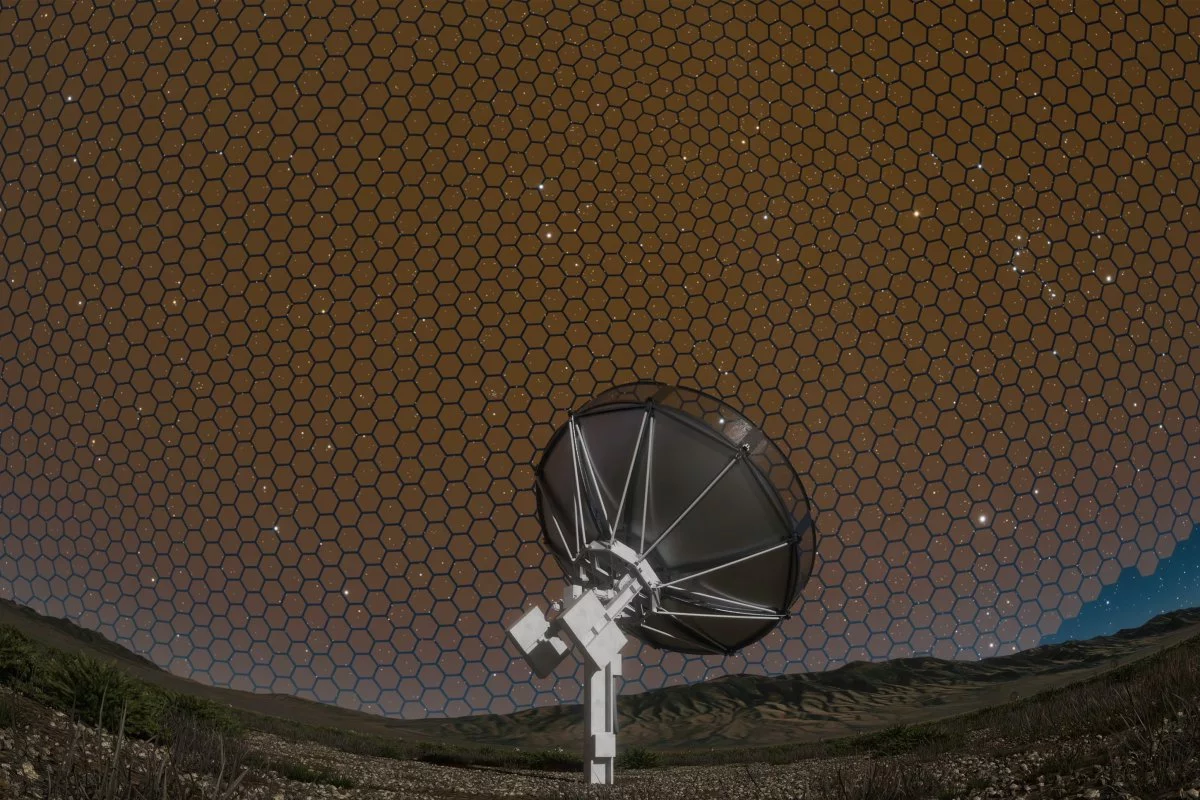
Caltech’s planned Deep Synoptic Array (DSA) is being positioned not merely as a new telescope, but as a new operating model for observational science—one that treats the sky as a continuously monitored system rather than a set of targets to be visited. With 1,650 radio dishes, each roughly 20 feet in diameter, distributed across a 12-by-10-mile remote Nevada site, the DSA aims to function as a single, coordinated instrument through distributed aperture synthesis. The ambition is stark: survey the entire visible sky multiple times within five years, delivering in a day what legacy approaches can take years to assemble.
If achieved on schedule for 2029, the DSA would become a defining example of how modern astronomy is increasingly shaped by the same forces remaking enterprise technology: massively parallel hardware, high-throughput networking, and real-time data pipelines. The project’s projected scientific yield—around one billion newly detected radio sources, compared with roughly 20 million catalogued today—signals a step-change in scale. But the deeper story is how that scale is being engineered: by treating sensitivity, speed, and openness as co-equal design constraints rather than trade-offs.
Engineering the “large-N” array: sensitivity, correlation, and the petabyte problem
At the heart of the DSA concept is a bet that large numbers of modest dishes, intelligently synchronized, can outperform smaller collections of bespoke instruments. This is not new in principle—aperture synthesis has long been foundational in radio astronomy—but the DSA pushes it into an era where the limiting factor is less the metal in the ground and more the compute and I/O architecture that turns raw signals into usable sky maps.
Key technical drivers stand out:
- Aperture synthesis at unprecedented element count: Orchestrating 1,650 elements across a wide footprint increases spatial resolution and sky coverage, but it also risks the classic “large-N” penalty where sensitivity can be lost if receivers and calibration are not engineered with extreme care. The DSA’s approach emphasizes reclaiming that sensitivity through receiver design and signal processing tuned for scale.
- Real-time correlation at extreme data rates: Combining signals from hundreds to thousands of antennas requires correlation engines capable of handling petabyte-scale data streams. This is where the DSA begins to resemble hyperscale computing: the challenge is not only raw FLOPS, but data movement, latency, and bottleneck avoidance across the pipeline.
- Near–real-time access as a product requirement: The plan to provide rapid data availability to both researchers and the public implies a system designed for continuous ingestion, processing, and publishing, rather than periodic releases. That operational posture has implications for storage tiers, metadata standards, and automated quality control—areas where modern data engineering practices will be as important as astronomy expertise.
For business and technology leaders, the DSA reads like a live case study in edge-to-core architecture: what must be processed on-site to reduce bandwidth and latency, what can be shipped to centralized compute, and how to maintain scientific integrity while automating decisions at machine speed.
From cake pans to capital strategy: manufacturing, supply chains, and regional economics
One of the most revealing signals in the DSA story is not a new algorithm, but a supplier: Fat Daddio’s, a cake-pan manufacturer enlisted to help produce lightweight, cost-effective metal dishes. The partnership is more than a quirky anecdote; it reflects a broader industrial pattern in advanced hardware programs—repurposing high-precision, high-throughput commercial fabrication rather than defaulting to slow, bespoke aerospace-style procurement.
This cross-industry collaboration highlights several implications:
- Agile supply chains for scientific infrastructure: If a consumer manufacturing process can meet tolerance, durability, and cost targets, it can compress timelines and reduce unit costs—an approach that may generalize to other capital-intensive domains such as satellite components, specialized enclosures for quantum systems, and RF hardware.
- A multi-hundred-million-dollar signal of long-horizon investment: The DSA’s budget underscores continued willingness—public and private—to fund frontier research even amid macroeconomic uncertainty. The return is not only scientific prestige; it is also instrumentation IP, workforce development, and potential spin-out technologies in sensors, networking, and compute.
- Rural Nevada as an infrastructure beneficiary: Large scientific installations can act as anchor projects for regional economies through construction, logistics, and ongoing operations. In an era where industrial policy increasingly emphasizes geographic distribution, the DSA offers a model of distributed infrastructure investment outside traditional coastal tech hubs.
The subtext is that “big science” is evolving into a more modular, procurement-savvy ecosystem—one that looks increasingly like advanced manufacturing and less like artisanal engineering.
Open data, spectrum politics, and the next frontier for edge AI
Perhaps the most strategically consequential choice embedded in the DSA plan is its posture toward data: near-immediate public release. That approach treats observational output as a shared asset—fuel for discovery not only in academia, but also in adjacent fields such as machine learning, signal processing, and RF analytics. Open, high-cadence data streams can catalyze:
- Citizen-science and developer ecosystems built around alerts, anomaly detection, and visualization tools
- Startups offering value-added analytics, indexing, and domain-specific models trained on radio sky dynamics
- Cloud and platform partnerships that productize access, governance, and compute-on-data workflows for institutions without bespoke infrastructure
Yet openness and speed also intensify the policy and operational constraints around the array. The DSA’s remote siting underscores a growing tension: as 5G expansion, satellite internet constellations, and defense systems proliferate, radio-quiet zones become harder to preserve. Any spectrum protections sought for the DSA could influence future FCC proceedings and set precedents for how scientific users coexist—or compete—with commercial deployments.
Technically, the DSA also points toward a convergence with edge AI. The need to triage torrents of data in real time makes a compelling case for on-site inference using FPGAs or AI accelerators, mirroring patterns seen in autonomous systems and industrial IoT. Add the realities of desert operations—power constraints, thermal management, and reliability—and the array becomes a proving ground for energy-efficient compute and remote microgrid design, with lessons transferable to data centers and telecom infrastructure.
The DSA’s promise is astronomical, but its significance is equally terrestrial: a blueprint for how ambitious science increasingly depends on scalable computing, unconventional manufacturing, open-data economics, and spectrum governance—disciplines that now sit at the center of competitive advantage in business and technology.

 By
By
 By
By

 By
By
 By
By

 By
By
 By
By







