

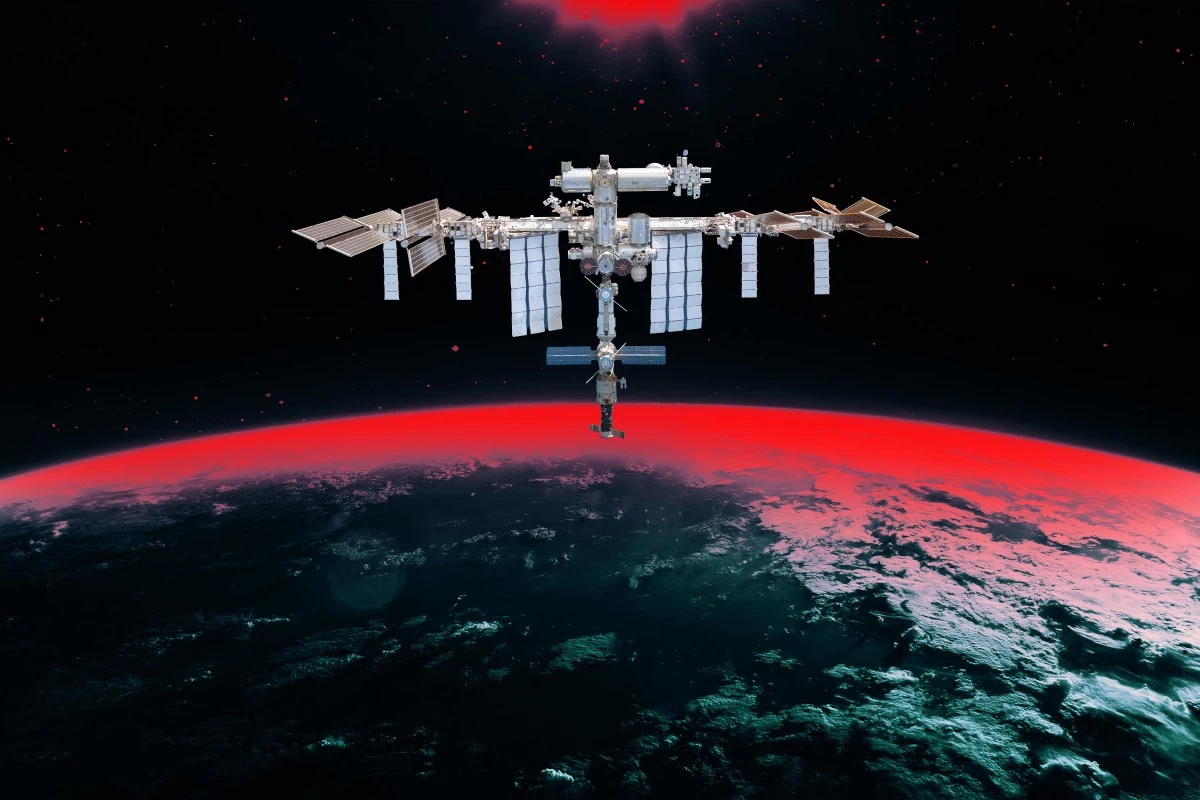

A containment drill that doubled as a governance stress test in low Earth orbit
NASA’s June 5 disclosure—that five International Space Station (ISS) crew members temporarily sheltered inside a docked SpaceX Dragon while Russian engineers pursued emergency work on the Russian-built PrK module—reads like a procedural safety measure. Yet the episode carries broader significance: it exposed how technical fragility, operational authority, and geopolitical mistrust can converge into a single moment of risk management in low Earth orbit (LEO).
The PrK module’s intermittent air leaks, reportedly observed since at least 2019, have long been treated as a manageable defect within the ISS’s aging ecosystem. What changed this time was the combination of escalating repair tactics—including reported use of power tools such as a handsaw and drill—and a deterioration in NASA–Roscosmos coordination. NASA’s decision to move crew into Dragon signaled that the agency judged the probability of sudden depressurization, however uncertain, to be operationally non-trivial.
Just as importantly, the public nature of the disclosure suggests NASA wanted to establish a clear record of its safety posture and decision logic. In an era where ISS operations are increasingly intertwined with commercial spacecraft and future commercial stations, transparency becomes part of risk governance—not merely a communications choice.
The PrK leak as a case study in orbital maintenance limits and diagnostic blind spots
Technically, the PrK leak underscores a reality that aerospace engineers have been warning about for years: the ISS is a quarter-century-old, continuously inhabited system operating far beyond the assumptions that shaped many of its early design margins. Fatigue cracks and seal failures are not anomalies in such an environment; they are the predictable outcome of:
- Thermal cycling across extreme orbital temperature swings
- Micrometeoroid and orbital debris exposure that accumulates over time
- Material aging and microfracture propagation in pressure-bearing structures
- Complex interfaces between modules built to different national standards and eras
The reported reliance on hand-operated or improvised tooling—especially tools not purpose-built for spacecraft structural repair—highlights a deeper capability gap. Modern aviation and industrial infrastructure increasingly rely on standardized inspection regimes, non-destructive evaluation, and modular replacement. In orbit, the toolkit is narrower, the environment is harsher, and the cost of a misstep is existential.
Equally consequential is the data problem. Sparse telemetry on crack growth and pressure transients can leave mission teams debating not only *what to do*, but *what is happening*. The PrK episode illustrates why the next generation of space infrastructure is likely to treat sensor density and predictive analytics as core architecture rather than optional upgrades. For ISS-like platforms and their successors, the most valuable maintenance technology may not be a new sealant—it may be the ability to forecast failure with enough confidence to avoid emergency posture altogether.
Key technology needs emerging from this incident include:
- Pervasive sensor networks for strain, acoustic emissions, and microleak localization
- Digital twin modeling to simulate crack propagation and pressure dynamics in real time
- AI-driven anomaly detection tuned to orbital operational noise and false positives
- Robotic or semi-autonomous repair systems that reduce reliance on ad hoc manual methods
The economics of extending the ISS versus accelerating commercial LEO alternatives
The ISS represents over $150 billion in cumulative investment, and its continued operation through 2030 and potentially beyond is often framed as a bridge to commercial successors. The PrK situation complicates that narrative by making the marginal costs of extension more visible—especially when emergency repairs compete with budgets for lunar programs, deep-space exploration, and commercial LEO development.
When a single module’s degradation forces contingency sheltering in a crew vehicle, it sharpens the economic question: How much should stakeholders spend to preserve legacy capability versus shifting resources to replace it? This is where commercial station proposals—such as Axiom Space, Nanoracks concepts, and Blue Origin’s Orbital Reef—gain strategic leverage. Their pitch is not only innovation, but a different risk-and-capital model: private operators absorb more of the development burden while agencies become anchor tenants.
Sanctions and supply-chain fragmentation add another layer. Restrictions affecting Russia’s space sector can complicate access to specialized components, adhesives, and metallurgical inputs. Meanwhile, Roscosmos’s pivot toward domestic sourcing may introduce:
- Higher unit costs due to reduced supplier competition
- Longer lead times for specialized materials
- Certification and interoperability friction with international partners
These “hidden costs” don’t always appear as line items, but they accumulate as schedule risk, integration overhead, and operational uncertainty—precisely the factors that make aging infrastructure harder to justify.
A shift in space power dynamics—and a preview of how future stations may be run
The PrK dispute also functions as a geopolitical signal. US–Russian cooperation on the ISS has long been treated as a durable exception to terrestrial tensions, a form of pragmatic interdependence. The public friction over repair methods and the subsequent pause of Roscosmos’s cut-and-remove strategy suggest that technical disagreements can now escalate faster, with fewer trusted channels to deconflict decisions.
NASA’s reliance on SpaceX Dragon as a shelter option is also emblematic: the center of operational resilience is moving toward commercial capability. Dragon is not just transportation; it is a safety asset and a strategic hedge. As the PrK module is decommissioned and left unpressurized—reducing docking capability and narrowing operational flexibility—the ISS becomes incrementally less modular and more constrained, even as its partnership model becomes more brittle.
For the broader LEO economy, the episode reinforces several likely trajectories:
- Modular, detach-and-replace station architectures will be favored over bespoke repairs
- Clearer governance protocols will be demanded, including repair authority and tool certification
- Commercial maintenance and inspection services may emerge as a distinct market category
- Multilateral partnerships will increasingly codify dispute-resolution mechanisms before crises occur
The PrK incident is not merely about a leak; it is about what happens when an aging orbital asset meets modern geopolitical strain and incomplete maintenance tooling. The organizations that thrive in the next phase of human spaceflight will be those that treat predictive maintenance, modular resilience, and governance clarity as inseparable parts of the same system.

 By
By
 By
By
 By
By
 By
By
 By
By


 By
By







