

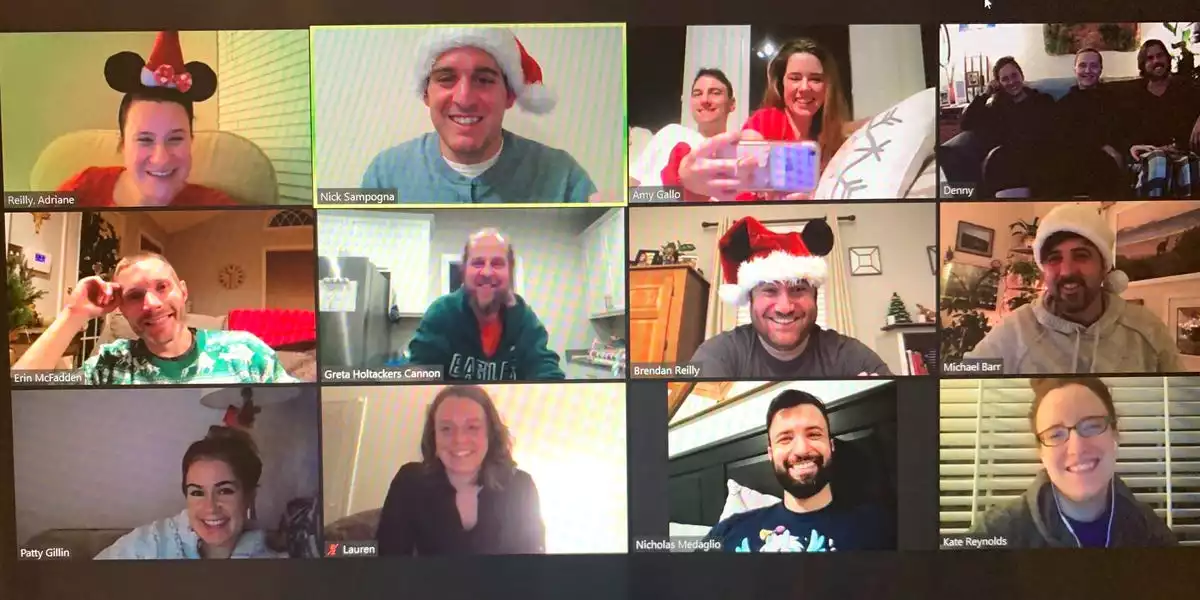

A pandemic workaround that matured into a durable digital institution
On March 19, 2020—at the precise moment when office corridors, neighborhood bars, and family dining rooms abruptly went quiet—eight college friends from Villanova University opened a Zoom link and began what they assumed would be a temporary check-in. More than 300 Thursday-night calls later, the “NovaZoom” crew has effectively built a standing social institution: consistent, voluntary, and resilient enough to survive job changes, marriages, childbirth, milestone birthdays, and the slow churn of adult life spread across five countries and 13 U.S. states.
What makes the story commercially and culturally instructive is not simply the longevity of the habit, but the way it reframes video conferencing. Zoom—emblematic of pandemic-era work—becomes, in this context, a “third place”: neither home nor office, but a recurring environment where identity is reinforced and relationships are maintained. The group’s appeal lies in its unforced authenticity. In an online ecosystem often shaped by performative feeds and polished self-presentation, their weekly cadence functions as an “anchor of normalcy,” a space where friends can speak candidly about parenting, politics, pop culture, and legacy without the incentives of public visibility.
For business and technology leaders, the signal is clear: the most enduring digital products are not always those with the flashiest features, but those that can be ritualized—woven into the calendar until participation feels less like usage and more like belonging.
Zoom as “social infrastructure”: stickiness, switching costs, and trust
The NovaZoom ritual highlights a strategic reality for synchronous communication platforms: retention is often behavioral, not contractual. Corporate licensing may introduce users to a tool, but habit and emotional utility keep them there. A weekly cadence creates a subtle but powerful form of platform stickiness—one rooted in network effects and high switching costs that are social rather than technical. Replacing the tool would mean renegotiating norms, links, reminders, and the shared muscle memory of “Thursday night,” even if a competitor offered marginally better features.
This is where product design meets human psychology. Long-running groups like this implicitly demand capabilities that enterprise roadmaps sometimes treat as secondary:
- Reliability and low friction: rituals collapse when links fail, audio breaks, or onboarding is cumbersome.
- Continuity features: persistent group spaces, lightweight scheduling, and shared artifacts that reinforce identity over time.
- Trust and privacy: years of intimate conversation raise the stakes around encryption, data retention, and user control.
The privacy dimension is especially underappreciated. As calls accumulate over years, platforms become stewards of deeply personal archives—whether or not they are formally recorded. That reality intensifies questions about data minimization, rights to delete, and the boundary between “memories worth preserving” and “conversations that should evaporate.” For providers of video collaboration and messaging services, long-term social groups are a reminder that trust is not a compliance checkbox; it is a prerequisite for sustained emotional use.
The “ritual economy” meets the loneliness market—and reshapes workplace culture
Beyond the human-interest appeal, NovaZoom maps neatly onto a broader economic and societal backdrop: rising adult isolation, increasingly hybrid lifestyles, and a growing premium on mental resilience. The group’s weekly call is a low-cost, high-impact intervention against loneliness—one that doesn’t require clinical infrastructure, formal facilitation, or geographic proximity.
This points to a plausible emerging category: a “ritual economy” in which products and services help people create, maintain, and deepen recurring social bonds. The opportunity is not to commoditize friendship, but to support the scaffolding that makes it easier to sustain amid modern constraints. Potential value pools include:
- Ritual platforms and subscriptions: tools that manage cadence, attendance norms, milestone reminders, and lightweight group governance.
- AI-enabled continuity (handled carefully): optional prompts, memory aids, or anniversary recaps that strengthen group identity without intruding on privacy.
- Experience and travel tie-ins: services that translate digital continuity into periodic in-person reunions.
The workplace implications are equally significant. As hybrid work becomes standard, organizations are discovering that culture is not preserved by policy documents—it is preserved by informal bonding. Strong ties outside the office can stabilize employees through transitions, reduce burnout risk, and indirectly support retention. Companies may not be able to manufacture authentic friendships, but they can design environments that don’t inadvertently erode them—by acknowledging the importance of digital third spaces, affinity groups, and peer communities that aren’t purely task-driven.
In this light, NovaZoom is not an outlier; it is a case study in how social capital can be engineered through consistency, not through corporate programming.
What comes next: immersive co-presence and community-centric living models
If the past four years proved that video calls can carry real intimacy, the next phase will test whether technology can deliver something closer to co-presence—the subtle nonverbal cues, shared environments, and ambient togetherness that make physical gatherings uniquely bonding. Expect growing experimentation with AR lounges, persistent virtual rooms, and richer spatial audio—not as “metaverse hype,” but as pragmatic attempts to reduce the emotional distance that flat rectangles still impose.
The NovaZoom cohort also hints at a longer arc: as friends age together, the logic of recurring digital rituals can extend into community-centric living. Their half-joking visions of shared retirement housing or co-living arrangements mirror a real market direction—co-housing models built around pre-existing social bonds, rather than proximity alone. That creates adjacency opportunities for:
- Real estate and co-housing developers designing for friend networks and intergenerational community
- Eldercare and health services shifting from institutional models toward peer-supported living
- Lifestyle and membership brands focusing on sustained engagement over one-off campaigns
The deeper takeaway is that technology’s most consequential role may not be replacing human connection, but protecting it from entropy. In a fragmented world, the companies—and communities—that learn to support authentic, self-sustaining rituals will shape the next chapter of digital life, not by making people more online, but by helping them stay meaningfully together.

 By
By
 By
By

 By
By

 By
By
 By
By








