


A Senate-stage signal: NASA’s administrator turns Pluto into a governance question
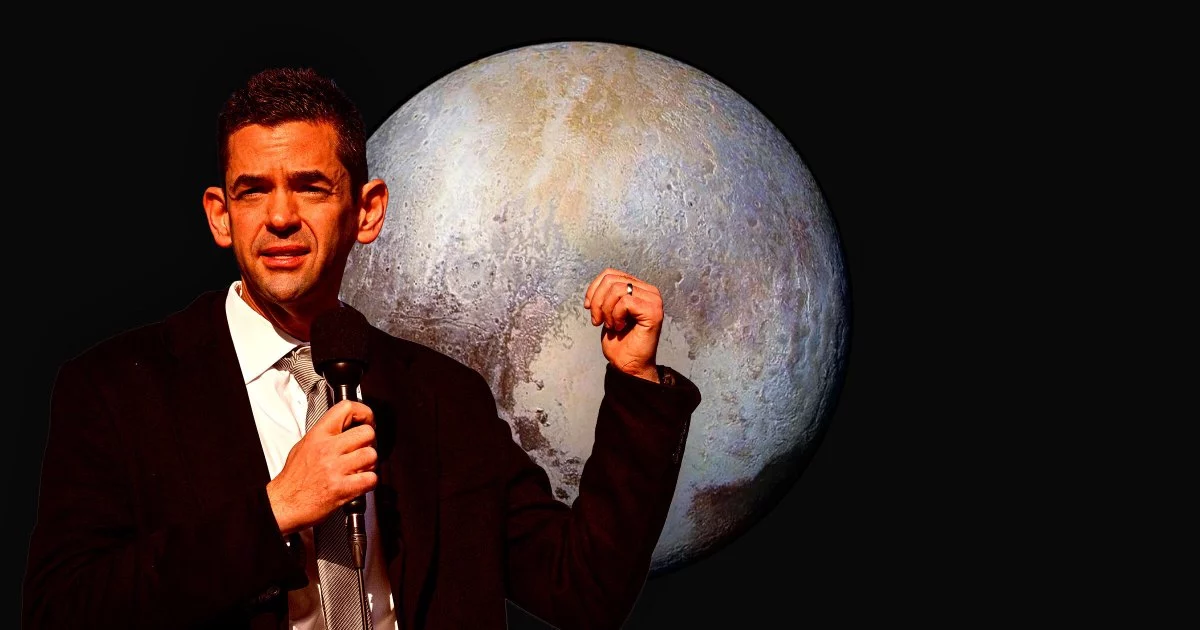
NASA Administrator Jared Isaacman’s endorsement of a campaign to reinstate Pluto as a full planet—delivered in testimony before a Senate committee—reads as more than a nostalgic gesture. By indicating that NASA is preparing formal documentation urging the International Astronomical Union (IAU) to revisit its 2006 planetary definition, the agency is effectively stepping into a domain traditionally managed by international scientific consensus rather than national policy momentum.
The political theater matters because it changes the context in which scientific definitions are debated. Pluto’s 2006 reclassification to “dwarf planet” was never merely a semantic tweak; it was an attempt to impose order on a rapidly expanding inventory of outer solar system objects. Isaacman’s framing—positioning the effort as a tribute to Clyde Tombaugh and a correction of what he described as an emotional injustice—signals a deliberate choice to harness public sentiment as a strategic asset.
Yet the move also raises a delicate question for science policy: who gets to arbitrate scientific taxonomy when the stakes include budgets, national prestige, and public identity? The IAU’s authority rests on international coordination and peer-driven standards. NASA’s authority rests on mission execution, data generation, and—crucially—its ability to translate exploration into public value. When those two forms of authority collide, the Pluto debate becomes a case study in how modern science is governed.
From New Horizons to LSST: why classification is increasingly a data-engineering problem
At the heart of the dispute is a tension between legacy taxonomy and data-driven redefinition. The IAU’s 2006 criteria—especially the requirement that a planet must “clear its neighborhood”—were shaped by a dawning realization: Pluto is part of a broader population in the Kuiper Belt, not an isolated ninth planet. Astronomers such as Caltech’s Mike Brown and Washington University’s Bill McKinnon have argued that Pluto’s reclassification reflects improved understanding rather than any diminishment of Pluto’s scientific importance.
What has changed since 2006 is not only the quantity of data, but the nature of it. Outer solar system science is now built on a pipeline that blends spacecraft reconnaissance with industrial-scale sky surveys. That pipeline pressures any fixed definition of “planet” to remain coherent across multiple measurement regimes:
- Orbital dynamics: long-term stability, neighborhood dominance, resonances, and population context within belts and families
- Volumetric and geophysical metrics: size, shape, differentiation, internal heat, potential subsurface oceans
- Compositional signatures: surface ices, atmospheres, seasonal cycles, and radiation-driven chemistry
- Comparative planetology frameworks: treating “dwarf planets” as systems with complex geology rather than as leftovers
This is where NASA’s interest becomes structurally understandable. Flagship missions like New Horizons do not just answer questions; they reframe categories by revealing complexity that older definitions did not anticipate. Meanwhile, ground-based surveys—historically exemplified by programs like Pan-STARRS and increasingly associated with next-generation facilities such as the Vera C. Rubin Observatory’s LSST—are expanding the catalog of small bodies so quickly that classification becomes a scaling problem as much as a philosophical one.
If the IAU definition were broadened, downstream effects could ripple into technology roadmaps. A more inclusive “planet” category could strengthen the case for comparative exploration across Pluto-like bodies, potentially accelerating demand for:
- Miniaturized spectrometers and magnetometers tuned for low-light, low-temperature environments
- Autonomous navigation and hazard avoidance for low-gravity flybys and orbit insertions
- Long-duration power and thermal systems that make Kuiper Belt missions operationally viable
In other words, the Pluto debate is also a debate about what kinds of instruments—and what kinds of missions—become “normal” in the next era of deep-space exploration.
The business of sentiment: public engagement as a funding and partnership lever
Pluto occupies a rare place in science communication: it is both a technical object and a cultural icon. That dual identity can be monetized—not in the crude sense of merchandising, but in the strategic sense of budget justification and coalition building. Isaacman’s posture suggests NASA may see Pluto’s reinstatement campaign as a way to rekindle broad public enthusiasm for outer solar system exploration, which historically competes with nearer-term priorities in human spaceflight, Earth observation, and national security space.
For business and technology stakeholders, the more instructive angle is how symbolic narratives can shape real capital flows. A high-visibility “Pluto renaissance” could:
- Support congressional appetite for follow-on Kuiper Belt missions, including orbiter concepts or ambitious sample-return studies
- Encourage philanthropic and academic co-funding models by making outer solar system science feel culturally urgent
- Create marketing tailwinds for private-sector partners in the deep-space supply chain—propulsion, avionics, in-space manufacturing, and communications—seeking alignment with NASA’s most publicly resonant initiatives
This is not unique to astronomy. It mirrors patterns seen in other frontier domains—AI safety, climate tech, biotech—where emotionally legible narratives can unlock investment faster than technical white papers alone. The risk, of course, is that narrative-driven momentum can be perceived as pressuring scientific institutions to validate a preferred outcome.
Institutional authority and global coordination: what happens if standards fragment
The most consequential implication may be institutional rather than astronomical. If NASA formally challenges the IAU’s criteria, it tests the boundary between data-producing agencies and standard-setting bodies. That boundary is already under strain across technology sectors, where competing jurisdictions and institutions produce fragmented rules—whether in privacy, cybersecurity, or medical regulation.
A Pluto redefinition effort could also introduce geopolitical complexity. If NASA’s advocacy is seen as setting a precedent, other space-faring actors—ESA, CNSA, Roscosmos, and regional scientific unions—may feel incentivized to assert parallel interpretive authority. Even if everyone continues to share data, divergent classification regimes can complicate education standards, public communication, and the framing of mission objectives.
There is also a longer-horizon legal and commercial undertone. As interest grows in space resource utilization, labels can influence perception, and perception can influence policy. The distinction between “planet,” “dwarf planet,” and “minor body” may eventually intersect with how lawmakers and treaty negotiators think about access, stewardship, and rights in deep space—especially as commercial capabilities mature beyond the Moon and Mars.
Pluto, then, is functioning as a proxy: for how science updates its definitions under discovery pressure, for how agencies convert public emotion into strategic capacity, and for how international coordination holds when national institutions decide that a taxonomy is no longer just a taxonomy.

 By
By
 By
By

 By
By


 By
By
 By
By







