

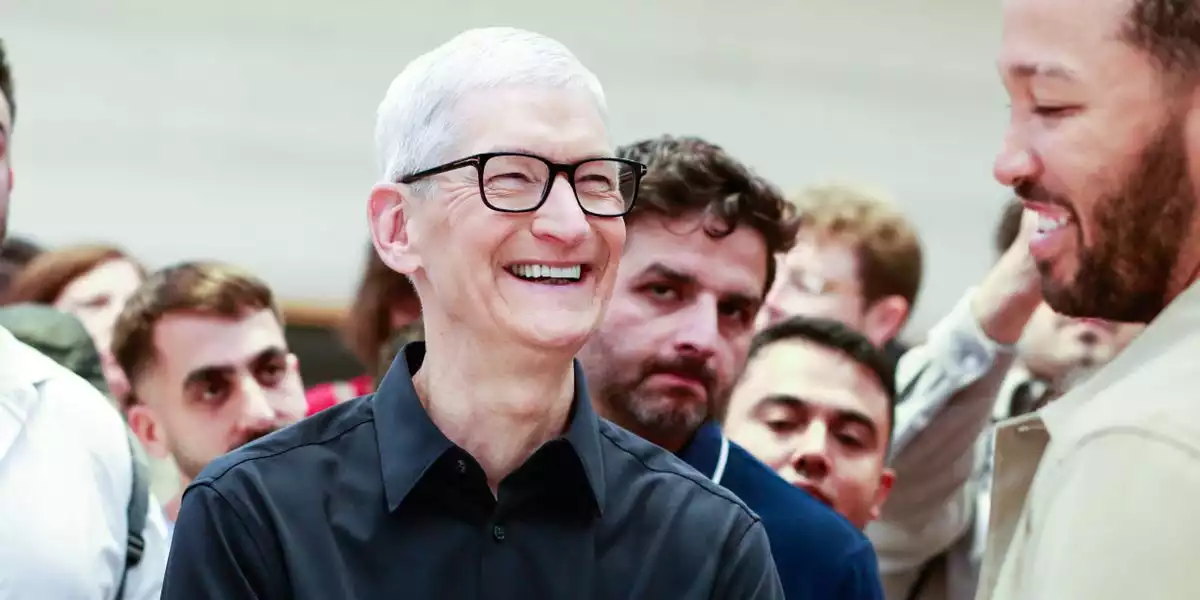

A meticulously staged handoff at the world’s most scrutinized tech company
Apple CEO Tim Cook’s decision to step down after 15 years, with John Ternus set to assume the role in September, reads less like a rupture and more like a controlled transfer of operational DNA. Apple’s board is not signaling a search for a savior or a radical strategist; it is elevating a leader shaped inside the company’s most defining advantage: end-to-end hardware engineering tightly fused to software and services.
Cook’s tenure is widely associated with industrial discipline—scaling Apple’s global footprint, refining supply-chain execution, and building a services engine that reduced dependence on the iPhone upgrade cycle. The succession choice implies Apple believes its next era will be won not primarily through financial engineering or splashy acquisitions, but through product-platform execution: turning prototypes into mass-market categories while preserving margins and brand coherence.
For investors, partners, and competitors, the message is clear: Apple is betting that the next decade will reward companies that can still do the hard thing—ship differentiated hardware at scale—while using that hardware as the distribution layer for recurring revenue.
John Ternus and the engineering-first signal: silicon, sensors, and spatial computing
John Ternus, Apple’s Senior Vice President of Hardware Engineering, is closely associated with the company’s modern hardware trajectory—particularly the Apple silicon roadmap (M-series chips) and the broader philosophy that performance, efficiency, and differentiation increasingly come from owning the stack. His elevation suggests continuity with Apple’s most successful strategic pattern of the last several years: custom silicon enabling experiences competitors struggle to replicate.
This matters because Apple’s next growth vectors are likely to be more technically demanding and capital-intensive than the smartphone era:
- AR/VR and mixed reality: Moving from early adopter hardware toward mainstream form factors requires breakthroughs in power efficiency, displays, thermals, and developer tooling—areas where Apple’s silicon and hardware integration can compound advantages.
- Next-generation health and wearable sensors: Apple Watch and health initiatives depend on sensor accuracy, regulatory navigation, and on-device processing—again favoring deep hardware leadership.
- On-device AI as a product feature, not a cloud add-on: If Apple leans harder into privacy-preserving AI, the differentiator becomes inference efficiency and specialized silicon pathways, not just model size.
Ternus inherits a company where hardware is no longer merely the product—it is the platform for monetization, identity, payments, health data, and developer distribution. That makes the CEO role, in practical terms, the stewardship of a hardware-enabled ecosystem whose competitive moat is built on integration and scale.
The services-heavy Apple Cook built—and the ecosystem Ternus must protect
A defining feature of Cook’s era is Apple’s deliberate pivot toward Services—including the App Store, iCloud, Apple Music, Apple TV+, and subscription bundles—creating a revenue stream that is more recurring and resilient than device cycles. Social commentary around the transition may nostalgically spotlight iPhone-era product theater, but the business reality is that services now represent more than one-third of Apple’s revenue, anchoring valuation narratives around stability and lifetime customer value.
The strategic challenge for Ternus is not choosing between hardware and services; it is maintaining the flywheel:
- Hardware primes adoption (new devices, new sensors, new form factors)
- Services monetize engagement (subscriptions, storage, payments, content, developer fees)
- Integration increases switching costs (continuity features, ecosystem convenience, privacy posture)
In a market where global smartphone growth has plateaued and competitive pressure from Chinese OEMs remains intense, Apple’s margin defense increasingly depends on sustaining premium differentiation. That differentiation is less about raw specs and more about experience-level integration—battery life, performance per watt, camera pipelines, security, and seamless cross-device workflows.
Ternus’s engineering background may also shape how Apple approaches the next phase of services: deeper coupling between proprietary silicon and subscription value. Plausible directions include health analytics performed on-device, real-time translation and accessibility features embedded at the system level, and AI-driven personalization that stays aligned with Apple’s privacy brand.
Memes, mystique, and market psychology: leadership branding in the social-media era
The online reaction—memes invoking Vatican-style “white smoke,” jokes about Siri’s obliviousness, and callbacks to the “Tim Apple” moment—may look like internet ephemera, but it reflects a serious shift in corporate reality: a CEO’s persona becomes part of the product. In the social-media era, leadership transitions are not simply disclosed; they are collectively narrated in real time, with humor acting as both critique and free marketing.
This dynamic creates a new communications landscape for Apple and its peers:
- Virality can reinforce loyalty when it taps nostalgia and shared cultural memory around product moments.
- Reputational risk accelerates because narratives form instantly and spread without context.
- Corporate mystique becomes participatory, with audiences remixing brand symbols into memes that can either strengthen or dilute messaging.
For governance watchers, Apple’s internal succession also functions as a template. Rather than defaulting to a CEO profile dominated by finance, dealmaking, or external turnaround credentials, Apple is elevating deep technical leadership—an approach that may influence how other S&P 500 boards think about bench strength in an era defined by AI compute, supply-chain fragility, and platform transitions.
Cook leaves behind an Apple engineered for resilience: operationally disciplined, services-rich, and culturally omnipresent. Ternus steps into a mandate that is both narrower and harder—translate frontier engineering into mass adoption without breaking the ecosystem’s trust, margins, or momentum—while the world watches, jokes, and refreshes its feeds in real time.

 By
By
 By
By
 By
By
 By
By
 By
By


 By
By







