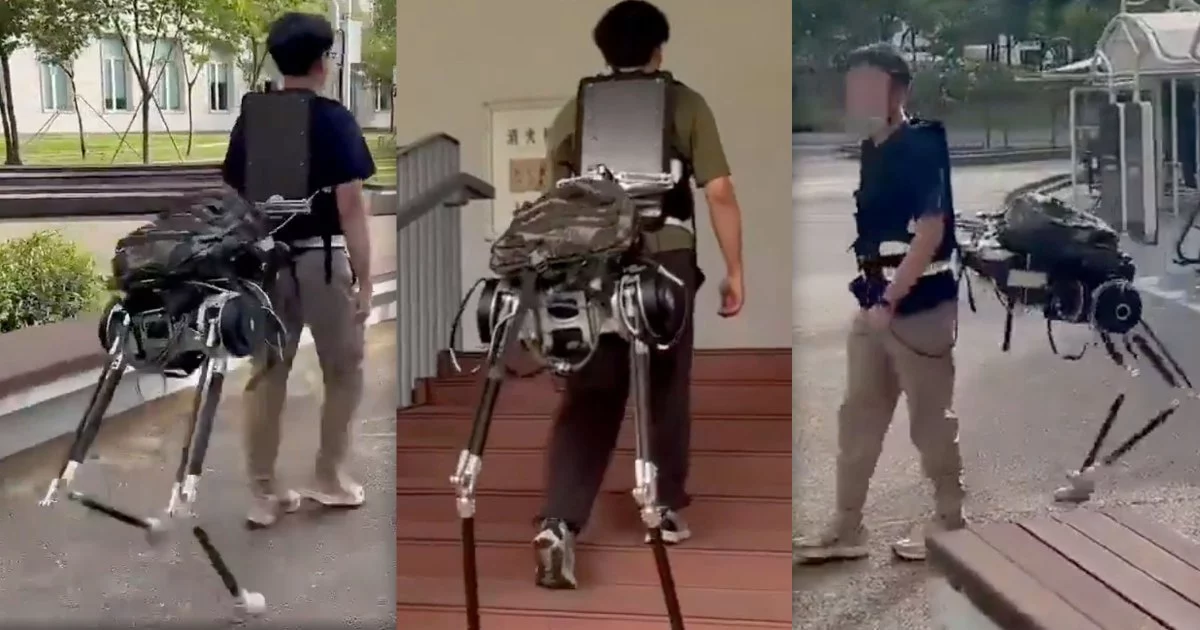

A “centaur” wearable robot reframes load-carrying as collaboration, not replacement
Engineers at the Southern University of Science and Technology (SUSTech) in Shenzhen have introduced a wearable, two-legged “centaur” robot aimed at reducing the metabolic cost of carrying heavy loads while walking. Reported in the *International Journal of Robotics Research*, the system is positioned less as a spectacle of autonomy and more as a practical bet on human–robot symbiosis: the wearer supplies perception, intent, and balance, while the robot contributes torque, endurance, and load redistribution.
That design choice matters. In unstructured environments—stairs, uneven ground, changing inclines—fully autonomous porters (quadrupeds, wheeled carriers, drones) often face a familiar set of constraints: mapping uncertainty, obstacle classification errors, and the “last-meter” problem where a human still has to intervene. The centaur approach effectively moves the decision-making to the human nervous system, using the robot as an extension of the body rather than an independent agent.
Early demonstration videos reportedly show modest gait synchronization challenges, a reminder that wearable robotics lives or dies on comfort, predictability, and trust. Yet the core claim—reduced physiological exertion compared with carrying a conventional 44-pound backpack—signals real progress in a field where incremental efficiency gains can translate into meaningful operational and health outcomes.
Key technical premise: controlled interaction forces allow the robot to “negotiate” motion with the wearer rather than imposing it, a subtle but crucial distinction for safety and adoption.
Control systems and embodied intelligence: why this architecture is strategically interesting
The centaur robot’s technical narrative aligns with a broader robotics trend: shifting from centralized “brain-heavy” autonomy toward embodied intelligence, where responsiveness and safety emerge from tight coupling between sensors, actuators, and local control loops.
At a high level, the reported system reflects a hybrid stack that blends:
- Model-based dynamics for predictable segments of gait and terrain
- Data-driven adaptation for irregularities such as stairs, variable inclines, and transient disturbances
- Sensor fusion (e.g., inertial measurement units, force sensors at human–robot interfaces, and potentially vision modules) to continuously recalibrate joint torques and timing
This matters for two reasons relevant to business and deployment:
- Latency and stability are product features. In wearable robotics, a few tens of milliseconds can separate “assistive” from “unsettling.” Embedding intelligence closer to the actuators can reduce lag and improve perceived smoothness.
- Safety is inseparable from control design. Unlike industrial robots fenced off from people, a centaur system shares the wearer’s center of mass and failure modes. The risk profile includes tripping dynamics, unexpected force spikes, and misalignment under fatigue—issues that standards bodies will increasingly need to codify.
The research also implicitly challenges a common assumption in automation strategy: that the endpoint must be full autonomy. In many real-world settings—construction sites, disaster zones, dense urban delivery corridors—human judgment remains the most robust navigation system available. The centaur robot attempts to monetize that reality rather than fight it.
Productivity, cost curves, and the “why not a cart?” commercialization dilemma
The economic promise is straightforward: reduce fatigue, reduce injury, and increase throughput in jobs dominated by manual material handling. If a wearable load-sharing platform can reliably lower exertion, it could plausibly improve:
- Worker endurance and shift consistency in warehousing, construction, and agriculture
- Musculoskeletal injury rates, with downstream effects on workers’ compensation and retention
- Labor participation in aging societies by extending the viable working life for physically demanding roles
However, commercialization will hinge on a question critics raise bluntly: why is this necessary when low-tech alternatives exist—carts, dollies, rickshaws, lifts, or redesigned workflows?
The answer is situational. Low-tech tools dominate where the environment is structured and wheeled transport is feasible. The centaur value proposition strengthens where those assumptions break:
- Stairs and vertical transitions (multi-floor buildings, older infrastructure)
- Debris, mud, narrow passages, or crowded interiors where wheels are compromised
- Dynamic tasks where workers must frequently stop, pivot, crouch, or step over obstacles
Still, the business case will be decided by total cost of ownership (TCO) and operational friction, not novelty. Wearable robotics must contend with battery cycles, actuator maintenance, fit and sizing logistics, hygiene protocols, training time, and downtime. Even if unit costs fall—potentially toward sub-$10,000 with scale and modular manufacturing, as some projections suggest—buyers will demand proof that the device outperforms cheaper interventions across a full year of operations.
Adoption is therefore likely to favor financing and service models that reduce upfront risk, such as leasing, pay-per-use, or performance-based contracts (e.g., cost per mile carried or per kilogram-hour). In enterprise procurement, the winning product may be the one that bundles hardware with field support, predictive maintenance, and measurable ergonomic outcomes.
Where this could land first: logistics edges, disaster response, and health-tech convergence
Strategically, the centaur robot sits at the intersection of robotics R&D competition and practical deployment niches. China’s robotics ecosystem—manufacturing depth, supply-chain proximity, and policy support—creates a plausible runway from lab prototype to pilot programs, especially if university–industry partnerships accelerate ruggedization.
The most credible near-term applications cluster where autonomy struggles and human mobility is essential:
- Last-meter logistics: couriers navigating building interiors, stairs, and pedestrian zones where vehicles cannot reach
- Disaster response and humanitarian aid: first responders carrying tools and medical supplies through debris without relying on maps
- Rehabilitation and clinical mobility support: if gait and force sensors can double as biomechanical monitoring, the platform could converge with telemedicine and therapy workflows
That last point—health-tech convergence—may become a decisive lever. If wearable load-sharing systems can generate clinically meaningful gait data, they may unlock reimbursement pathways or employer-sponsored health programs, supporting higher price points than industrial buyers alone would tolerate.
The Shenzhen centaur project ultimately advances a pragmatic thesis for the next phase of robotics: in the messy, unstructured parts of the economy, the most scalable “autonomy” may be the kind that amplifies human capability without demanding the world be redesigned for machines.

 By
By
 By
By
 By
By



 By
By