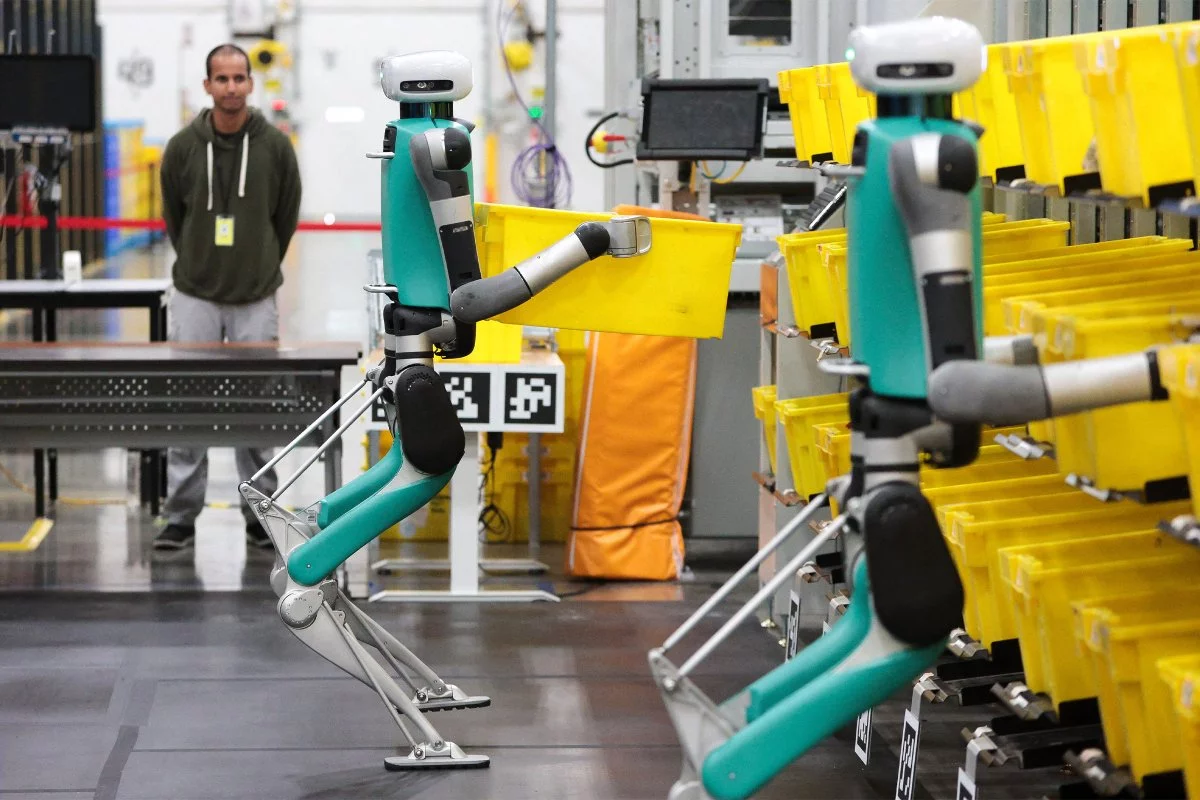

Amazon’s robotics cuts signal a reweighting of automation bets, not a retreat from it
Amazon’s decision to enact significant layoffs in its robotics division—against the backdrop of more than 57,000 roles eliminated since 2022, including a reported 30,000 in October 2025—lands as more than another headcount headline. It reads as a strategic rebalancing inside one of the world’s most operationally complex companies: a shift in emphasis from hardware-heavy physical automation toward software-led AI and cloud infrastructure, where scale economics can be more elastic and monetization pathways more direct.
The company has not disclosed the precise number of robotics roles affected, though the unit has previously been understood to employ over 3,000 people. Vice President Scott Dresser described the reductions as “difficult but necessary,” while reiterating robotics as a “strategic priority.” That dual message—cutting while reaffirming importance—captures the tension many large technology firms face: robotics remains essential to long-term logistics advantage, yet the near-term capital and talent allocation is increasingly being pulled toward AI platforms and data centers.
At the same time, Amazon plans to raise capital spending on AI and data centers to roughly $200 billion through 2026, a figure that underscores where leadership believes the next compounding returns will come from. In practical terms, the company appears to be optimizing for the parts of the stack where it can win not only in its own warehouses, but across the global enterprise market via cloud services.
Key takeaway for business and technology observers: this is less about “automation slowing down” and more about automation changing shape—from machines on warehouse floors to models in data centers that can be deployed, updated, and monetized at software speed.
Why the center of gravity is moving from warehouse hardware to AI infrastructure
Amazon’s robotics organization sits at the intersection of engineering disciplines—mechanical systems, sensors, reliability, safety, and increasingly data science. But robotics is also capital-intensive and operationally constrained: deployments require physical installation, maintenance cycles, supply chain coordination, and site-by-site integration. By contrast, AI investment—especially at hyperscale—can deliver broader leverage across products and customers, from fulfillment optimization to AWS services.
Several forces likely explain why Amazon is reallocating resources now:
- Marginal ROI dynamics: Robotics gains in fulfillment can be substantial, but they often follow a curve where early deployments deliver step-changes and later rollouts become more incremental. If throughput improvements per additional engineer or per additional machine have softened, leadership will scrutinize staffing levels.
- Platform competition in AI: Amazon is competing directly with Microsoft and Google in cloud AI, while also navigating a hardware ecosystem increasingly shaped by NVIDIA and specialized chip-to-data-center players. In that environment, AI capex is not just investment—it is positioning.
- Software scalability vs. physical constraints: AI models, inference optimization, and cloud services can be scaled across regions and customers with fewer physical bottlenecks than robotics deployments, which remain tied to real-world facilities and maintenance realities.
This does not make robotics “less strategic.” It makes it a domain where Amazon may seek higher talent density—fewer people, more specialized—and potentially a different operating model that relies more on modularity, standardization, and selective internal R&D rather than broad-based expansion.
The economic logic: post-pandemic normalization, cost of capital, and cash-flow discipline
Amazon’s pandemic-era expansion was a rational response to extraordinary demand. As e-commerce growth normalized, the company—like much of the sector—has been forced into a more disciplined posture. The layoffs across the organization suggest a multi-year correction aimed at aligning cost structure with a less exuberant demand curve.
Two macroeconomic realities sharpen that discipline:
- Higher interest rates and inflationary pressure raise the effective hurdle rate for long-duration projects. Capital-intensive initiatives must clear a higher bar, especially when markets reward free cash flow resilience.
- Investor expectations have shifted from growth-at-all-costs to operational rigor. Even for a company with Amazon’s scale, the tolerance for inefficiency is lower when capital is more expensive and competition is intense.
Notably, robotics layoffs complicate the popular narrative that “automation replaces jobs.” Here, the teams building automation are themselves being reduced—an important reminder that technology organizations must justify their own economics. Automation is not immune to ROI scrutiny; it is subject to it.
What this could mean next: modular robotics, talent arbitrage, and a new automation operating model
The most revealing aspect of Amazon’s posture is the simultaneous embrace of massive AI data-center spending and the trimming of a robotics unit that directly supports the fulfillment engine. That combination suggests a strategy built around flexibility: preserve the ability to automate physically, but concentrate internal investment where platform advantages are strongest.
Several forward-looking implications stand out:
- A pivot toward modular or partner-driven robotics: Amazon may increasingly rely on third-party integrators or standardized components for certain automation layers, keeping internal teams focused on orchestration, safety systems, and AI-driven optimization rather than every deployment detail.
- “Real options” in workforce allocation: By reducing robotics headcount while expanding AI infrastructure, Amazon retains the option to redeploy high-value talent into AI, cloud, and optimization roles—effectively a form of talent arbitrage between physical and digital automation.
- Human-machine collaboration as a productivity strategy: A leaner robotics organization can still be highly impactful if it concentrates on system-level design—digital twins, predictive maintenance, routing intelligence, and end-to-end integration—where small teams can influence large operational surfaces.
For technology leaders watching Amazon, the lesson is not to abandon physical automation, but to interrogate where value is compounding fastest:
- Prioritize investments with scalable unit economics and repeatable deployment patterns.
- Treat robotics as a portfolio—some initiatives are core differentiators, others are candidates for standardization or partnership.
- Maintain innovation capacity while enforcing cost discipline, so efficiency gains do not come at the expense of long-term technological leadership.
Amazon’s latest move captures a defining feature of the current tech cycle: the race is no longer simply to automate, but to automate in the form that best converts capital, talent, and data into durable advantage—at hyperscale, under scrutiny, and in full view of a market that now demands both ambition and arithmetic.

 By
By
 By
By

 By
By

 By
By

 By
By