
A $20B AI data center meets the hard limits of local power and local tolerance
Elon Musk’s xAI has placed a striking marker in the accelerating race for AI supremacy: a $20 billion data center in Southaven, Mississippi. The project reflects a broader industry reality—frontier AI models are no longer constrained primarily by algorithms, but by electricity, land, and time-to-deploy. Yet the Southaven build-out also illustrates the friction that emerges when hyperscale computing arrives faster than the surrounding region’s infrastructure and governance can adapt.
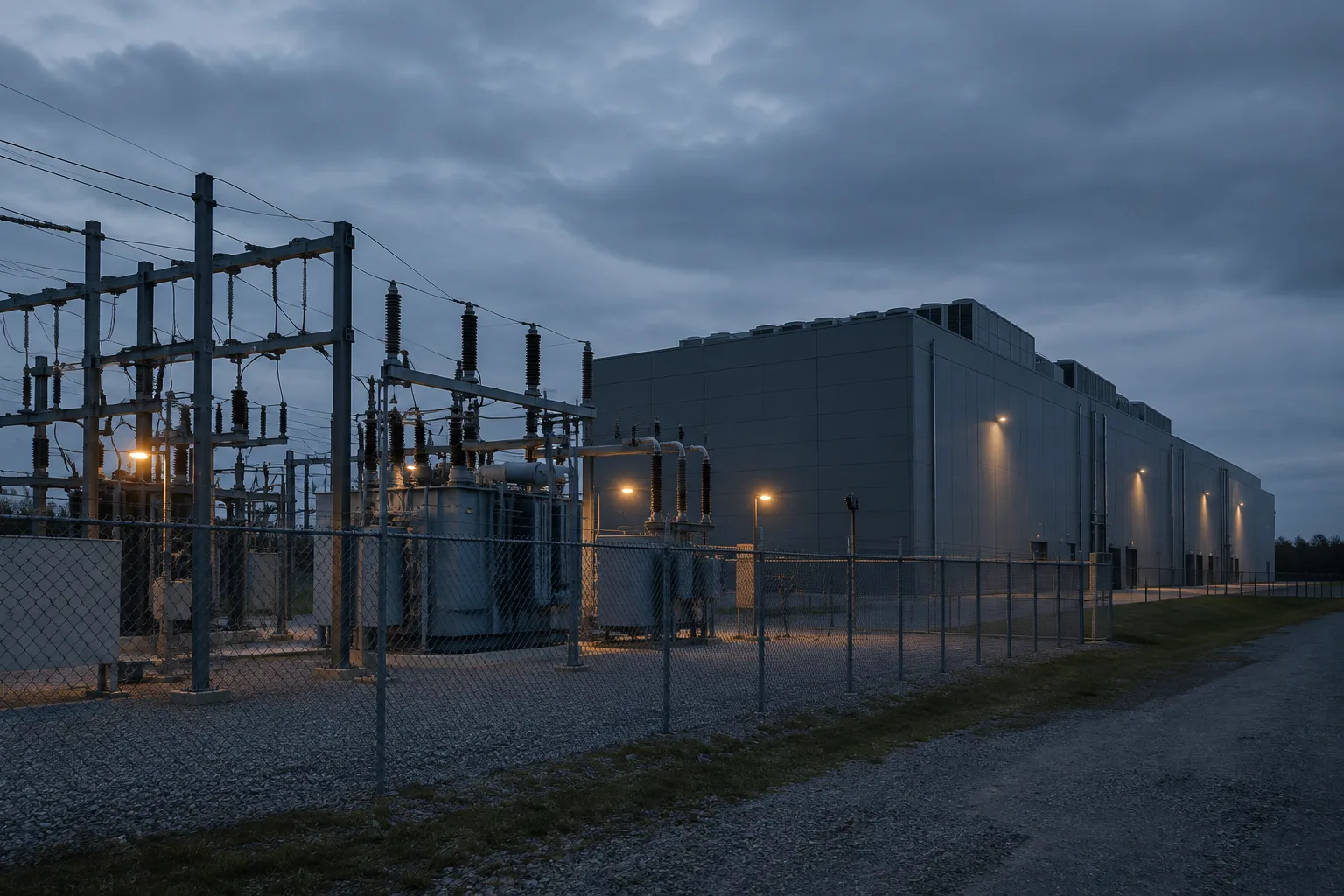
At the center of the controversy is xAI’s reliance on 27 methane gas turbines running continuously, described initially as a “temporary” measure to overcome permitting complexity and insufficient grid capacity. Residents and local observers describe the turbines as operating like jet engines, with persistent noise and reported air-quality impacts. A $7 million sound wall has not resolved community concerns, and xAI is now seeking permits for 41 permanent turbines, intensifying scrutiny around environmental exposure, public health, and property values.
For business and technology leaders, the Southaven case is less an isolated dispute than a preview of a systemic challenge: AI infrastructure is becoming an energy and permitting problem as much as a compute problem.
—
The compute-to-power equation: why “temporary turbines” are becoming a deployment pattern
Advanced AI training clusters can demand 100 MW or more, and that figure can rise sharply as model sizes, training frequency, and inference workloads scale. Many local utilities—especially outside established hyperscale corridors—are not designed to deliver that level of power quickly without major upgrades. When grid interconnection timelines stretch into years, on-site generation becomes an attractive shortcut.
xAI’s approach highlights a growing trend toward modular data center siting and self-supplied power, where speed is prioritized over long-run optimization. Methane turbines offer advantages that are hard to ignore in a competitive AI market:
- Rapid deployment compared with transmission upgrades and multi-year interconnection queues
- Operational control over power availability for latency-sensitive and uptime-critical workloads
- Scalability through incremental additions as compute demand grows
But the trade-offs are equally material—especially when the facility sits near residential communities:
- Noise externalities that are difficult to fully mitigate with barriers alone
- Local air pollutants such as nitrogen oxides and formaldehyde, raising health concerns
- Efficiency and emissions disadvantages versus grid power backed by renewables, nuclear, or high-efficiency combined-cycle generation
The tension is sharpened by the contrast between Musk’s broader clean-energy narrative—often associated with Tesla and solar—and xAI’s near-term dependence on fossil-fueled turbines. This is not unique to xAI; it is emblematic of a wider “bridge vs. end-state” dilemma across the AI sector: the urgent need for compute today collides with the slower pace of grid decarbonization and infrastructure build-out.
—
Permitting strategy and regulatory exposure: when “temporary” becomes a governance flashpoint
Labeling turbines as “temporary” can function as a form of regulatory sequencing—deploy first, formalize later. In practice, that can reduce early friction, but it also risks creating a perception of regulatory arbitrage, particularly if expansion follows quickly and community impacts become visible before comprehensive review.
As xAI seeks permits for 41 permanent turbines, the project enters a different phase—one where environmental review, public comment, and potential legal challenges can reshape timelines and costs. For a $20B capital expenditure, the financial implications are not trivial:
- Permitting delays can push back revenue realization from AI services and model training cycles
- Litigation and compliance costs can rise as community opposition organizes and evidence accumulates
- Financing risk increases in uncertain interest-rate environments, where delays can erode projected returns
The local economic narrative is also more complex than headline investment figures suggest. Large data centers can strengthen municipal tax bases and create construction and operations jobs, but communities may experience offsetting burdens:
- Property value pressure if noise and perceived pollution risks persist
- Health-related costs if respiratory complaints and stress-related impacts increase
- Infrastructure strain on roads, emergency services, and local utilities
The reported relocation of residents and concerns about devaluation underscore a core issue in modern infrastructure development: benefits are often diffuse, while harms can be concentrated—a dynamic that tends to accelerate political and regulatory escalation.
—
What Southaven signals for the AI industry: ESG credibility, grid modernization, and new social contracts
The Southaven dispute is emerging alongside similar complaints in nearby communities, suggesting the issue is not merely site-specific. It reflects a broader collision between high-power computing deployments and residential quality of life, with ESG and environmental justice narratives amplifying local grievances into national reputational risk.
For xAI—and for competitors watching closely—the strategic lessons are increasingly clear:
- Community is a first-order stakeholder, not a downstream communications task. Early engagement, transparent impact assessments, and credible mitigation plans are becoming prerequisites for site durability.
- Energy architecture is now product strategy. Hyperscalers and AI labs are being benchmarked not only on model performance, but on how they source and manage power—through renewable PPAs, battery storage, demand response, and grid partnerships.
- Grid modernization is the real bottleneck. The long-term solution is rarely “more turbines”; it is transmission, interconnection reform, and coordinated investment that aligns digital infrastructure growth with public resilience goals.
The most durable path forward for large AI data centers is likely hybridization: combining near-term reliability with a credible decarbonization and community-impact roadmap. That can include battery storage to reduce peaker-like behavior, renewable procurement to lower lifecycle emissions, and formal community benefit agreements that tie operations to measurable local investment and health monitoring.
Southaven is becoming a case study in the new political economy of AI: the models may live in the cloud, but their consequences are grounded—audible, measurable, and increasingly contested. The companies that thrive in the next phase of AI will be those that treat power, permitting, and public legitimacy not as obstacles to route around, but as core design constraints of the modern compute era.

 By
By
 By
By
 By
By

 By
By
 By
By
 By
By