
A small Bluetooth clicker that signals a bigger shift in e-reader interaction
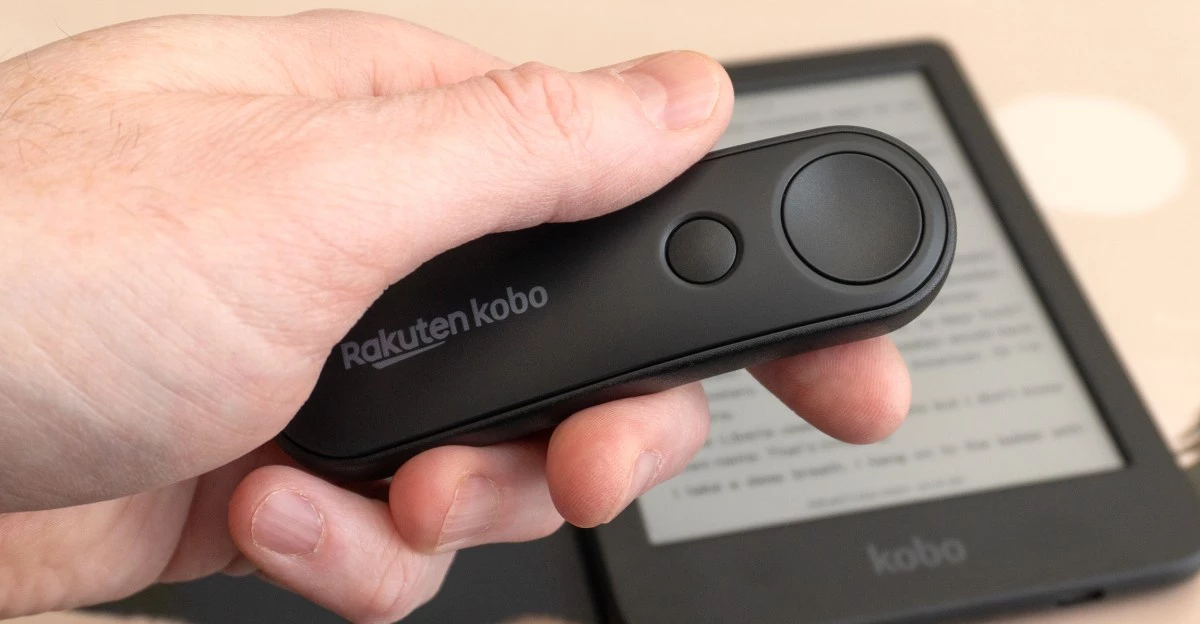
Kobo’s launch of the Kobo Remote, a $30 Bluetooth page-turner, reads like a modest accessory announcement—until you consider what it represents in a maturing e-reader market. At under four inches long, powered by a single AAA battery, and designed around two tactile buttons (forward and back), the device is intentionally low-complexity. Yet its rapid sell-out suggests the product is tapping into a surprisingly under-served demand: hands-free, low-friction reading control that doesn’t require improvised hacks.
The core appeal is straightforward. The remote pairs with compatible Kobo e-readers and auto-reconnects after sleep/wake, removing the setup friction that often undermines accessory adoption. It also avoids the awkward ecosystem of clip-on “page tapper” devices and workarounds that have circulated among e-reader enthusiasts for years. In doing so, Kobo is effectively validating a use case that has moved from niche to mainstream: reading while walking on a treadmill, staying under a blanket in winter, or turning pages with gloves on.
From a product-design standpoint, the Kobo Remote is less about novelty and more about reducing micro-frictions—the tiny interruptions that accumulate and degrade an otherwise immersive reading experience. In consumer technology, those micro-frictions are often where loyalty is won or lost.
Demand, pricing, and the economics of “comfort tech” accessories
The Kobo Remote’s sell-out and restock lag is more than a supply-chain footnote; it’s a market signal. E-readers have reached a point of feature convergence—high-resolution displays, warm lighting, waterproofing, and long battery life are now table stakes. As core hardware becomes harder to differentiate, accessories that improve comfort and convenience can become disproportionately influential in purchase decisions and brand attachment.
At $30, Kobo’s pricing lands in a strategic middle ground:
- Low enough to feel like an impulse add-on for committed readers
- High enough to maintain “official accessory” credibility and margin
- Positioned to encourage ecosystem attachment without requiring a major upgrade cycle
This is also a reminder that the e-reader category, while smaller than smartphones, can be unusually receptive to peripherals because reading is a high-frequency, long-duration activity. A small improvement—like not needing to lift a hand to tap a screen—can compound into meaningful perceived value over months.
Kobo’s distribution strategy reinforces that intent. Making the remote available via Rakuten Kobo, Amazon, and other retailers suggests an omnichannel approach that prioritizes reach and convenience over exclusivity. For a company competing in the shadow of Amazon’s Kindle ecosystem, meeting customers where they already shop can be as important as the accessory itself.
Minimalist hardware, maximalist implications for platform strategy
Technologically, the Kobo Remote reflects a broader trend toward screen-independent interaction models—simple peripherals that rely on standard wireless stacks rather than proprietary connectors or complex companion apps. By leaning on Bluetooth integration, Kobo reduces onboarding friction and support complexity, while also aligning with a wider Internet-of-Things pattern: ultra-low-power devices that do one job reliably.
The design choices—small footprint, optional wrist lanyard, months-long battery life—signal a product philosophy that values:
- Portability over feature density
- Tactile certainty (physical buttons) over gesture ambiguity
- Reliability and reconnection behavior over customization
That said, the most notable criticism is also the most instructive: limited button customization, particularly the inability to control audiobook playback or other functions beyond page turning. This is where the accessory becomes a lens into a larger platform question. Hardware can be simple; software flexibility is harder. And as audiobooks continue to grow, the boundary between “reading device” and “media device” is increasingly porous.
In practical terms, the remote’s constraint highlights an opportunity—and a risk. The opportunity is clear: firmware and software updates that enable button remapping, expanded controls, or context-aware behavior (e.g., different functions in audiobook mode). The risk is that users who increasingly expect multifunction control may view the remote as artificially limited, even if its simplicity is intentional.
Competitive pressure and what comes next for Kobo’s ecosystem play
Strategically, Kobo’s remote underscores a subtle but important pivot: competition is shifting from standalone devices to comfort-centric ecosystems. When display specs and industrial design converge, differentiation often moves to the edges—accessories, integrations, and the overall “lifestyle fit” of the product.
Several forward-looking implications stand out:
- Accessory ecosystems as retention engines: A reader who buys a remote is more likely to stay within the Kobo device family, because the accessory’s value is realized over time and across daily routines.
- A template competitors may need to answer: If demand remains strong, rivals may respond with first-party remotes, partnerships, or deeper accessibility features baked into their platforms.
- Software as the next battleground: The remote’s limitations point to a broader truth in consumer electronics: the best peripherals increasingly depend on platform-level extensibility, not just hardware execution.
- Alignment with demographic and behavioral trends: Hands-free convenience maps well to an aging population, accessibility needs, and the post-pandemic normalization of reading in varied contexts—exercise, commuting, and multi-tasking environments.
For Kobo and parent company Rakuten, the remote also hints at cross-platform possibilities—bundles, loyalty incentives, or subscription tie-ins that turn a simple accessory into a broader engagement lever. But the immediate takeaway is more fundamental: the Kobo Remote demonstrates that even in a mature category, small, well-targeted products can unlock outsized demand—especially when they remove friction from a habit people return to every day.

 By
By

 By
By

 By
By


 By
By